


ETFs have evolved beyond long-term investment vehicles to become important tools for tactical allocation, liquidity management, and risk transfer. As ETFs represent a larger share of institutional portfolios, implementation decisions increasingly extend beyond security selection to include vehicle choice and execution timing. Record inflows of $1 trillion through June reinforce their growing role in portfolio implementation.

A note from the global trading desk
The first half of 2026 gave markets a real liquidity test. Investors had to reprice policy risk, absorb the Iran conflict and navigate major capital markets events while still getting trades done across products. Pricing moved, depth shifted and the best execution windows opened and closed quickly.
Trading activity reinforced those changes. Through June, the average daily trading volume was 20.1 billion shares, up 17.8% year-over-year. [1] SpaceX put a spotlight on what the next wave of mega-IPOs could mean. Hedging demand also changed quickly as investors moved from participation to protection.
For large allocators, the challenge was translating views into trades while managing timing, funding, or liquidity. Vehicle choice, market depth and the cost of hedging all influenced how effectively investors could adjust portfolios, reinforcing the importance of having experienced execution and scalable trading capabilities.
Three key themes shaped client execution during the first half of 2026:

AI trading moved beyond mega-cap technology
AI-related activity broadened well beyond semiconductor manufacturers and hyperscale technology companies into data center operators, power and utility providers, networking companies and software firms positioned to benefit from productivity gains. That broader participation created meaningful liquidity and trading opportunities beyond the Magnificent Seven (Mag 7).
Market returns reinforced the broadening opportunity set. MSCI Asia ex Japan returned 26.34%, the Russell 2000 returned 21.86%, MSCI ACWI ex U.S. returned 14.01% and the S&P 500 ex Mag 7 returned 13.60%. The S&P 500 returned 10.20%, while the Mag 7 returned 2.00%.
AI also became more visible in fixed income. Year-to-date total investment-grade supply ran 32% above last year’s pace, with AI ecosystem borrowers accounting for approximately 15% of issuance, more than double their roughly 7% share from a year ago.

ETFs evolved into execution infrastructure
ETF trading continued to expand beyond long-term allocation. Investors used ETFs as tools for tactical allocation, liquidity management, and risk-transfer. The growing use of ETFs across institutional portfolios contributed to deeper secondary-market liquidity and reinforced their role in trading implementation. In turn, implementation decisions extended beyond security selection to include vehicle selection and execution timing.
ETF inflows reached $1 trillion through June, matching in six months what previously took 22 months. That followed record inflows of $1.5 trillion in 2025, putting 2026 ahead of last year’s pace.

Mega-IPOs became cross-asset trading events
SpaceX became the defining example of how a major IPO can affect multiple markets, raising $75 billion at a valuation above $1.7 trillion. Index inclusion was mixed, with the S&P 500 waiting at least 12 months while FTSE Russell, Nasdaq, CRSP, and MSCI moved on faster timelines. The offering generated over $70 billion in global retail orders, with the retail allocation being roughly 20% of the deal, which is higher than most IPOs. Participation was particularly heavy among Japanese investors, prompting SpaceX to increase its Japan fundraising target by 25% to $2.5 billion.
Investor demand extended beyond the IPO itself. SpaceX’s inaugural $25 billion investment-grade bond offering attracted approximately $78 billion in demand across 5- to 30-year maturities. Options activity began with retail-driven, short-dated call buying immediately following the listing, then shifted to institutional hedging to protect and monetize gains. Collar trades also emerged as a preferred approach for managing downside risk while monetizing existing gains.
Coordinating execution across multiple asset classes became an important consideration for investors seeking to manage risk while responding efficiently to changing market conditions.
The trading tape: Key moments
Trading desk observations
- Equities
- Fixed Income
- FX
- Derivatives
The Iran conflict triggered a familiar rise in volatility and risk reduction, but the market response proved short-lived. Investors quickly differentiated between direct economic impacts and headline risk, allowing markets to stabilize rapidly as liquidity proved resilient.
AI-related investment flows continued to dominate the market. Leadership broadened beyond semiconductor manufacturers and hyperscale technology companies to beneficiaries across the AI infrastructure value chain, demonstrating market liquidity and strength beyond the Mag 7.
1H2026 Total Returns (%)
Source: Bloomberg
Retail participation was strong, with the SpaceX IPO attracting participation from both individual and institutional investors. Unlike previous cycles, retail flows were concentrated in large-cap growth companies and event-driven opportunities, making retail sentiment a more meaningful contributor to price discovery.
Institutional transition activity remained elevated as investors adjusted strategic allocations, implemented manager changes, and refined portfolio structures. In a more dispersed market, execution quality and implementation efficiency were key priorities.
What’s on the horizon:
The desk expects AI-related capital expenditure and investment flows to remain an important market driver during the second half of the year. ETFs are likely to remain central to tactical implementation and portfolio repositioning, while a healthy pipeline of large IPOs could create additional cross-asset trading opportunities. Institutional transition activity is also expected to remain strong as investors refine strategic allocations.
Private credit and business development companies drew greater scrutiny early in the year after Blue Owl temporarily suspended investor redemptions, triggering broader concerns. Contagion remained limited, but private credit's estimated 20% exposure to the software sector renewed scrutiny of larger managers. Blackstone received redemption requests totaling 7% of assets in 4Q25, exceeding its 5% quarterly redemption limit.
Transition activity was strongest in January, then moderated as clients became more cautious amid uncertainty surrounding Federal Reserve policy and geopolitical developments. Even so, clients continued to reposition, reallocating toward sovereign debt and selectively extending duration as yields remained attractive.
Rates began the year range-bound, with the U.S. 10-year Treasury yield trading in the low-to-mid 4% range. Tensions involving Iran in March reignited inflation concerns, sharply increasing rate volatility and pushing yields higher as investors priced greater risk premia.
The U.S. Treasury's May refunding announcement left coupon auction sizes unchanged, while relying more heavily on Treasury bill issuance to meet funding needs. A month later, Federal Reserve Chair Kevin Warsh reinforced a hawkish policy stance and the Fed's commitment to its 2% inflation target, prompting markets to price in roughly 1.5 hikes through year-end.
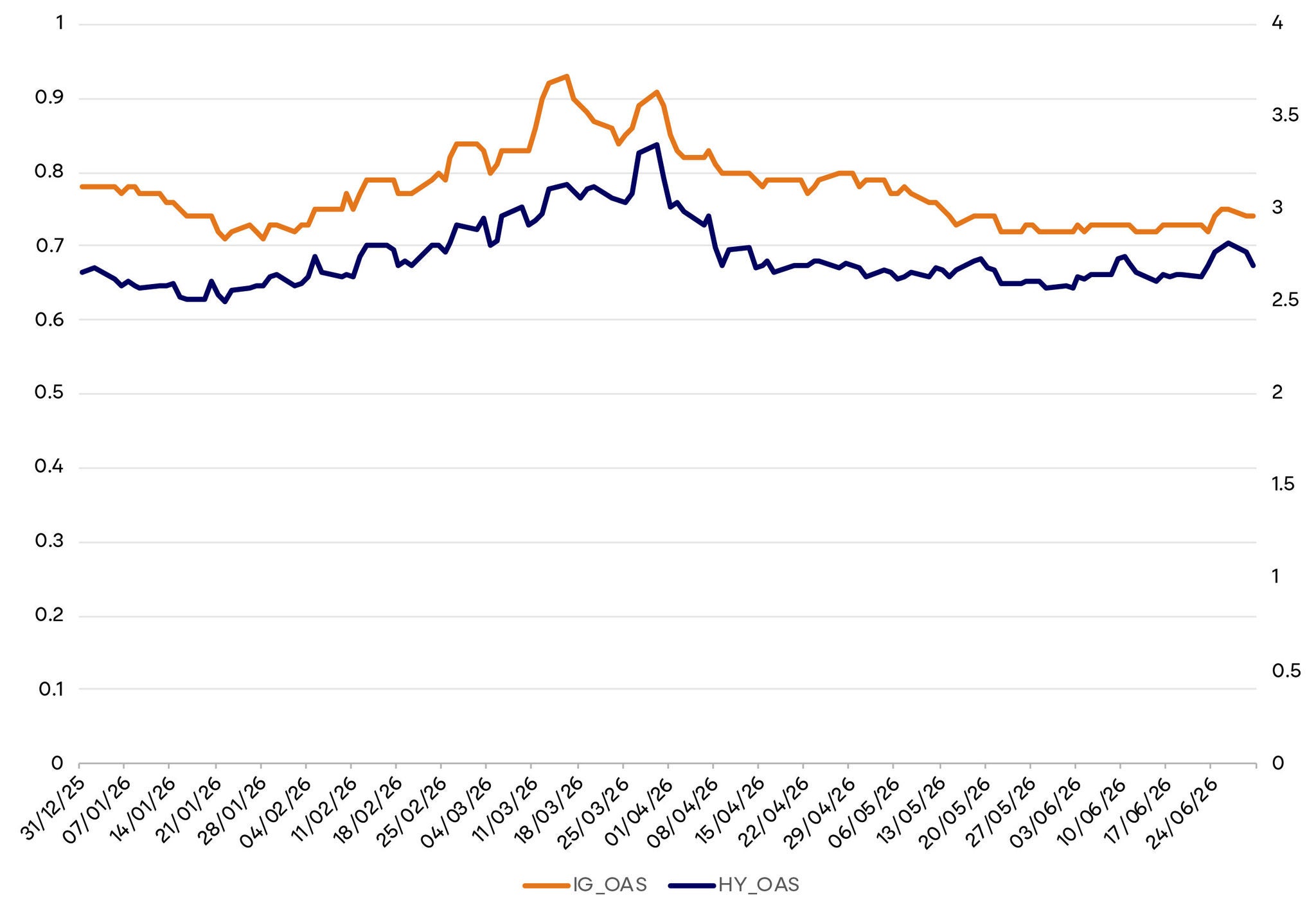
High-yield credit was the most volatile segment during the first half, with weekly fund flows alternating between inflows and outflows as investors responded to changing rate expectations, the Iran conflict and oil price volatility. By contrast, investment-grade credit remained remarkably resilient. Despite record first-quarter issuance and the global energy shock stemming from the Iran conflict, Bloomberg U.S. Investment Grade Index spreads remained below 100 bps year-to-date. As of July 7, spreads stood at 74 bps OAS (Option-Adjusted Spread), while high yield traded at 277 bps OAS, near the tightest levels since the late 1990s. Elevated all-in yields, defensive positioning and solid corporate earnings continued to suppress spread volatility.
Primary issuance was exceptionally strong, with year-to-date investment-grade supply up 32% above last year's pace and non-financial issuance up 41%. The AI ecosystem accounted for approximately 15% of investment-grade issuance, more than double its share a year earlier. SpaceX's inaugural $25 billion bond offering attracted approximately $78 billion in demand across maturities ranging from five to 30 years, with the demand strongest for the 5-year (~$24.3 billion) and the 10-year (~$18.2 billion).
Investment grade credit spreads
Source: Bloomberg
What's on the horizon:
The desk remains focused on the Federal Reserve's policy path, Treasury issuance dynamics and inflation trends. Credit spreads remain historically tight, placing greater emphasis on technical factors and investor demand. Corporate issuance, particularly from AI-related borrowers, will provide an important gauge of investor demand and the market's capacity to absorb new supply.
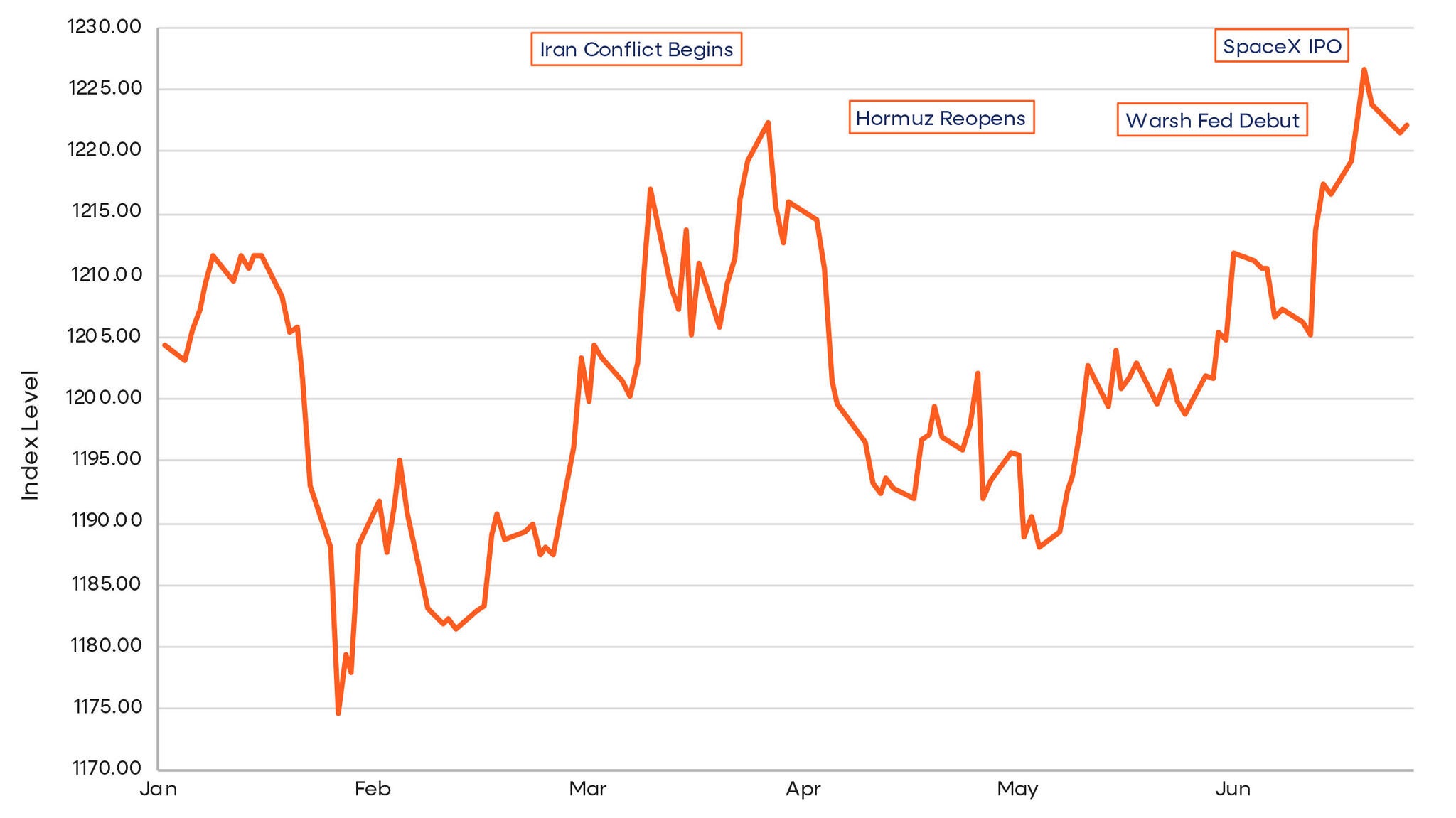
The Bloomberg Dollar Spot Index (BBDXY) was broadly range-bound despite sharp swings in sentiment. Geopolitical tensions and shifting U.S. rate expectations drove short-term moves, but neither produced a sustained directional trend. After falling from 1,204.5 at the start of the year to approximately 1,175 in late January, the index rebounded above 1,220 during the escalation of the Iran conflict before retreating as tensions eased. The tone shifted in June following Federal Reserve Chair Kevin Warsh's inaugural press conference, which prompted a sharp repricing of U.S. rate expectations and lifted the index back to 1,220–1,225 by quarter-end.
Bloomberg Dollar Spot Index (BBDXY)
Source: Bloomberg
Diverging central bank policy remained the primary driver of G10 currency markets. Following Chair Warsh's remarks, markets moved from pricing almost no probability of a July rate hike to approximately a 36% chance, supporting broad U.S. dollar strength. EUR/USD fell below 1.14 to its lowest level in a year, while USD/JPY rose above 162 to its highest level since 1986 as persistent yield differentials outweighed growing expectations of official intervention. Sterling also remained under pressure, with GBP/USD trading near its 2026 lows amid heightened domestic political uncertainty.
Geopolitical shocks triggered brief safe-haven demand for the U.S. dollar. The Iran conflict initially strengthened the U.S. dollar, but those gains quickly reversed following the reopening of the Strait of Hormuz and progress toward a ceasefire, highlighting the market's focus on evolving monetary policy over geopolitical risk. Cross-border investments also supported FX volumes, with the $75 billion SpaceX IPO generating significant U.S. dollar demand from international investors, particularly in Asia. USD conversion activity accelerated ahead of the offering, with daily volumes averaging $157.9 billion from June 5 to June 11, before reaching $135.1 billion on the June 12 listing date.[2]
What’s on the horizon:
Policy divergence is likely to remain the primary driver of FX markets, while geopolitical developments may continue to create episodic trading opportunities. Cross-border capital flows, including major equity and debt issuance, should also remain an important source of FX activity.
Strong demand for synthetic equity exposure and heightened hedging following the SpaceX IPO defined derivatives trading in the first half.
Equity index futures traded at a premium to fair value, with most contracts above their 12-month average. As geopolitical tensions eased and AI-related stocks extended their gains, demand for long synthetic exposure increased, lifting equity funding costs. During the June-to-September roll cycle, S&P 500 futures traded at an average premium of 81 bps to fair value. Futures continued to richen and equity funding costs climbed into June quarter-end, reaching +100–120 bps before moderating to 80–90 bps in early July.
The SpaceX IPO generated significant client demand for hedging strategies. Following an initial surge in retail-driven short-dated call buying, options activity shifted toward institutional hedging and monetizing gains. Collar strategies emerged as the preferred approach given relatively flat put-call skew and investors' willingness to cap further upside given their substantial accrued gains. The desk continued to see strong options liquidity, with a social size of $200–300 million.
What’s on the horizon:
Passive index inclusion, future share unlocks and institutional monetization following the SpaceX IPO are likely to remain key drivers of derivatives activity. Equity funding costs and demand for options-based hedging will also provide important signals for positioning in the second half.
On our radar
Today's markets demand more than strong investment ideas. Portfolio outcomes depend on efficient implementation and the ability to respond as market conditions evolve.
In the second half, our trading desks are watching the forces most likely to shape execution across markets. Central bank policy and geopolitical developments will remain key drivers of investor sentiment. Capital markets activity, institutional portfolio repositioning and the expanding use of ETFs and derivatives will provide important signals on how investors allocate capital and manage risk.
For investors, implementation remains a source of potential advantage. As market conditions evolve, execution quality, vehicle selection and disciplined risk management will continue to shape portfolio outcomes.
1 https://www.sifma.org/research/statistics/us-equity-and-related-securities-statistics
2 State Street eFX
Common client questions
AI-related trading has broadened beyond semiconductor manufacturers and hyperscale technology companies into data center operators, utilities, networking companies, software firms, and fixed income markets. AI ecosystem borrowers also accounted for approximately 15% of investment-grade issuance in the first half of 2026, more than double their share a year earlier, reflecting AI's expanding influence across capital markets.
Trade execution is increasingly influenced by a combination of market structure and macroeconomic forces. During the first half of 2026, AI investment, ETF adoption, mega-IPOs, central bank policy, and geopolitical developments all affected liquidity, trading behavior, and how investors implemented portfolio decisions across asset classes.
Large IPOs increasingly influence market activity well beyond the equity offering itself. The SpaceX IPO generated more than $70 billion in global retail orders, drove significant demand for its inaugural investment-grade bond offering, and increased hedging activity in derivatives, highlighting the importance of coordinated execution across multiple asset classes.