
Retirement ‘bucketing’: a practical approach
A ‘bucketing’ strategy is an easy to understand, simple to implement approach to managing retirement savings. Joel Atputharaj explains what it is and why it works so well.

A little about Joel
Joel is the Director, Retirement Solutions at Russell Investments. A Fellow of the Institute of Actuaries, he helps members and clients navigate complex challenges and has worn many hats across the superannuation and consulting businesses. Joel currently leads a program of work aimed at making continuous improvements to Russell Investments’ offer for members approaching, at, or in retirement.
Managing your money in retirement doesn’t have to be complicated. While there are many choices to make about things like pension amounts, payment frequency and managing your investment options, there are strategies you can use to help you handle these decisions calmly and with confidence.
One approach that financial advisers often use with their clients is a ‘bucketing strategy’, which is a straightforward and simple to implement way of managing your savings at and through retirement.
How it works
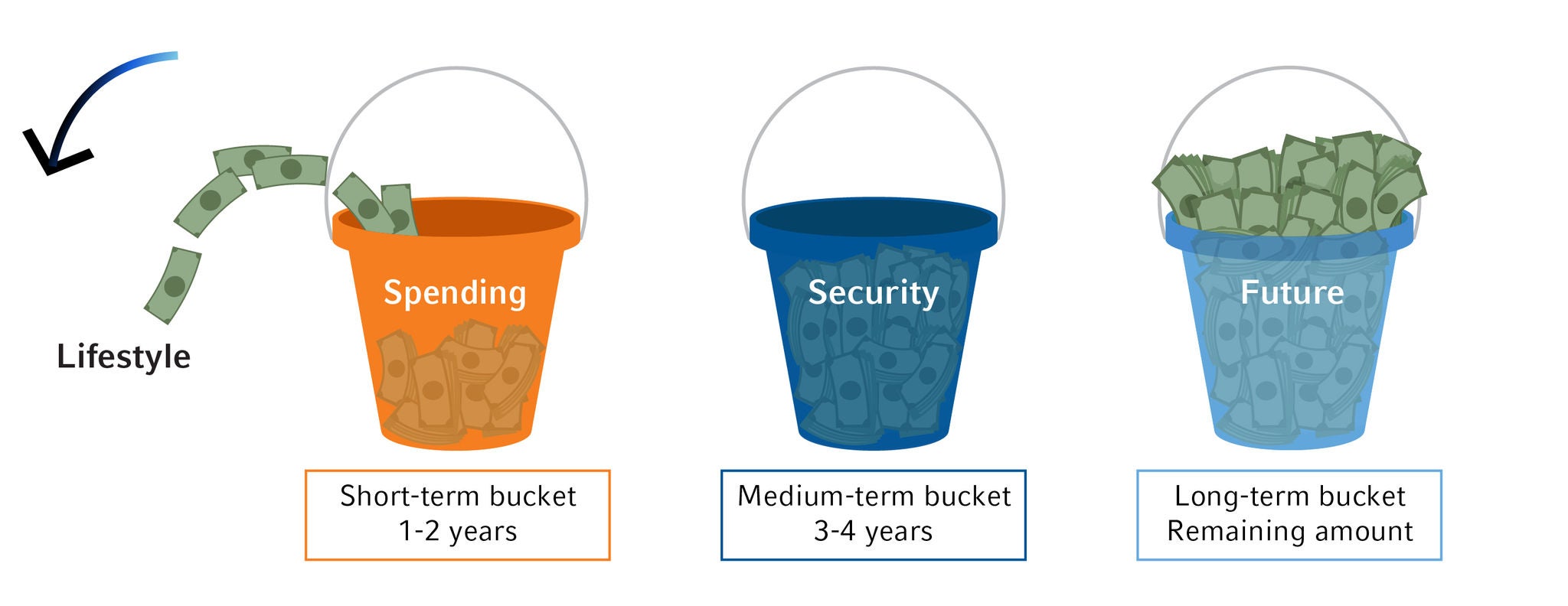
Adopting a bucketing strategy involves dividing your retirement savings into separate ‘buckets’ or categories, each with its own purpose, strategy and risk profile (being the expected variation in investment returns each year).
Using a three-bucket strategy, for example, you’d split your money as follows:
The spending bucket – to spend over the short term, say the next 1-2 years
The security bucket – to spend over the medium term, say the next 3-4 years
The future bucket – to hold the rest of your savings for the longer term.
Bucketing strategy in action
Let’s look at how a bucketing strategy could work in practice.
Consider Simon, who has just retired with $400,000 in retirement savings. He has budgeted on drawing $24,000 a year from his super to support his lifestyle. He will separately receive the government Age Pension.
Using a bucketing strategy, Simon would allocate two years’ worth of pension payments to his ‘spending’ bucket ($48,000 or 12% of his retirement balance). He invests this in the Australian Cash Investment Option, which is a stable and low-risk investment option.
Simon allocates four years’ worth of pension payments into his ‘security’ bucket ($96,000, or 24% of his balance). He invests this in diversified, defensive investments that are low risk, but with some exposure to investment market gains, and potential losses.
The rest of Simon’s money ($256,000 or 64% of his balance) goes into his ‘future’ bucket. He will spend this money later, so he can afford to take a little more investment risk, with the aim of earning higher returns over the longer timeframe. He chooses to invest in a diversified growth option.
| Spending bucket | Security bucket | Future bucket |
| $48,000 (12% of balance) | $96,000 (24% of balance) | $256,000 (64% of balance) |
Confidence to spend
Having money set aside for specific purposes lets Simon confidently draw his pension payments out of the spending bucket so he can live the lifestyle he wants knowing that his expenses are covered over the next few years even if investment markets are volatile.
He can top up the spending bucket from his security bucket as needed or choose to automatically top up his spending bucket at regular intervals—this is sometimes referred to as automatic rebalancing. This lets him set aside the money in his future bucket for as long as possible to help support his lifestyle later in retirement.
With a longer time horizon, Simon can invest his future bucket savings knowing his investments will have time to recover if sharemarkets fall, and his immediate spending won’t be affected. This reduces the emotional stress of market ups and downs. It removes the panic that can lead to poor decisions that may lead to ‘locking in’ investment losses.
Making the strategy work in practice
Understanding the income you need from your retirement savings to support your desired lifestyle is the first step in setting up your bucketing strategy. From there, you can allocate your savings to the appropriate buckets and set up your rebalancing strategy.
It’s also worth reviewing your strategy, adjusting things like investment allocations (or options) and payment amounts as needed. Doing so at least annually, or when circumstances change materially, would be a good guide.
Overall, a bucketing strategy is an easy to implement approach to organising your retirement savings so you can spend with confidence today, while still looking after your future.
Zest! recommends
Issued by Total Risk Management Pty Limited ABN 62 008 644 353, AFSL 238790 (TRM) as trustee of Russell Investments Master Trust ABN 89 384 753 567. Nationwide Super and Resource Super are Divisions of the Russell Investments Master Trust. The Product Disclosure Statement (‘PDS’), the Target Market Determinations and the Financial Services Guide can be obtained by phoning 1800 555 667 or by visiting russellinvestments.com.au, or for Nationwide Super by phoning 1800 025 241 or visiting nationwidesuper.com.au, or for Resource Super by phoning 1800 824 227 or by visiting resourcesuper.com.au. Any potential investor should consider the latest PDS in deciding whether to acquire, or to continue to hold, an investment in any Russell Investments product. Russell Investments Financial Solutions Pty Ltd ABN 84 010 799 041, AFSL 229850 (RIFS) is the provider of MyTracker and the financial product advice provided by GoalTracker Plus. General financial product advice is provided by RIFS or MUFG Retire360 Pty Limited (Retire360) ABN 36 105 811 836, AFSL 258145. Limited personal financial product advice is provided by Retire360 with the exception of GoalTracker Plus advice, which is provided by RIFS. Russell Investments Employee Benefits Pty Ltd (70 099 865 013) (RIEB) is the provider of the Super Tracker Mobile App.
This communication provides general information only and has not been prepared having regard to your objectives, financial situation or needs. Please note, errors may occur on occasion and if they do we will rectify them. If you identify an error, please let us know and we will rectify it. Before making an investment decision, you need to consider whether this information is appropriate to your objectives, financial situation and needs. If you'd like personal advice, we can refer you to the appropriate person. This information has been compiled from sources considered to be reliable but is not guaranteed. Past performance is not a reliable indicator of future performance. To the extent permitted by law, no liability is accepted for any loss or damage as a result of reliance on this information. This material does not constitute professional advice or opinion and is not intended to be used as the basis for making an investment decision. This work is copyright 2026. Apart from any use permitted under the Copyright Act 1968, no part may be reproduced by any process, nor may any other exclusive right be exercised, without the permission of Russell Investments.