
Insights from Kate El-Hillow, our President & CIO

Five Forces Reshaping Investing for the Second Half of the Decade

Hi everybody. It's so great to be here today with all of you. We really appreciate your taking the time out. Um we're going to make sure it's worth it. So, over the last year, the conversations that I've been having with CIOs, board members, long-tenured investors has changed. The questions are different, the tone is different, and the playbooks that they've relied on for years aren't working in quite the same way. And when that starts to happen across people that have been doing this for decades, I pay attention. Because it suggests that something more fundamental might be starting to shift underneath the surface. That's what I want to talk to you about today. Not a market outlook, not a 12-month forecast, but the forces that are starting to rebuild and reshape how capital is allocated, how returns are generated in portfolios, and how we make decisions. So, before we do that, I want to ask you this. Who here remembers where you were on November 2008 when this headline hit? Yep. Yep. Great. And how about this one in 2020? Two crises, two different setups going into them, and two very different recoveries. Do you remember how you felt? Maybe panic, uncertainty. I mean, for some, like pit in the stomach fear. Does it sometimes feel like we're starting to head towards that level of uncertainty? Or that there's a major rewiring that's happening in the markets? I remember the first time I felt that. It was in 1997. I was in at JP Morgan on the credit trading desk in Tokyo. It was during the Asian financial crisis. Volatility was unfolding in real time, spreads were blowing out, positions were moving. I remember thinking at the time, reading about volatility is very different than living through it. But more importantly, what I learned is that the hardest question to answer in these times isn't what just happened. It's is this temporary or is this becoming structural? After the GFC, banks pulled back and private credit stepped in. That was a structural shift. During COVID, we saw another structural shift as major policy moves to deal with near-term shocks has structural impact on major macro drivers like inflation. Now, I'm not saying that we need to have a major crisis to determine kind of whether structural change is happening. But misreading what's temporary and what's structural has real consequences. You can wait out a cycle. But you can't build a portfolio for a world that no longer exists. That's the core idea I want to leave you with today. What we're navigating right now isn't just a cycle. It's a shift in terms of how capital is allocated, how returns are generated, and how we're making decisions. And there's five forces that are driving it. So, I'm going to start with AI. Uh and you're probably wondering what Wednesday Addams has to do with AI and investing. So, Netflix is much less like a studio and much more like a real-time capital allocator of data. When they launched Wednesday, it wasn't just a creative bet. It was a data-driven decision that was driven by viewership, audience overlap, demand. They weren't just creating content. They were aligning content with timing and distribution to amplify demand. And the result, 1 billion views in the first month. They weren't creating demand. They weren't They They weren't um you know, shaping demand. They were reshaping it. That's what's happening in investing. We're not to it. We're starting to shape it. So, think about AI. At its core, you need proprietary data, unique data sets coming in, and that's going to help you identify patterns and help you find insights that hopefully are going to help you make decisions better. Right? And that's a feedback loop. And then it keeps on going through, you keep on building out your data set. When we're looking at managers and researching managers that say they're using AI, that's what we're looking for. Do they have the data sets? Do they have the insights that they're capturing? And is it translating into repeatable decision-making that's hopefully driving value? At Russell, we have an amazing data set of manager data, both qualitative and quantitative insights that we've developed over the past since the 1970s. It's impossible for a human to take all of that data and synthesize it at speed or scale. So, a couple of years ago, Evgenia helped us take AI and use that data set to start to drive new looking for patterns, looking for new insights to hopefully help us make better decisions as we're thinking about manager selection or how we're constructing portfolios. And all of it's being grounded in human judgment. The portfolio managers that you know, the manager researchers that everybody here in this room has interacted with, they're using that information to try to figure out if there's a manager that we haven't been focusing on that might have an edge, or one that's losing their edge, or if there's some concentration that's building up in portfolios. The way that we're combining manager data, market data, and portfolio data now, it's it's mind-blowing to me versus I'd never would have thought we'd get there versus a couple years ago. And so, it's not just about who's using AI. It's about who's actually creating value with it. Okay. So, the next bit of a rockier landscape they're going to head into. There's some things that we can control, like how we're deploying AI into our organizations, And others that we can't lead geopolitics. Right? So, we've all lived through elections, major policy shifts, yeah, and and different, you know, types of, you know, conflicts that are occurring. And for the most part, the impact on markets has been episodic. It does seem like these days that the impact of those things and the frequency of them is just going up. And more of it is because some of the stuff Zach was saying, it's more because of how we're interacting with news and data. It's in our pockets, right? Information is coming at us constantly. Markets are repricing in real time. It's a pretty familiar pattern. Headline hits, market reacts, and more often than not we're seeing a V-shape recovery. But what we've got to figure out, are these just moments that are going to be more episodic? Or is it starting to build into much more of a structural shift? Let's take infrastructure as an example. For most of us, it's, you know, airports, roads, bridges, how we power our iPhone. But in the investing world right now, infrastructure is at the center of the structural changes that are being driven by geopolitics. Right? Energy independence, rebuilding, reshoring. All of these things are capital intensive moments that are happening. And it's a great tailwind for infrastructure. If we looked at Q1, real assets and infrastructure were the one bright spot in terms of returns. Everything else is pretty much flat to down. Some of that is because of the inflation sensitivity and the the cash flow profile, you know, of infrastructure. And that's one of the reasons where we tend to be overweight real assets within a lot of our portfolios. Because infrastructure and real assets are at the center of a lot of these structural shifts that are being driven by geopolitics, and they have some pretty good portfolio benefits that you can also have. So, we all know that we can't predict the future. And we all know that for the most part, these events are going to still be binary. But the conversations that we're having are is there data and technology that can help us better look at those events, see the narratives, and look to see if it's starting to get priced into markets and into our portfolios. Cuz we want to build portfolios that are resilient. But we also need to make sure that we're building portfolios based on where the world is going. Okay, so based on where the world's going, how many people here thought you'd be talking about data centers as much as we do today? And how many people really know where data centers are represented in your portfolio? Think about it. It's real estate, it's infrastructure, it's liquid cooling, it's chips. It's across your portfolio in all different asset classes. Your venture portfolio, your public and your private credit book, infrastructure, your public equity book. We're also seeing it with companies. More and more companies, when they're issuing debt, they're doing it in the public or private markets depending on what makes most sense for them. You know, the features might be different, the collateral underlying it might be different, but it's the same issuer. This is one of the reasons why we're talking about how public and private markets are converging. And part of it is that this isn't new, right? This is a something that started happening after the GFC and it really accelerated in the past couple of years. And some of it, you know, is maybe because of the growth we've seen in private markets, but it's much more about how public and private are interacting with each other. Zach has said this, they're interconnected, they're interacting with each other. It's much less siloed than it used to be. And we need to be thinking about that as we're developing our investment teams and how we think about making decisions. We can't be thinking in silos as much, you know, anymore. Your teams need to be looking across the opportunities that we're going to thinking about what's that next dollar you want to allocate. Let's take real estate decisions an example. Public and private real estate are very different, right, in terms of exposures that you can get to. The private side is more of your core exposures. You have to think about multifamily rentals, retail, office. On the On the public side and REIT side, it's much more specialty sectors. Data centers, healthcare, you know, you have your you know, single-family rentals. So, very different exposures you can get across the two, but there are some sectors that overlap across both of them, and they can get pretty dislocated between the two, and there can be opportunities, you know, in terms of between public and private market if you're paying attention, both in terms of how you're designing and managing the portfolio. Ultimately, as you're thinking about what real estate should I have in my portfolio, it should be driven by the outcome you're trying to achieve and certain themes that you want in the portfolio. But, you definitely should be looking at it holistically when you're making those decisions across public and private. There's just this interaction and an integration that's starting to happen more and more. Now, I can't talk about public and private markets convergence without talking about the real considerations that we all grapple with when we're thinking about how large my private allocation should be around transparency, cost, liquidity, and increasingly what type of vehicle you're accessing it in. That's obviously gotten a lot of headlines over the last like couple of months in terms of private credit. But, when you think about like how you're kind of accessing, you know, these markets and and what you want to do there, you know, it's not about like going, you know, do I pick one versus the other? Some of these things are starting to improve a lot. I would posit that data and transparency over the next couple of years for private markets is going to improve materially. It's because that we have a lot more data, and you also have investors that are demanding it. That's going to start to shift, and that is going to change how we're thinking about public and private markets, not just how we design the portfolio, cuz we're all doing that right now, but how we're managing it. And so, it won't be about public versus private. It's going to be about where's that next dollar of capital they want to allocate to, and then do I need to shift between the paths that I can take. Okay. So, for next one, diversification. And this is going to be one I'm going to have to do my best to keep shorter cuz I could talk about this forever. But I'm going to start with what the heck British take on Mexican food has to do with diversification. So when I was preparing for this, I was in London about a month ago. And I was thinking about how over the last 30 years of me living in and visiting London, the food has changed massively. When I was there in college in the '90s, it was pretty grim. You had beer, fish and chips, maybe a roast pizza with corn on it. Right? You know, and then the EU had lots of benefits. Here I saw a couple of faces in the audience. It's not good. It doesn't taste good. Um When I was in So when I got there during the GFC, things had changed you know, materially. You know, there was you know, Japanese, there was Greek, there was Thai. I was super excited for all the choices. But was it all good? I mean, has anybody had a good street taco or nachos in London? Not really. Yeah. So it's not just about having more choice. It's about having the right ingredients combined in the right way and prepared by experts that know how to make the dish. I mean, it actually sounds a lot like portfolio diversification. I mean, think about it. Over the last 20 years, the number of asset classes that we have access to has just multiplied. Right? Venture, private credit, infrastructure, even digital assets like crypto. So we've got more choice and I think everybody in this room has gotten a lot better about thinking through and seeing how different asset classes operate in different market environments. So it's not going to be when we think about building a diversified portfolio just about active, passive, public, private, which factors do I have exposure to. We can be much more deliberate about the types of asset classes across the whole, you know, universe that are going to best help us achieve our outcome. So I have to take a little bit of a sidebar. If we're talking about diversification, I feel like we have to talk about the rise of passive that we've had. It solves a lot of problems and concerns that we as investors had around cost as well as where's the best place to target alpha within a portfolio. But indexes have gotten a lot more concentrated you know, over the last 10 years. And so when we're thinking about diversification, we need to make sure that some of these default moves that we've been using that we're not missing out on the fact that with the diversification in portfolios actually has gotten a little bit worse as people have shifted to passive into these much more concentrated indexes. So just something that we need to keep on thinking about. But I'm going to hit on in a little bit more depth some of the comments that Grace made on a couple of asset classes, hedge funds and private credit. Just to bring some of this to life. So after the GFC, my experience was most clients didn't want to talk about hedge funds anymore. The fees were high, rates were low, liquidity was abundant, volatility was low, and they just weren't performing in the same way. But now you've got higher rates, higher vol, higher dispersion, and you also don't have to look at hedge funds as an asset class. Right? And you don't have to allocate to it just to get low correlation within the portfolio. That's a feature, but that's really that's just the first step. There are certain hedge funds that can really change how you're kind of building a broader diversified portfolio at the top level. So there are some hedge funds that we all know that track trend. And others that are really good at managing and benefiting from shifts in volatility. If you combine those two types of hedge funds in a portfolio that has a lot of equity in it, it can be pretty helpful in certain types of market shocks and complement your fixed income portfolio. You never know where the shock's coming from. If it's inflation, your fixed income is not going to help you a whole heck of a lot. Some of these hedge funds could. In the first quarter, small example, where we saw that most asset classes were flat to down other than real assets, hedge funds, those types of hedge funds I was mentioning were up 5 to 7%. Okay, now I'll shift to private credit cuz you can't go throughout the day without talking about private credit these days. And a lot of clients stayed on the sidelines for many years because of cost, liquidity, and complexity of private credit. Some of our E&F clients, they didn't want to consider private credit more because it just wasn't hitting the return hurdle for their private sports portfolio. But we know that market's gotten a lot broader and a lot deeper. And we also know that um objectives have changed in the past couple of years for lots of different organizations. Private credit is not just sponsor-led direct lending. It is a broad universe that's continuing to get deeper. And there's so many levers we can pull when we're building a portfolio that includes private credit. There's yield, cash flow, the underlying collateral quality as Grace had mentioned. Like obviously the duration. There's so many different levers that you can pull. So if you're a pension that's well-funded and has a lot of your assets in LDI, putting some investment-grade private credit in the portfolio to diversify your public credit, to pick up some more yield, to continue to build some surplus, and still have an effective liability hedge can be pretty powerful. In a hospital system, thinking about like a medium-term pool of capital, you can add an investment-grade private credit to get some extra yield, some liquidity that might be very aligned with the capital projects you've got 5 years out that you're planning for. So we know that no asset class is a silver bullet when you're designing portfolios, but we've got a lot of choice now, and we've got to be much more deliberate about which ones we're using for the outcome that we're trying to achieve. Right. Diversification is no longer going to be about assuming that you're diversified based off of long-term assumptions and averages of asset classes. It's going to be much more deliberate in terms of how you design it. Right. And probably much more active. Okay, the fifth force. The rise of the retail investor. Not the most obvious topic for an institutional conference, but retail assets are moving fast. Retail assets are expected to outpace institutional assets by the end of the decade. And this isn't a new phenomenon. We're seeing this. Like 20 to 25% of US equity flow is driven by retail right now. It's much more in the option space. And retail investors have very different objectives, you know, than institutional investors. They care about taxes, they care about liquidity. They think they have a shorter time horizon. We probably need to work with them on that. They probably have a longer time horizon than they realize. They don't have the same institutional checkpoints that we have as institutional investors. Investment committees, boards they need to run decisions by. They might have a partner or spouse, but increasingly they're they're looking at Reddit to get their advice. And they can move fast. And part of it is because they can just with a click of the phone, they can be accessing the market. And so they are they're just set up to, whether it's narratives or momentum, move much quicker. And we're seeing it. We're seeing in buy the dip mentality, except for this last month. And we're seeing it in options volume. You're seeing the retail flows. And that's not something new to track. I'm Paul and the team when we think about how sovereigns are starting to impact commodities in FX. We've looked at that for decades. If you think about pensions rebalancing at month end and quarter end, we're focused on what the impact is going to be on equity and fixed income markets. What's different here is that retail investors have the speed, the scale, and now the access to be having much more of an impact on market pricing. So, who here remembers uh 2020 and AMC and GameStop and the meme stock rally? Yeah. And who here had family and friends that asked you if they were good buys? Yeah. Yeah. I mean, it's kind of unfortunate that our loved ones think that what we do is trade meme stocks. So, you got to help them with that. Yeah. But at the end of the day, this is not a a shift that's going to happen overnight. Institutional money, 401(k)s, and advisors are still going to be the anchor in terms of the market. But retail participation is going to start to have more of an influence on the market and market action, and we need to be much more aware of it. Fundamentals are going to drive long term. And we know that most of these things are going to be noise, but we've got to be able to distinguish between when it's noise and when we need to take an action. And I will say as an institutional investor, as more individuals become investors, we need to help them understand all the things that we've learned over decades so they can continue to build their wealth and retirement. Okay. So, thank you for sticking with me through the five forces. These fundamental shifts that are driving these forces are not isolated. They're reinforcing each other, and we're going to talk about them throughout the day today. But AI is changing how we're making decisions, geopolitics is changing how capital is flowing, public and private markets are converging, diversification needs to evolve alongside that, and retail is going to have impact on the market, you know, as well as our industry. Each of these individually matter, but together, they really are changing the power dynamic of the market that we're operating in. So, what does this mean for portfolios? It's still developing. Structural change takes time to take hold. This is not a call to action to make major shifts in in portfolios. We all know that acting early is the same as being wrong in our world. But this these types of forces are really driving the decisions that we're making, the debates we're having, and a lot of the research that we're doing. And that honestly has made such an exciting time to be working at Russell and working with all of you. We have the data, we have the tools, we have the external manager reach, and the perspective to bring it all together. So, through all of this and all this talk about change, the one thing I would leave you with is that the one thing that is not changing is AI can't replicate judgment. AI can't replace people. Right? And the people that you have at the table pushing you, asking you questions, making you make smarter decisions, that all matters as we're dealing through all this change. So, for me, that's why this room matters a lot and kind of getting your perspective and getting the time that we spend with you to try to make the portfolios better so we can build portfolios for the future. So, thank you so much for your partnership and thank you so much for spending the day with us.

Key takeaways

  • Investing success now depends less on static allocations and more on active design, manager judgment, and integration across markets.
  • Diversification has shifted from asset-class mixing to intentional risk design, sizing, and regime awareness across the total portfolio.

  • Structural forces like AI, private capital growth, retail flows, and geopolitical fragmentation are reshaping return sources and portfolio resilience.


The rulebook for sound investing has never been static, but rarely has it evolved so visibly or at this speed. Over my career—shaped by market bubbles, financial crises, and a few humbling moments—I’ve learned that the investors who endure are the ones willing to adapt. We’re at a defining moment, where long-held assumptions about markets and portfolios are being tested, and in some cases, broken.

The first half of the 2020s has altered market dynamics in ways that make building resilient portfolios materially harder. Policy shocks, supply-chain realignment, inflation volatility, and rapid advances in technology and AI have compressed the cycle of change. Old patterns are breaking faster, correlations are less reliable, capital is increasingly raised outside public markets, and structural forces are playing a larger role than cyclical ones.

For allocators, this is a new environment, one that challenges the traditional stock-bond framework and even more recent public and private market mixes. Portfolio outcomes are increasingly shaped through an active lens—by how exposures are selected, sized, and combined across markets and regions. As we look ahead to the second half of the decade, staying ahead will require clarity about which forces are durable, how they interact, and what they mean for capital allocation, manager selection, and portfolio construction.

While many factors are reshaping the investment landscape, five stand out for their durability, their reach across asset classes, and the way they fundamentally change how portfolios are built and managed. These are the forces I believe will most shape investment decisions and portfolio resilience in the years ahead.


1. The AI Advantage and the Great Data Divide

ChatGPT’s rapid adoption marked the fastest mass adoption of a new technology in recent history. AI’s significance is not just technological—it is structural. Its impact shows up in three distinct ways: how investments are made, how managers are differentiated, and where new investment opportunities emerge.  

On the investment process side, AI has brought data science and generative modeling once limited to systematic teams into traditional investment teams. The differentiator is no longer access to tools, but the quality of data behind them and the judgment applied to their outputs. As technology converges, outcomes remain highly differentiated. Well-structured inputs, human insight, and clear decision frameworks turn AI-enabled visibility into better security selection, more consistent portfolio construction, and earlier recognition of structural change.

This has raised the stakes for manager selection, particularly in private markets. Unlike public markets where datasets are standardized and broadly available, private markets remain fragmented and opaque. AI can improve visibility, but judgment and context still matter when information is incomplete. Teams that apply consistent, cross-market frameworks tend to produce more durable outcomes.

AI is also shaping the investment opportunity set itself. Many of the most consequential AI-related investments across infrastructure and enabling technologies are originating in private markets and move through the capital stack over time. This makes AI a cross-portfolio consideration rather than a standalone theme, reinforcing the importance of investment processes and strategies that can deploy capital across markets and adapt as opportunities evolve. 

Implications for allocators

AI is less a beta allocation decision than a test of manager capability, data discipline, and governance—especially where information is scarce and dispersion is high.

2. A New Lens on Diversification

The old assumptions about diversification no longer hold. A simple equity-bond mix can’t be relied on to deliver balance in a world of less predictable inflation, policy, and correlations. Investors are being pushed to think more deliberately about where risk and return truly come from.

Today, effective diversification depends on combining active and passive strategies with systematic, fundamental, and alternative approaches, including private markets. But breadth alone does not create resilience. As traditional anchors such as bonds have weakened, each allocation must earn its place, be sized to matter, and be judged by how it behaves across different market environments.
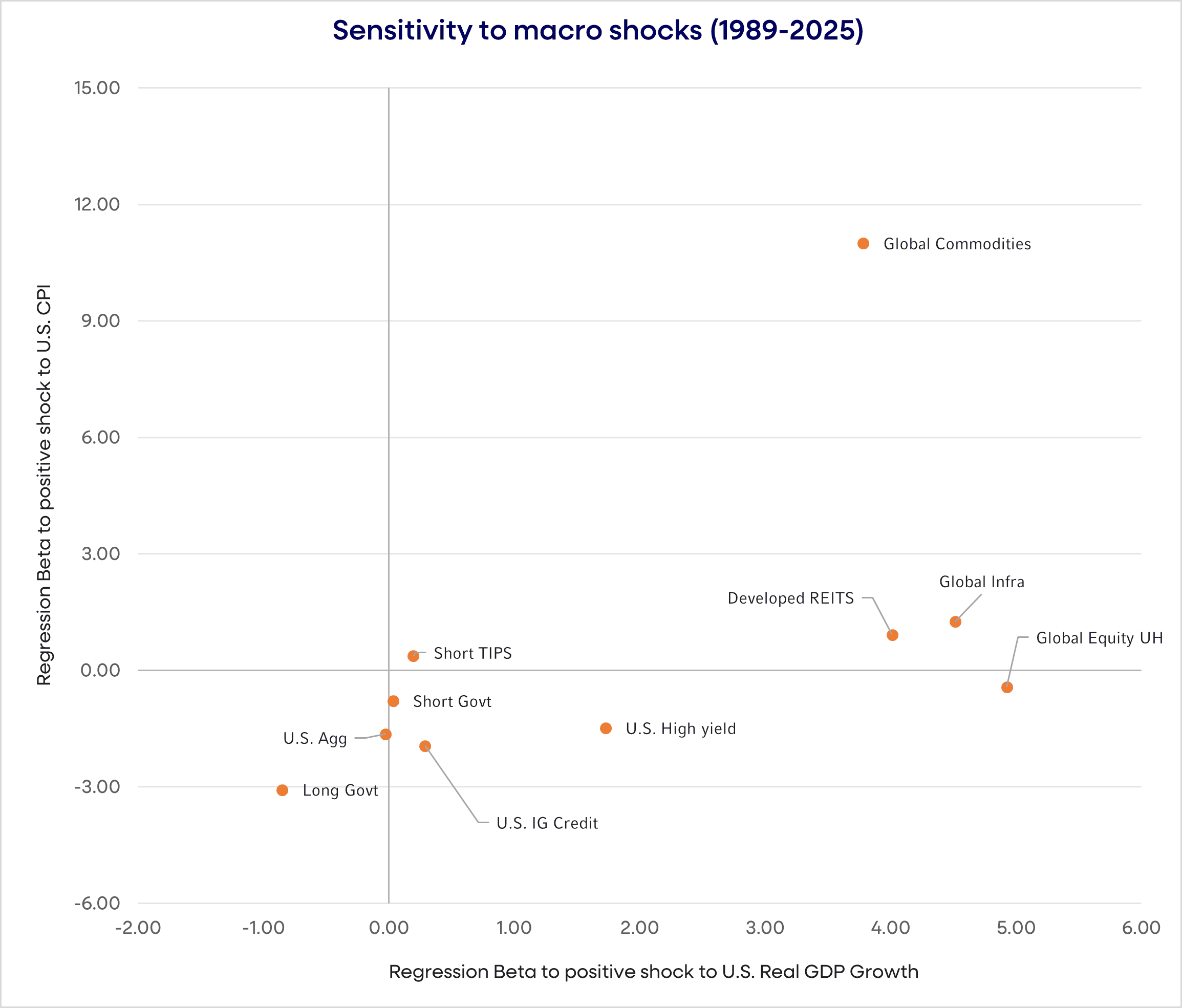
Sensitivity to Macro Shocks Chart (1989–2025)

Source: Russell Investments

It is critical now more than ever to understand the underlying risks driving portfolio outcomes. Those risks increasingly cut across markets and asset classes, making it essential to be explicit about exposures, offsets, and unintended concentrations.

This has driven a shift toward a total-portfolio mindset, where diversification is assessed across the whole portfolio rather than within individual sleeves. Resilience now depends on the ability to see how risks interact, adjust exposures as regimes evolve, and reinforce diversification when it is needed most.

Implications for allocators

Diversification is best viewed as a design consideration rather than just an asset-class decision, informed by intentional sizing, regime awareness, and ongoing portfolio oversight.

3. The New Shape of Capital Formation

Public-private market convergence is reshaping how companies raise capital and how investors access growth. What was once a clear divide is becoming a more continuous opportunity set, with capital moving more fluidly across markets and the capital stack. This is especially evident in the AI buildout. Capital-intensive assets such as data centers, power generation, and digital infrastructure are often financed first with private capital, then move through private credit, structured solutions, and in some cases into public markets as projects scale and risks evolve.

At the same time, access to private markets is broadening. Institutional allocators have already built meaningfully larger private allocations, and that pace is accelerating with greater access through new vehicles and platforms. With private exposure growing, portfolios can no longer rely on clean separations between public and private sleeves. Exposures overlap, liquidity varies by structure, and capital moves more dynamically over time.

This raises the bar for portfolio construction. Allocators must be deliberate about the role each exposure plays across return, liquidity, risk, and resilience. Higher interest rates and regulatory changes continue to reshape relative value. In private equity, returns increasingly depend on operational execution and sector expertise rather than leverage. Private credit has become a durable source of financing alongside banks, particularly in asset-backed and infrastructure-linked lending. Real assets provide flexibility to move between listed and private vehicles as conditions change.

Broader participation has prompted questions about whether expanding access could dilute returns. What changes is access, reflected in how the market responds to demands to address barriers (e.g., liquidity and transparency) and how investors develop the discipline to manage liquidity, pacing, and portfolio construction as the investor base and market evolve. 

Implications for allocators

Managing private exposure is now as much about integration and liquidity management as it is about return potential. 

4. The Rise of Retail

Retail investors are playing a larger role in market dynamics, with wealth channels expected to approach half of global assets under management by 2027. Their growing influence is reshaping product design, trading behavior, and market outcomes.

Digital tools have lowered barriers to participation, making trading easier and more frequent. As retail accounts make up a larger share of marginal trading, flows and sentiment increasingly drive short-term price action. Demand for customization and tax efficiency is also rising, accelerating adoption of tools such as direct indexing and more personalized portfolio solutions.

These dynamics are most visible during periods of elevated retail activity. Options usage and flow-driven trading have fueled sharp rallies in meme stocks and lower-quality assets linked to big themes, widening the gap between price momentum and fundamentals. Similar patterns are emerging in credit and emerging markets, where ETF-driven retail demand can accelerate risk-on/risk-off repricing.

Broader retail participation also helps explain the uneven recovery since late 2022. Households with exposure to equities and housing have benefited from rising asset values and continue to spend, while others remain under pressure. As equity ownership broadens, asset performance has a more immediate impact on consumer confidence and spending—an important consideration when assessing macro conditions.

Implications for allocators

Retail-driven flows increase dispersion and speed, putting conviction in quality, liquidity awareness, and active risk management to the test.

5. A Less Synchronized Global Order

Politics and geopolitics are playing a larger role in shaping markets. Even the policy shifts around “Liberation Day” in April 2025 marked a clear break from a highly synchronized global cycle, pushing markets into a more fragmented, regionally driven environment. With major elections across the U.S., Europe, and emerging markets ahead, uncertainty is likely to persist.  

Positioning portfolios now requires separating short-term shocks from their second-order effects and longer-term structural shifts. That includes the basics of moving beyond long-standing home-country biases. As growth and policy paths diverge, concentrating risk in a single market becomes an active choice rather than a default.

Portfolios should focus less on geography and more on underlying exposures—such as inflation persistence, fiscal impulse, energy and defense demand, and supply-chain realignment. These dynamics are already evident. In Europe, fiscal support, defense spending, and industrial policy are supporting activity and earnings. In emerging markets, improving fundamentals—particularly in technology and reform-oriented economies—are creating selective opportunities. In the U.S., leadership is broadening beyond mega-cap growth toward companies translating sustained investment into durable cash flows.

Risk management also needs to adapt. Government spending is raising inflation uncertainty in some regions, while tighter financial conditions constrain others, widening dispersion across assets and sectors. Public markets remain prone to sentiment-driven mispricing, while credit markets continue to differentiate sharply based on balance-sheet strength.

A more balanced mix of private and public assets can help address these challenges. Capital-intensive themes are playing out over multiple years, creating opportunities in private infrastructure, selective private credit, and real assets tied to energy, data, and security.

Implications for allocators

Geographic allocation is increasingly a factor-expression decision, requiring intentional and currency-aware global diversification and flexible capital deployment.

A Shared Inflection Point

We are living through a rare inflection point in investing. Building resilient portfolios is more demanding than it once was, as long-trusted diversifiers behave differently. For allocators, this is also what makes the moment meaningful.

The opportunity is to move beyond prevailing assumptions and design portfolios that are forward-thinking, adaptive, and resilient—grounded in clear views on risk, disciplined manager selection, and an integrated approach across public and private markets. How portfolios are built today will matter well beyond this cycle.

Five Forces Reshaping Investing for the Second Half of the Decade

Meet the author

Kate El-Hillow

Kate El-Hillow

President & Chief Investment Officer

Connect and follow us

More research & insights

These views are subject to change at any time based upon market or other conditions and are current as of the date at the top of the page. The information, analysis, and opinions expressed herein are for general information only and are not intended to provide specific advice or recommendations for any individual or entity.

This material is not an offer, solicitation or recommendation to purchase any security.

Forecasting represents predictions of market prices and/or volume patterns utilizing varying analytical data. It is not representative of a projection of the stock market, or of any specific investment.

Nothing contained in this material is intended to constitute legal, tax, securities or investment advice, nor an opinion regarding the appropriateness of any investment. The general information contained in this publication should not be acted upon without obtaining specific legal, tax and investment advice from a licensed professional.

Diversification and strategic asset allocation do not assure a profit or guarantee against loss in declining markets.

Please remember that all investments carry some level of risk, including the potential loss of principal invested. They do not typically grow at an even rate of return and may experience negative growth. As with any type of portfolio structuring, attempting to reduce risk and increase return could, at certain times, unintentionally reduce returns.

The Russell Investments logo is a trademark and service mark of Russell Investments

This site uses cookies to offer you a better browsing experience. A cookie is a small text file that a website places on your computer or mobile device when you visit the site. It enables the website to remember your actions and preferences, so you do not have to keep re-entering them whenever you come back to or browse this site. Click here for a list of cookies and a description of how they’re used. The cookie-related information is not used to identify you personally. These cookies are not used for any purpose other than those described here.

Nothing in this publication is intended to constitute legal, tax securities or investment advice, nor an opinion regarding the appropriateness of any investment nor a solicitation of any type. This is a publication of Russell Investments Canada Limited and has been prepared solely for information purposes. It is made available on an "as is" basis. Russell Investments Canada Limited does not make any warranty or representation regarding the information.

We will provide our publications in alternative formats, upon request, in a timely manner, depending upon document specifications (e.g. length of document, format required).

Russell Investments is the operating name of a group of companies under common management, including Russell Investments Canada Limited.

Russell Investments is committed to ensuring digital accessibility for people with disabilities. We are continually improving the user experience for everyone, and applying the relevant accessibility standards.

Russell Investments' ownership is composed of a majority stake held by funds managed by TA Associates Management, L.P., with a significant minority stake held by funds managed by Reverence Capital Partners, L.P. Certain of Russell Investments' employees and Hamilton Lane Advisors, LLC also hold minority, non-controlling, ownership stakes.

Frank Russell Company is the owner of the Russell trademarks contained in this material and all trademark rights related to the Russell trademarks, which the members of the Russell Investments group of companies are permitted to use under license from Frank Russell Company. The members of the Russell Investments group of companies are not affiliated in any manner with Frank Russell Company or any entity operating under the "FTSE RUSSELL" brand.

Products and services described on these websites are intended for Canadian residents only. Information on these sites should not be considered a solicitation to buy or an offer to sell a security to any person.

© Russell Investments Canada Limited 1995-2026. All rights reserved. This material is proprietary and may not be reproduced, transferred, or distributed in any form without prior written permission from Russell Investments. It is delivered on an "as is" basis without warranty.