
Pick Your Poison: Higher Inflation or Slower Growth?

2025-04-23

Paul Eitelman, CFA

Paul Eitelman, CFA

Global Chief Investment Strategist


Find other posts with these tags:
Tariff tracker
Economic insights
Market insights

Key takeaways

  • Tariffs will likely cause growth to slump and inflation to rise
  • Fed officials will have to decide whether full employment or price stability is a higher priority
  • We expect one to two Fed rate cuts by the end of the year

The Fed’s in a bind. Policy uncertainty is high. And tariffs are likely to hit the U.S. economy with a “stagflation-lite” impulse in coming quarters—weaker growth and higher prices. 

How will central bankers prioritize their full employment and price stability mandates in the rare circumstance where they’re losing ground on both goals at the same time? And how do they make policy decisions when the economic outlook is so unclear?

It's complicated

Stagflation complicates the calculus for a central bank. Weaker growth would warrant rate cuts. Higher prices argue in favor of hikes. Fed Chair Jerome Powell detailed the Fed’s approach to this scenario in a recent statement, described neatly in recent remarks. “We would consider how far the economy is from each goal, and the potentially different time horizons over which those respective gaps would be anticipated to close.”

Put differently, the bigger—and more persistent—miss is what will get emphasized, whether that’s sluggish growth or rising inflation. Enter version 2.0 of the “transitory” debate. Do tariffs cause a one-time increase in prices or do they generate more persistent inflation, affecting longer-term expectations? Those that believe the former will have a more dovish outlook and focus on protecting full employment—and vice versa. 

There are a range of views on this issue, including among Fed leadership.
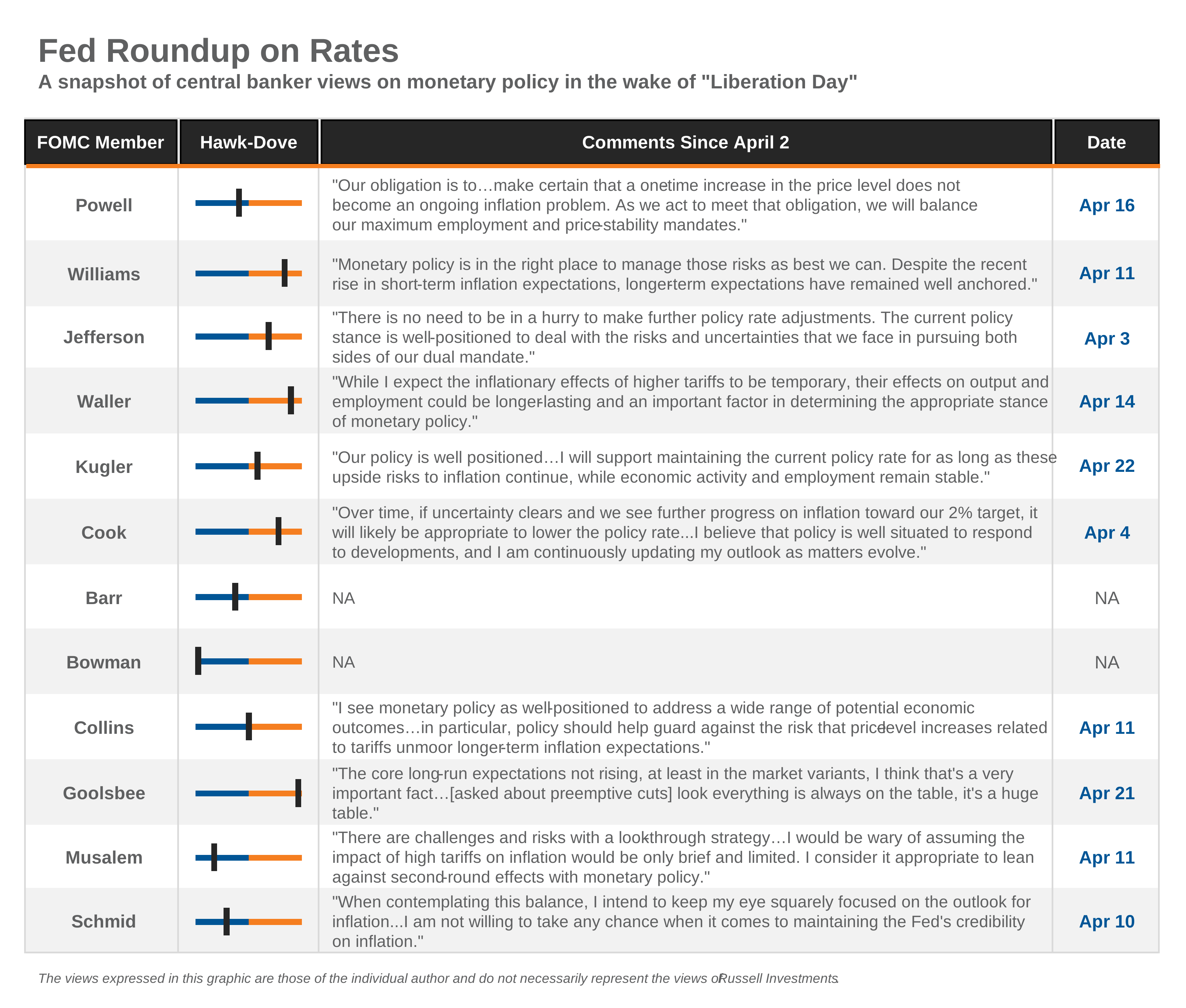
Fed Roundup on Rates

Wait-and-see mode

In Fed circles there’s something known as the Brainard principle, which states that policy makers should act with caution when faced with uncertainty. This motivates some of the Fed’s wait-and-see approach to rates right now.

"The Fed is unlikely to cut interest rates at coming meetings unless there is more convincing evidence that the business cycle is on the downswing."

Paul Eitelman, CFA

Global Chief Investment Strategist

This uncertainty—coupled with a range of Fed participant views on how problematic tariff-driven inflation might be—has put the bank in a more reactive position. Why?

Simply put, the bank is unlikely to cut interest rates at coming meetings unless there is more convincing evidence that the business cycle is on the downswing. Any decline in labor market data could cause central bankers to pivot. We’ll look at initial jobless claims, nonfarm payrolls and Indeed’s daily data on new job postings for any signs of emerging weakness in the days to come.

With growth likely to continue slowing, we expect the Fed to cut rates at some point. In our view, one or two rate reductions in the second half of the year are likely.


These views are subject to change at any time based upon market or other conditions and are current as of the date at the top of the page. The information, analysis, and opinions expressed herein are for general information only and are not intended to provide specific advice or recommendations for any individual or entity.

This material is not an offer, solicitation or recommendation to purchase any security.

Forecasting represents predictions of market prices and/or volume patterns utilizing varying analytical data. It is not representative of a projection of the stock market, or of any specific investment.

Nothing contained in this material is intended to constitute legal, tax, securities or investment advice, nor an opinion regarding the appropriateness of any investment. The general information contained in this publication should not be acted upon without obtaining specific legal, tax and investment advice from a licensed professional.

Diversification and strategic asset allocation do not assure a profit or guarantee against loss in declining markets.

Please remember that all investments carry some level of risk, including the potential loss of principal invested. They do not typically grow at an even rate of return and may experience negative growth. As with any type of portfolio structuring, attempting to reduce risk and increase return could, at certain times, unintentionally reduce returns.

The Russell Investments logo is a trademark and service mark of Russell Investments

This site uses cookies to offer you a better browsing experience. A cookie is a small text file that a website places on your computer or mobile device when you visit the site. It enables the website to remember your actions and preferences, so you do not have to keep re-entering them whenever you come back to or browse this site. Click here for a list of cookies and a description of how they’re used. The cookie-related information is not used to identify you personally. These cookies are not used for any purpose other than those described here.

Nothing in this publication is intended to constitute legal, tax securities or investment advice, nor an opinion regarding the appropriateness of any investment nor a solicitation of any type. This is a publication of Russell Investments Canada Limited and has been prepared solely for information purposes. It is made available on an "as is" basis. Russell Investments Canada Limited does not make any warranty or representation regarding the information.

We will provide our publications in alternative formats, upon request, in a timely manner, depending upon document specifications (e.g. length of document, format required).

Russell Investments is the operating name of a group of companies under common management, including Russell Investments Canada Limited.

Russell Investments is committed to ensuring digital accessibility for people with disabilities. We are continually improving the user experience for everyone, and applying the relevant accessibility standards.

Russell Investments' ownership is composed of a majority stake held by funds managed by TA Associates Management, L.P., with a significant minority stake held by funds managed by Reverence Capital Partners, L.P. Certain of Russell Investments' employees and Hamilton Lane Advisors, LLC also hold minority, non-controlling, ownership stakes.

Frank Russell Company is the owner of the Russell trademarks contained in this material and all trademark rights related to the Russell trademarks, which the members of the Russell Investments group of companies are permitted to use under license from Frank Russell Company. The members of the Russell Investments group of companies are not affiliated in any manner with Frank Russell Company or any entity operating under the "FTSE RUSSELL" brand.

Products and services described on these websites are intended for Canadian residents only. Information on these sites should not be considered a solicitation to buy or an offer to sell a security to any person.

© Russell Investments Canada Limited 1995-2025. All rights reserved. This material is proprietary and may not be reproduced, transferred, or distributed in any form without prior written permission from Russell Investments. It is delivered on an "as is" basis without warranty.