

Bright sun in a blue sky with scattered white clouds.

Fallen angels: When downgrades create opportunity

2026-02-17

Ogi Hrnjez

Ogi Hrnjez

Head of Product, Canada


Find other posts with these tags:
Diversification
Fixed income

Key takeaways

  • Fallen angels are corporate bonds, often issued by well-known companies, that have been downgraded from investment grade to high yield.
  • Forced selling after a downgrade can push prices too low, creating opportunities as many fallen angels later recover and are upgraded back to investment grade.
  • Historically, fallen angels have delivered stronger long-term returns than broad high yield and can enhance yield, quality, and diversification within a fixed income portfolio.

What are fallen angels?

Fallen angels are corporate bonds that were once rated investment grade but have been downgraded to high yield. While the term may sound dramatic, fallen angels are a well-established segment of the fixed income market and have existed for decades.

How do fallen angels emerge?

Credit downgrades typically occur due to:

  • A cyclical downturn
  • An increase in the company’s leverage
  • Sector-wide stress (e.g., energy in 2015, travel in 2020)
  • Temporary earnings or cash flow pressure

Fallen angels, more so than most high yield issuers, tend to be household names. Examples of past fallen angels include Kraft Heinz, Ford, and Newell Brands, maker of some well-known products such as Rubbermaid containers, Sharpie pens, and Elmer’s glue.

What is the investment opportunity with fallen angels?

Fallen angels often overshoot on the downside, as many investors are forced to sell their holdings within a short time frame due to regulatory or mandate guidelines (e.g., many investment-grade funds and mandates are prohibited from holding high yield debt). This can lead to sharp price declines unrelated to long-term fundamentals, creating mispriced opportunities.

Investors can also benefit from the “rising star” effect. Many fallen angels are “rising stars” – names that tend to be more frequently upgraded back to investment grade than existing high yield names.

Research shows that fallen angels have historically delivered stronger long-term returns than the broad high-yield universe.
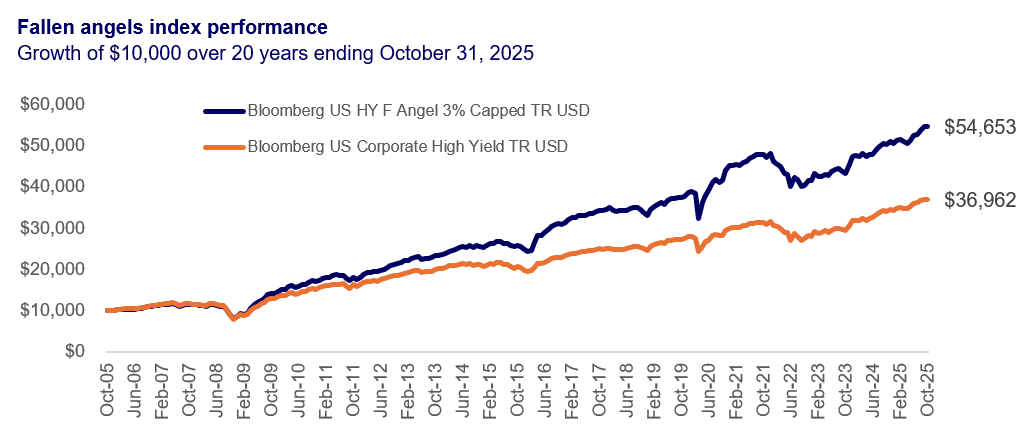

Fallen angels index performance
Fallen angels indexes and benchmarks

Source: Morningstar Direct. In USD. As of October 31, 2025. Indexes and benchmarks used in this material are unmanaged and provided for general comparison only – they cannot be invested in directly. Past performance is not a guarantee or indicator of future results.

What role do fallen angels play in a diversified portfolio?

Fallen angels offer the potential for:

  • Return improvement – Fallen angels can capture mispricing opportunities after a downgrade and benefit from price appreciation after a subsequent upgrade to investment grade.
  • Yield enhancement – Fallen angels’ allocation within a core fixed income allocation can increase portfolio yield.
  • Relative credit quality improvement – Fallen angels are typically downgraded to a higher rating compared to broad-based high yield.

Fallen angels can be a complement to traditional high-yield allocations and act as a way to access high yield with a different risk profile (i.e., a quality tilt).

While fallen angels can offer attractive return and income characteristics, they can also experience periods of elevated volatility—particularly around downgrade cycles—making diversification and sizing important considerations.

The bottom line

Fallen angels represent a segment of the bond market driven by credit transitions. By focusing on bonds that fall from investment grade into high yield, the strategy seeks to take advantage of mispricing opportunities created by downgrades, forced selling, and subsequent normalization.

For investors, fallen angels can offer a blend of yield and potential price appreciation, making them a suitable complement and diversifier within a fixed income allocation, when implemented as part of a diversified portfolio.


Nothing in this publication is intended to constitute legal, tax securities or investment advice, nor an opinion regarding the appropriateness of any investment, nor a solicitation of any type. This information is made available on an “as is” basis. Russell Investments Canada Limited does not make any warranty or representation regarding the information.

Diversification and strategic asset allocation do not assure a profit or protect against loss in declining market.

Indexes are unmanaged and cannot be invested in directly. Past performance is not indicative of future results.

The Bloomberg US Corporate High Yield Bond Index measures the USD-denominated, high yield, fixed-rate corporate bond market. Securities are classified as high yield if the middle rating of Moody's, Fitch and S&P is Ba1/BB+/BB+ or below. Bonds from issuers with an emerging markets country of risk, based on Bloomberg EM country definition, are excluded.

The Bloomberg US High Yield Fallen Angel 3% Capped Bond Index is a component of the US Corporate High Yield Index that is designed to track USD-denominated, high yield, fixed-rate corporate bonds that have been downgraded from investment grade.

Russell Investments is the operating name of a group of companies under common management, including Russell Investments Canada Limited.

Russell Investments’ ownership is composed of a majority stake held by funds managed by TA Associates Management, L.P., with a significant minority stake held by funds managed by Reverence Capital Partners, L.P. Certain of Russell Investments’ employees and Hamilton Lane Advisors, LLC also hold minority, noncontrolling, ownership stakes.

Copyright © Russell Investments Canada Limited 2026. All rights reserved.

Frank Russell Company is the owner of the Russell trademarks contained in this material and all trademark rights related to the Russell trademarks, which the members of the Russell Investments group of companies are permitted to use under license from Frank Russell Company. The members of the Russell Investments group of companies are not affiliated in any manner with Frank Russell Company or any entity operating under the “FTSE RUSSELL” brand.

Date of first publication: February 2026.

This site uses cookies to offer you a better browsing experience. A cookie is a small text file that a website places on your computer or mobile device when you visit the site. It enables the website to remember your actions and preferences, so you do not have to keep re-entering them whenever you come back to or browse this site. Click here for a list of cookies and a description of how they’re used. The cookie-related information is not used to identify you personally. These cookies are not used for any purpose other than those described here.

Nothing in this publication is intended to constitute legal, tax securities or investment advice, nor an opinion regarding the appropriateness of any investment nor a solicitation of any type. This is a publication of Russell Investments Canada Limited and has been prepared solely for information purposes. It is made available on an "as is" basis. Russell Investments Canada Limited does not make any warranty or representation regarding the information.

We will provide our publications in alternative formats, upon request, in a timely manner, depending upon document specifications (e.g. length of document, format required).

Russell Investments is the operating name of a group of companies under common management, including Russell Investments Canada Limited.

Russell Investments is committed to ensuring digital accessibility for people with disabilities. We are continually improving the user experience for everyone, and applying the relevant accessibility standards.

Russell Investments' ownership is composed of a majority stake held by funds managed by TA Associates Management, L.P., with a significant minority stake held by funds managed by Reverence Capital Partners, L.P. Certain of Russell Investments' employees and Hamilton Lane Advisors, LLC also hold minority, non-controlling, ownership stakes.

Frank Russell Company is the owner of the Russell trademarks contained in this material and all trademark rights related to the Russell trademarks, which the members of the Russell Investments group of companies are permitted to use under license from Frank Russell Company. The members of the Russell Investments group of companies are not affiliated in any manner with Frank Russell Company or any entity operating under the "FTSE RUSSELL" brand.

Products and services described on these websites are intended for Canadian residents only. Information on these sites should not be considered a solicitation to buy or an offer to sell a security to any person.

© Russell Investments Canada Limited 1995-2026. All rights reserved. This material is proprietary and may not be reproduced, transferred, or distributed in any form without prior written permission from Russell Investments. It is delivered on an "as is" basis without warranty.