

Key takeaways
- Even with a roughly 2% gain in the MSCI World Index last month, performance diverged across companies and managers as the AI trade broadened and brief macro volatility tested discipline.
- Markets continued to reward fundamentals over narrative, reinforcing that company investments—particularly in AI—must translate into returns.
- Emerging markets outperformed the U.S., reinforcing the shift toward broader regional and sector leadership.
Markets start 2026 selectively
Global equity markets posted modest gains to start the year, driven by selective strength in technology and cyclical areas as leadership rotated. Beneath the surface, performance diverged across companies, sectors, and regions. While macro uncertainty continues to unsettle markets, outcomes are increasingly shaped by company fundamentals. Markets are showing less tolerance for growth narratives without clear evidence of return—a dynamic most visible within the AI trade.
Style performance in January reinforced this divergence across approaches. Value, income-oriented, and smaller-cap strategies outperformed, supported by strength in energy, materials, and industrials. Growth and large-cap growth lagged as markets placed greater emphasis on execution and nearer-term fundamentals. Together, these dynamics point to a market where fundamentals are driving outcomes and leadership is widening across styles and regions, underscoring that no single approach consistently captured opportunity in a more selective environment.
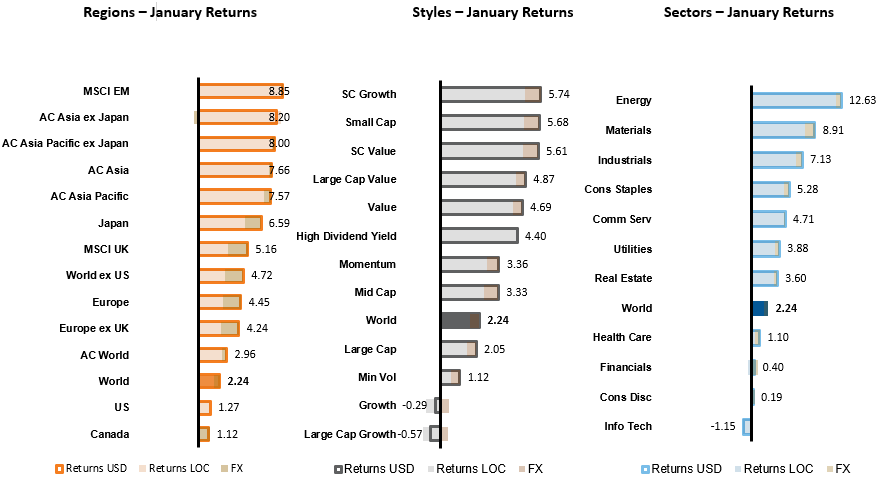
Source: MSCI, Russell Investments
AI raises the bar for technology performance
January underscored how the AI opportunity set is evolving. As the theme continues to broaden, outcomes increasingly reflected scrutiny around the balance of growth investment with financial discipline.
Differences emerged across the AI value chain. Companies tied to core AI infrastructure—chip manufacturing, equipment, and memory—generally held up better. Recent relative strength showed up in names such as TSMC, ASML, Lam Research, Samsung, SK Hynix, and Seagate. Select platform and deployment beneficiaries, including Alphabet and Alibaba, also performed better. These examples reflect observed market performance, highlighting where investors currently see demand translating more directly into earnings.
At the same time, several large technology stocks lagged, including Broadcom, Tesla, Oracle, Palantir, and Microsoft. Market attention stayed focused on capital discipline, investment scale, financing, and the clarity of AI strategies. Discussion also increased around potential AI-driven disruption within parts of the software sector, as investors assessed how AI spending is showing up in company performance.
Taken together, these dynamics point to a market where stock-level outcomes are increasingly differentiated, creating a more favorable environment for active management.
Leadership broadens beyond the U.S.
January also extended a trend of widening regional dispersion. The U.S. was again among the weaker-performing regions, with emerging markets leading the pack. This broadening reflects a market environment that is moving away from narrow leadership and toward a wider opportunity set across geographies and sectors.
Outside of technology, companies with solid fundamentals and reasonable valuations continued to find support. Areas such as healthcare, energy, financials, and defense saw selective strength, underscoring that investor attention is spreading beyond the AI narrative.
Uncertainty remains a key risk
January also served as a reminder that uncertainty remains a central risk for equity markets. While the geopolitical episode in the middle of the month proved short-lived, it highlighted how quickly sentiment can be disrupted. Markets appear willing to look through isolated events that resolve quickly, but sustained uncertainty could prove more challenging in an environment where valuations already reflect optimism in several areas.
Investor implications
Investors continue to find opportunity across global equities, but early in the year it has become clear that the market is growing more selective. The AI trade is moving beyond broad enthusiasm, with greater focus on how companies are using AI to improve execution and fundamentals. Performance differences across stocks, styles, sectors, and regions remain pronounced, reinforcing a market where choices matter more than themes.