


The answer often depends on portfolio objectives, liquidity needs, and existing public market exposure. Some institutions may look to reduce concentration risk quickly, while others may prefer to maintain exposure but manage how those holdings fit within broader benchmark and portfolio allocations once public trading begins.
Key takeaways
- Mega IPOs could quickly turn private market gains into concentrated public equity exposure.
- Passive index inclusion may increase exposure institutional investors already hold privately.
- Overlay strategies can help institutional allocators protect gains while preserving flexibility.
- Coordinated execution planning may improve portfolio rebalancing during IPO transitions.
When private market wins become public market challenges
The next IPO wave may create a different kind of portfolio challenge for institutions already holding private stakes in companies like SpaceX and OpenAI. Years of gains built inside venture funds, growth mandates, and GP structures could quickly become some of the largest public equity positions in institutional portfolios once those companies begin trading publicly.
The nature of private market holdings often masked concentration risk, with valuations updating infrequently, positions embedded inside broader vehicles, and liquidity remaining limited. A public listing changes that dynamic quickly. A successful private markets investment can quickly become a much harder public markets position to manage.
Now, with the IPO pipeline beginning to reopen around some of the largest private market companies, institutions may face a more complicated transition than many expected. The challenge is no longer simply participating in the upside. It is managing what happens after those private gains enter public markets.
Mega deals driving the next wave of large-scale IPO activity
Current attention is increasingly focused on the big mega deals, defined as venture capital financings of $100 million or more. Those transactions represented roughly 70% of U.S. VC deal value in 2025, up from 56% the year before.
The scale of some anticipated listings could make the next IPO wave materially different from prior cycles. Many institutions spent years deliberately building exposure to companies like SpaceX, OpenAI, and Anthropic through private markets. As those companies move closer to public listings, their sizes could quickly make them meaningful index exposures.
SpaceX alone has reportedly discussed valuations approaching $2 trillion, potentially making it the largest IPO in history. For context, the Nasdaq today is roughly a $30 trillion market, meaning even a small number of listings at these valuations could create new challenges around liquidity, rebalancing, and protecting years of accumulated private market gains.
The post-IPO reality
After the opening bell and early excitement fade, the real transition begins. Early investors often start realizing gains soon after listings, increasing the supply of shares entering the market and creating volatility tied more to liquidity and positioning than the company’s long-term outlook. That dynamic could become even more pronounced in the next IPO wave, as institutions decide how to protect years of private market gains and how those companies fit within public portfolios once trading begins.
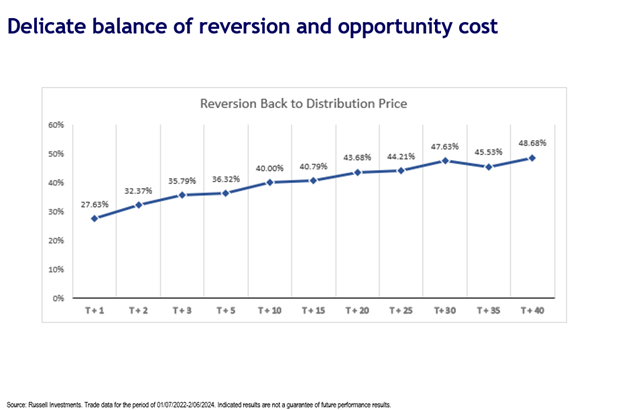
Our trading desk data shows how uneven that period can become. Only 28% of stocks traded at or above their distribution price on the first trading day after distribution, while nearly 48% had returned to distribution price by day 30. That gap can create difficult tradeoffs around timing, liquidity, and rebalancing for institutions managing large private stakes.
Historical examples such as Uber and Pinterest show how post-IPO volatility can persist long after the opening bell. Uber’s one-month implied volatility started around 60 before rising sharply around early earnings announcements and the November 2019 lock-up expiration. Pinterest experienced similar volatility spikes around early earnings periods as investors continued adjusting positions after the IPO.
Positioning portfolios ahead of the IPO wave
Volatility, selling pressure, and delayed liquidity can leave portfolios exposed to meaningful short-term swings just as concentration and implementation risks become more visible. For investors holding private stakes through venture funds or GP structures, lock-up restrictions and distribution timing can further delay when shares are actually available to sell, complicating rebalancing decisions after public trading begins.
That distinction is increasingly shaping how allocators approach hedging, customization, rebalancing, and execution planning ahead of a listing.
Several themes are beginning to shape how institutions manage these transitions:
1. Use overlays to create flexibility
Investors may still believe strongly in the company’s long-term outlook. The challenge is managing how that exposure fits within the broader portfolio after the IPO, particularly when delayed liquidity and selling constraints limit how quickly positions can be rebalanced.
In those situations, options-based overlays can help protect accumulated gains while creating more flexibility around timing and rebalancing decisions. Structured approaches such as costless collars, which exchange some future upside participation for downside protection without an upfront premium payment, may help reduce exposure risk while avoiding rushed selling during volatile post-listing periods.
Alternatively, some institutions are not seeking to hedge an overweight position, but rather to gain exposure to an IPO ahead of its inclusion in benchmark indices and related passive investment vehicles. Call options can provide a capital-efficient way to manage the risk of being underweight during this transition period.
2. Know where concentration is hiding and prepare for passive exposures
Positions that once sat inside diversified private market structures can quickly emerge as outsized public equity exposures. Investors are increasingly evaluating how IPO-related holdings could affect portfolio exposures, benchmark alignment, and overall risk once public trading begins.
What began as a high-conviction private markets investment can quickly become a large passive public market exposure once those companies enter major indexes. Institutions already holding private stakes in potential mega IPOs may not want indexed mandates adding even more exposure, but they may not necessarily want to exit the position either.
Completion portfolios, along with customization and exclusions, can help manage concentration more efficiently across the broader portfolio while still maintaining exposure. That flexibility may be particularly relevant across the endowment and foundation space, where implementation decisions often align closely with broader mission-driven priorities. For example, an institutional investor may have reduced its passive equity exposure and replaced it with an equity completion mandate designed to more efficiently manage aggregate factor exposures across the broader equity portfolio. In that context, the investor could choose to exclude adding SpaceX exposure if it was already economically overweight the company through shares received in a private equity transaction that had not yet become liquid.
3. Coordinate execution before rebalancing begins
Managing downside exposure is only part of the challenge. Large, concentrated positions still need to be unwound efficiently once investors decide to rebalance. IPO transitions can create liquidity pressures and temporary selling imbalances as multiple early investors attempt to reduce exposure simultaneously.
Poor execution can erode gains quickly once large positions begin unwinding. Coordinating hedging and execution early may help reduce slippage, preserve liquidity, and maintain portfolio stability during volatile post-listing periods. Agency trading models, where trades are executed on behalf of clients without taking principal positions, may also help align execution more closely with investor objectives during complex portfolio transitions.
Investor Implications
Institutions already holding private stakes in potential mega IPOs may need to treat the transition to public markets as an active portfolio event rather than a simple liquidity milestone. The challenge is not only whether to reduce exposure, but also how to manage timing, benchmark impact, and implementation constraints once public trading begins.
That may require decisions well before the IPO itself. Institutions that evaluate concentration, liquidity needs, hedging approaches, and benchmark exposure earlier may have greater flexibility once shares begin trading publicly and passive flows accelerate.
Common client questions
In many cases, yes. IPO transitions often create temporary selling pressure as early investors begin monetizing positions, creating volatility driven more by liquidity dynamics and positioning than by changes in the company’s long-term outlook.
The challenge may extend well beyond the IPO itself. Large, concentrated positions can require coordinated hedging, liquidity planning, benchmark customization, and execution management once public trading begins.
Yes. A high-conviction private markets allocation can become a much larger passive holding once indexes and ETFs begin adding exposure after a listing. That shift can create unintended concentration across broader portfolios.
Many allocators already hold meaningful exposure to companies like SpaceX and OpenAI through venture funds, growth mandates, and GP structures. Once those companies enter public indexes, passive mandates and ETFs may add even more exposure automatically, potentially creating larger concentration challenges than investors expected.
Institutional portfolios may already contain indirect ownership through private funds. Once companies become public and enter indexes, passive strategies can increase exposure further, creating unintended concentration.
Any opinion expressed is that of Russell Investments, is not a statement of fact, is subject to change and does not constitute investment advice.