

Fallen Angels are corporate bonds that have been downgraded from investment grade to high yield. These downgrades often trigger forced selling by investment-grade investors and passive funds, creating temporary pricing dislocations that can present attractive opportunities for patient investors.
Key takeaways
- The structural investment case for Fallen Angels remains intact, driven by persistent technical dislocations following credit downgrades.
- The opportunity has evolved as larger issuers, private credit growth and more efficient trading have changed the recovery profile.
- While price recoveries may take longer than in the past, the Fallen Angel universe today offers higher average credit quality than the broader high yield market, supporting a constructive long-term outlook.
For decades, Fallen Angels have occupied a unique position within fixed income markets. When investment grade issuers are downgraded into high yield, forced selling by investment-grade investors and passive index trackers can temporarily push bond prices below levels justified by their underlying fundamentals. Historically, patient investors have been rewarded as these technical pressures fade and valuations normalize.
Has that opportunity changed?
Credit market shifts
Recent years have seen significant shifts in credit markets. The growth of private debt has altered the composition of public high yield issuance, while larger and more concentrated downgrades have changed how quickly markets absorb new Fallen Angels. At the same time, advances in fixed income trading have improved market liquidity and execution.
Taken together, these developments suggest that while the mechanics of the opportunity remain intact, the path to realizing returns is evolving. We examine the outlook through three lenses: market structure, recovery and access.
Market structure
The investment case for Fallen Angels continues to be driven by market structure rather than simply credit deterioration.
When bonds lose their investment grade status, many institutional investors are required to sell regardless of valuation. Passive strategies tracking investment grade benchmarks must also remove these securities, creating concentrated selling pressure precisely when liquidity can be most challenged.
Historical downgrade cycles illustrate a consistent pattern. Bond prices often weaken ahead of a downgrade as markets anticipate rating actions, typically reaching their lowest point around the downgrade itself before recovering as forced selling subsides and investors reassess the issuer's underlying fundamentals.
While not every issuer recovers—some become so-called "fallen knives"—many Fallen Angels enter the high yield market with stronger balance sheets than the average high yield issuer. In some cases, issuers ultimately regain investment grade status as Rising Stars, reinforcing the cyclical nature of the asset class.
This technical repricing remains the foundation of the investment opportunity.
Average fallen angel bond cumulative return: 6 months before to 6 months after entering the index
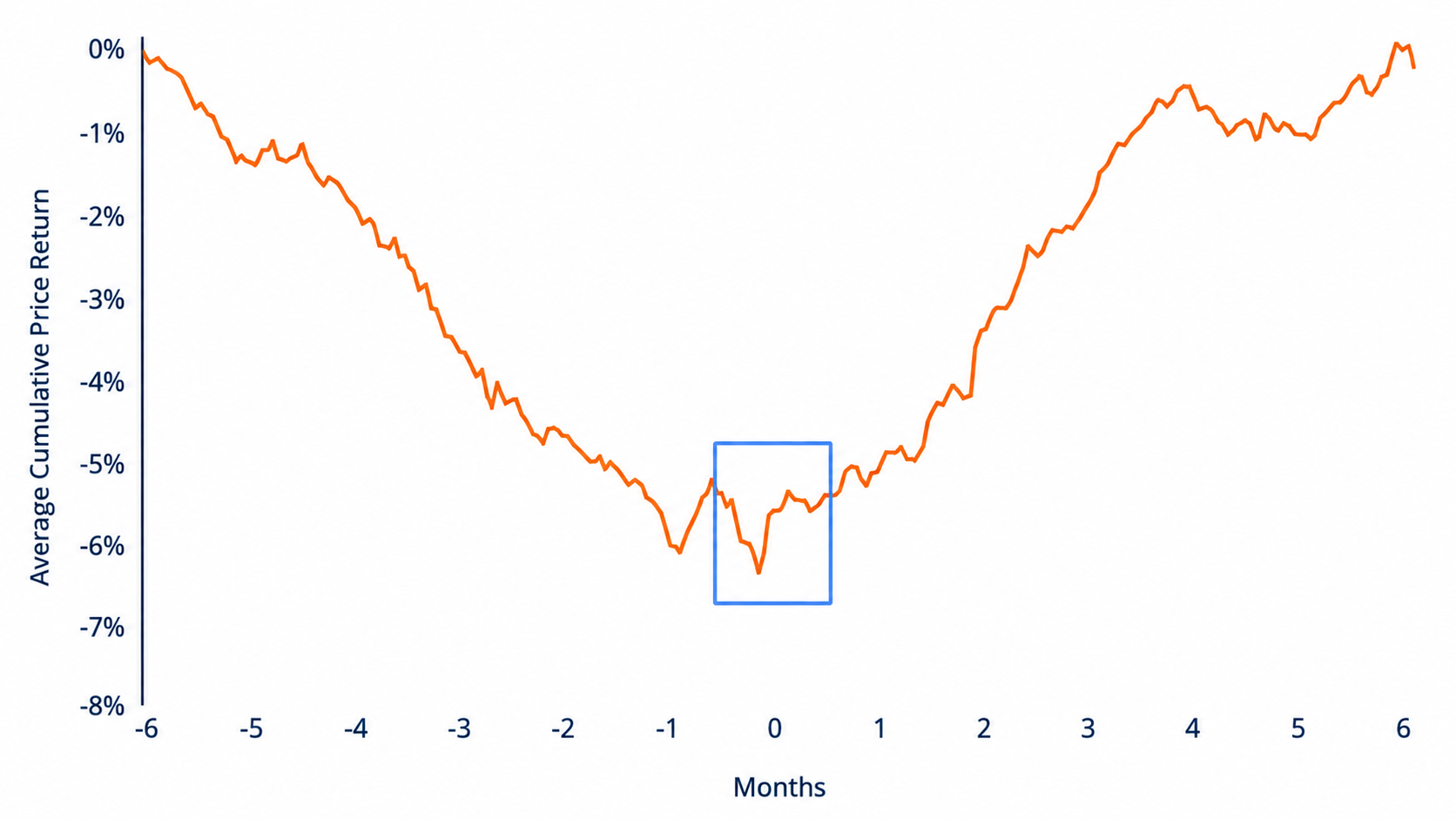
Source: FactSet. This chart is for illustrative purposes only Past performance is not indicative of future results. Data is based on bond constituents of the ICE BofA US Fallen Angel High Yield Index that were downgraded to high yield and entered the index in 2004 or later. Index data on and prior to February 28, 2020 reflects that of the ICE BofA US Fallen Angel High Yield Index (HOFA). From February 28, 2020 forward, the index data reflects that of the ICE US Fallen Angel High Yield 10% Constrained Index (HOCF).
Differing recovery profile
The opportunities present among Fallen Angels have not disappeared, but their characteristics have changed.
One trend has been the increasing size of Fallen Angel migrations. Recent downgrades, including Warner Bros. Discovery, rank among the largest ever to enter the asset class, while issuers such as Ford remain closely watched by markets because of the scale of debt that could potentially migrate into high yield.
The consequence has been a more gradual recovery profile. Whereas much of the historical price recovery often occurred within three to six months following a downgrade, recent experience suggests recovery periods have extended by around 25% as markets absorb larger issuance volumes.
At the same time, the growth of private credit appears to be reshaping the public market. Financing that may previously have been issued through public high yield markets is increasingly being sourced privately, particularly among lower-quality borrowers. As a result, the public Fallen Angel universe has become more concentrated in higher-quality issuers.
Fallen angels vs. broader HY
The combination of more liquid issuance (ex-IG) and stronger underlying fundamentals has led Fallen Angels to outperform the broader HY index.
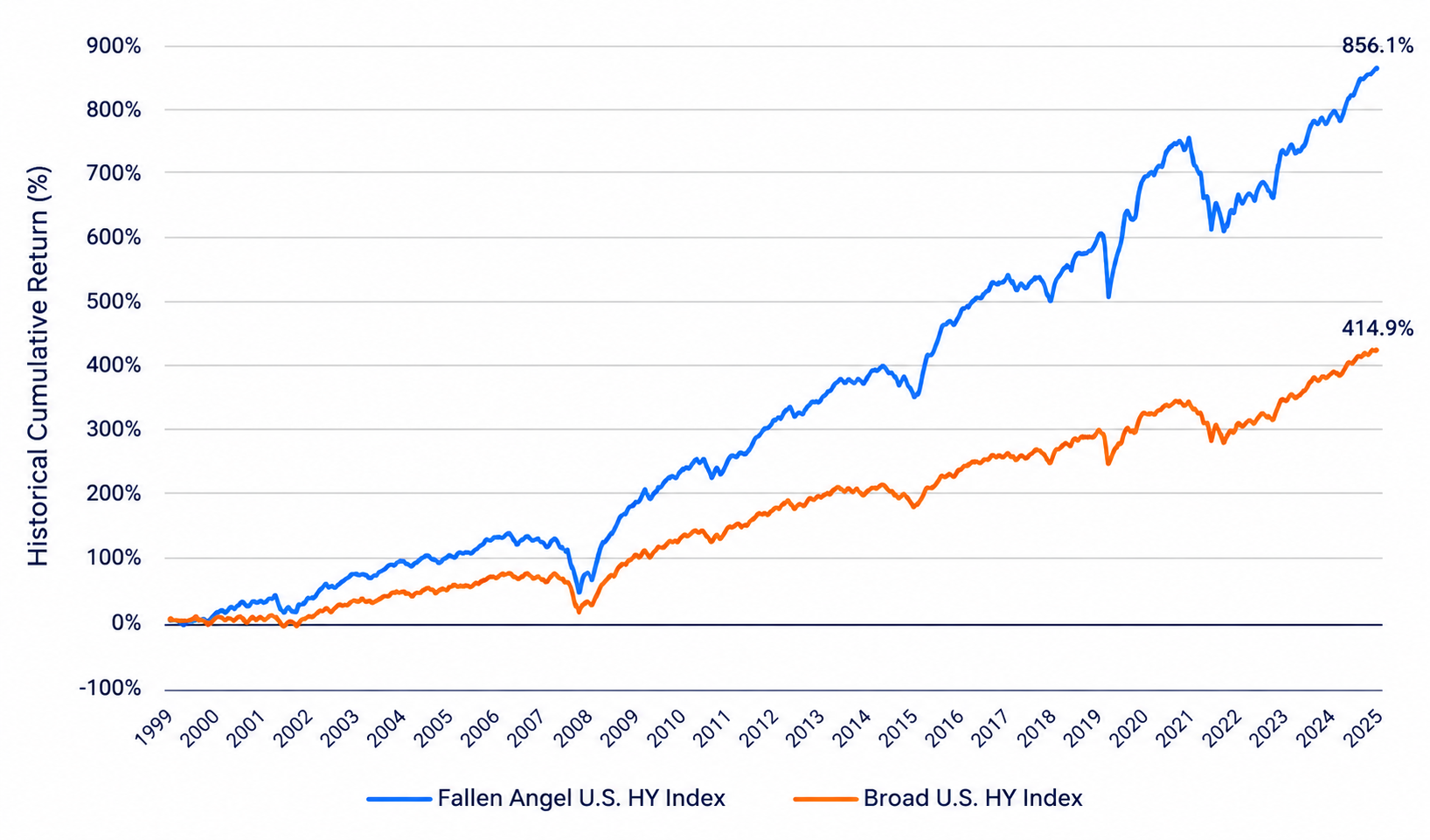
Source: Barclays research data.
This is reflected in the composition of the asset class. Compared with the broader high yield market, Fallen Angels continue to maintain greater exposure to BB- and single-B-rated securities, offering investors access to high yield through a relatively higher-quality segment of the market.
Meanwhile, advances in portfolio trading, ETF liquidity and risk transfer have made implementation considerably more efficient than in previous downgrade cycles, allowing larger transactions to be absorbed more effectively.
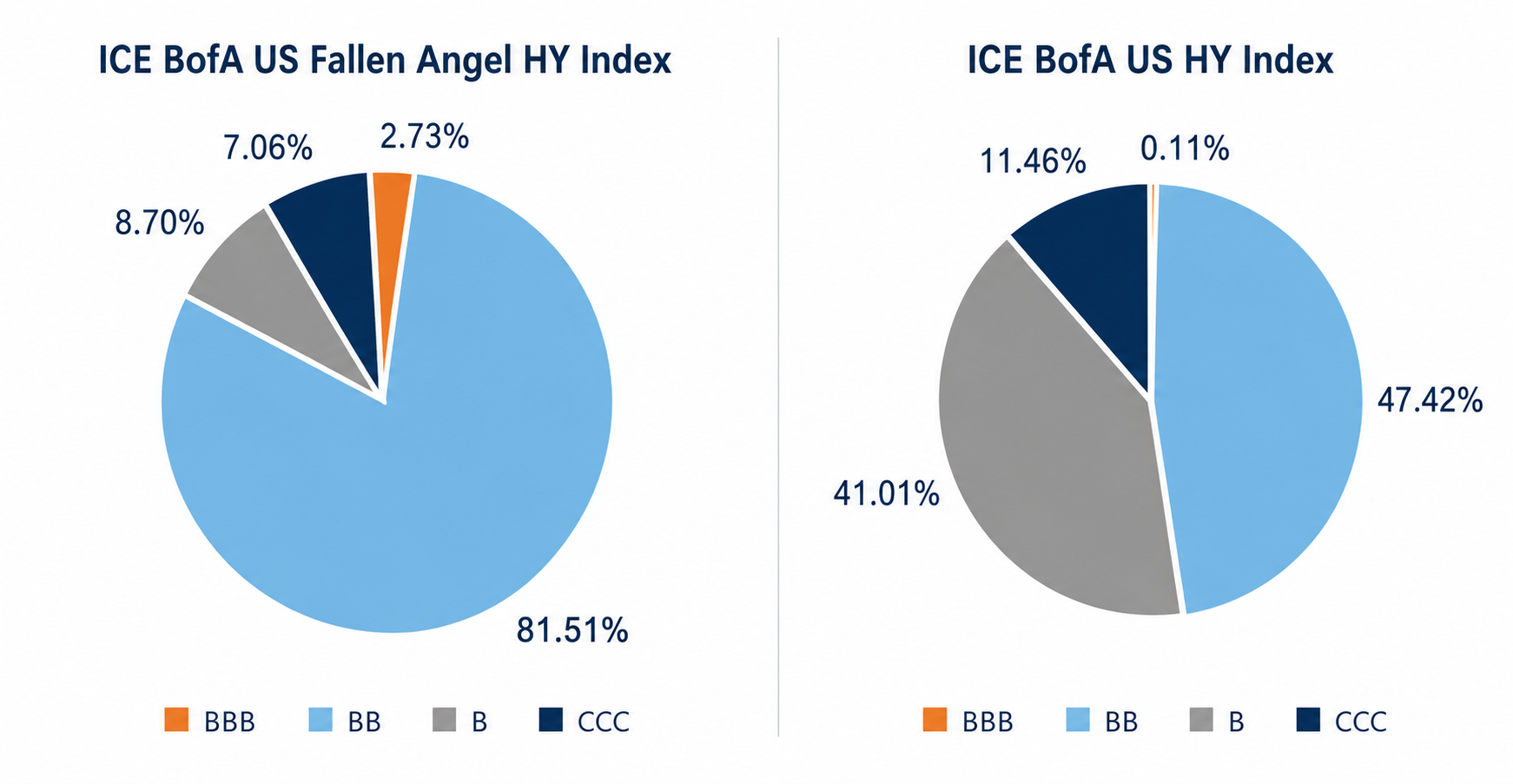
Source: ICE BAML, Bloomberg index data
Market access
Capturing the Fallen Angel opportunity depends on identifying attractive credits, but also on accessing the market efficiently.
Recent years have seen significant improvements in fixed income market access. The growth of portfolio trading, ETF liquidity and more sophisticated risk transfer mechanisms has made it easier for investors to transact in larger credit portfolios, reducing the balance sheet burden on dealers and improving market efficiency during periods of elevated turnover.
These developments are particularly important as Fallen Angel migrations have become larger and more concentrated. While sizeable downgrades can take longer for markets to absorb, improved trading infrastructure allows investors to establish or adjust positions more efficiently than in previous market cycles.
Implementation also extends beyond simply gaining exposure to the Fallen Angel universe. Active approaches can incorporate valuation disciplines that seek to identify bonds where technical selling has created the greatest pricing dislocations, while avoiding issuers whose valuations already reflect improving fundamentals. By combining exposure to the structural technical opportunity with selective value tilts, investors can seek to enhance risk-adjusted returns over time.
Investor implications
The outlook for Fallen Angels remains constructive, but the market is evolving.
The technical forces underpinning the strategy remain firmly in place. Forced selling continues to create temporary pricing dislocations, while the asset class retains a higher average credit quality than the broader high yield universe.
However, investors should recognise that today's opportunity differs from previous cycles. Larger issuers are extending recovery periods, private credit is reshaping the composition of public markets and implementation has become more efficient.
For investors seeking diversified high yield exposure, these changes reinforce the case for viewing Fallen Angels as a distinct allocation rather than simply another segment of the high yield market. While patience may be required as larger downgrades work through the system, the combination of attractive yields, relatively stronger credit quality and recurring technical dislocations continues to support the long-term investment case.
Common client questions
The investment opportunity in Fallen Angels stems from market structure rather than credit deterioration alone. Forced selling following a downgrade can push bond prices below their fundamental value. As technical selling pressure subsides and valuations normalize, many Fallen Angels have historically recovered over time.
Yes, the opportunity has evolved rather than disappeared. Larger issuer downgrades, the growth of private credit, and more efficient fixed income trading have extended recovery periods. However, the structural drivers of the strategy remain intact, and the asset class continues to offer relatively high credit quality within high yield.
Compared with the broader high yield market, Fallen Angels generally have higher average credit quality, with greater exposure to BB- and single-B-rated issuers. Many enter the high yield market with stronger balance sheets than typical high yield companies, supporting a differentiated risk-return profile.
Efficient implementation helps investors capture pricing dislocations before they normalize. Advances in portfolio trading, ETF liquidity, and electronic fixed income markets have improved market access, while active management can help identify the most attractive valuation opportunities and avoid issuers whose recovery is already reflected in prices.
Any opinion expressed is that of Russell Investments, is not a statement of fact, is subject to change and does not constitute investment advice.