



The most effective approach is to evaluate the underlying drivers of return rather than focusing exclusively on performance outcomes. Attribution analysis can help distinguish security selection, issue selection, or other repeatable skills from returns generated by broad factor, credit, duration, or currency exposures. This helps align fees with expected sources of value creation.
Key Takeaways:
- Higher dispersion, increasing benchmark concentration, and more diversified portfolios have increased the importance of active management and understanding the true drivers of risk and return.
- Active fees should be linked to repeatable sources of skill, not market exposures that can be accessed more efficiently elsewhere.
- Measuring active management requires a portfolio-level perspective that distinguishes security selection from factor, sector, credit, duration, and currency exposures.
- Portfolio construction, risk attribution, overlays, and completion portfolios can help concentrate active risk in areas where investors expect skill to add value.
Asking the right question
Active management is often judged by the wrong first question: Did the manager outperform?
For investment committees evaluating multi-asset portfolios, performance is often where the analysis begins. The question is straightforward: Did the manager outperform? Yet this is often not the most appropriate question to ask. As institutional portfolios have become more complex, performance alone only tells a fragment of the story.
A more useful question is: What exactly are institutions paying for?
Two portfolios can deliver similar results while relying on very different sources of return. One may reflect repeatable investment skill, while another may be driven largely by broad market exposures.
This distinction matters because what matters most is not how active a portfolio appears, but whether the risk being taken reflects genuine manager skill rather than beta exposures that can be accessed at a fraction of the cost. Investors should be able to identify and underwrite a manager's source of value before it shows up in performance.
Complex modern portfolios
Yet, measuring value in modern portfolios is a complex task. Modern portfolios are typically built from a mix of public and private markets, active and passive strategies, alternatives, factor exposures and overlays. Many investors employ dozens of managers and implementation vehicles, often with overlapping exposures to factors, sectors, regions, credit markets, and currencies.
The result is that understanding what investors are paying for requires looking beyond manager-level performance to the risks and return drivers embedded across the total portfolio.
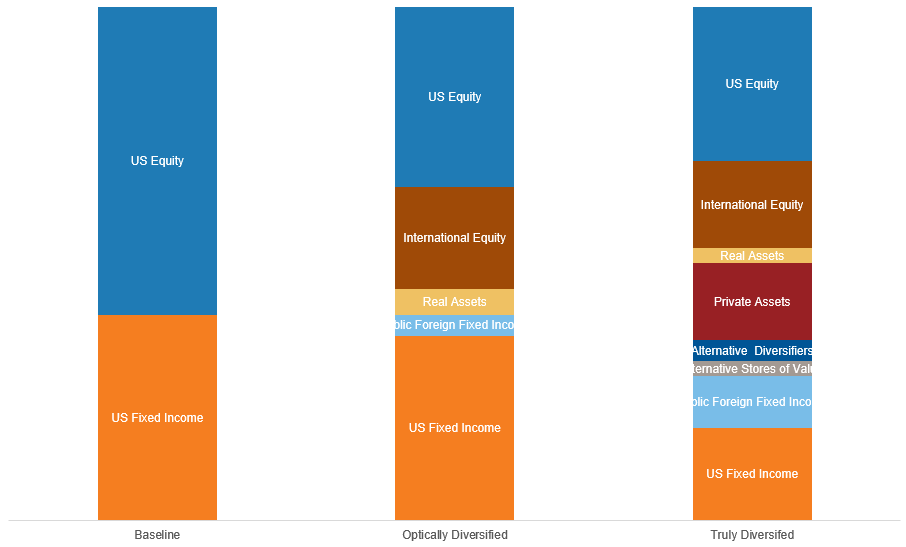
Exhibit 1 Asset class allocation direction for the next decade
Paying for skill, not exposure
In today’s climate, paying for skill has become more important. Higher rates, higher inflation, and greater variation in company fundamentals have widened the gap between winners and losers, creating a larger opportunity set for security selection.
Increasing benchmark concentration also means investors relying solely on market-cap-weighted indexes may be less diversified than they appear, making it more important to understand the exposures being added across a portfolio.
Active fees should be linked to repeatable sources of value creation. In equity, that may be security selection. In fixed income, it may be issue selection, liquidity provision, relative-value analysis, or curve positioning. These are capabilities investors can evaluate before the results appear in performance.
For institutional investors, the practical challenge is building a process that separates skill from exposure and prevents unintended risks from accumulating across the total portfolio.
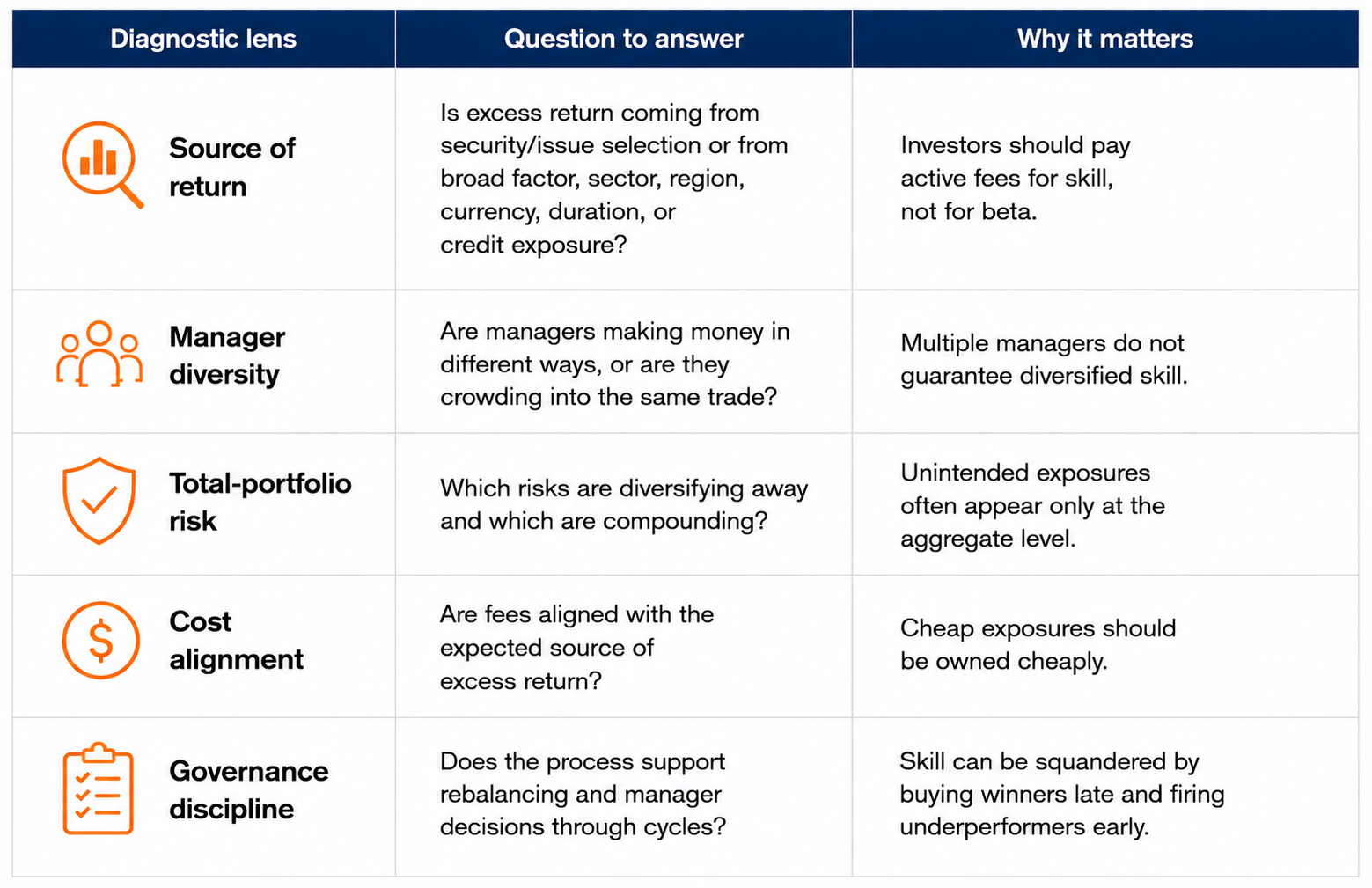
If investors are paying active fees, they should have confidence that the return they receive is coming from a manager's repeatable skill rather than from risks that could have been obtained more efficiently elsewhere.
Active share vs useful active risk
One common criticism of multi-manager investing is that it dilutes conviction. Combine several active managers and active share often declines. There is some truth to that observation, but it misses a more important point.
Consider two equal-weighted managers who each generate 4% excess return through stock selection. Combining them does not automatically eliminate the alpha simply because some positions offset each other. If both managers add value independently, that value creation does not disappear simply because aggregate active share declines. The return outcome remains the same: 50% × 4% + 50% × 4% = 4%.
Alpha can remain while aggregate active share declines
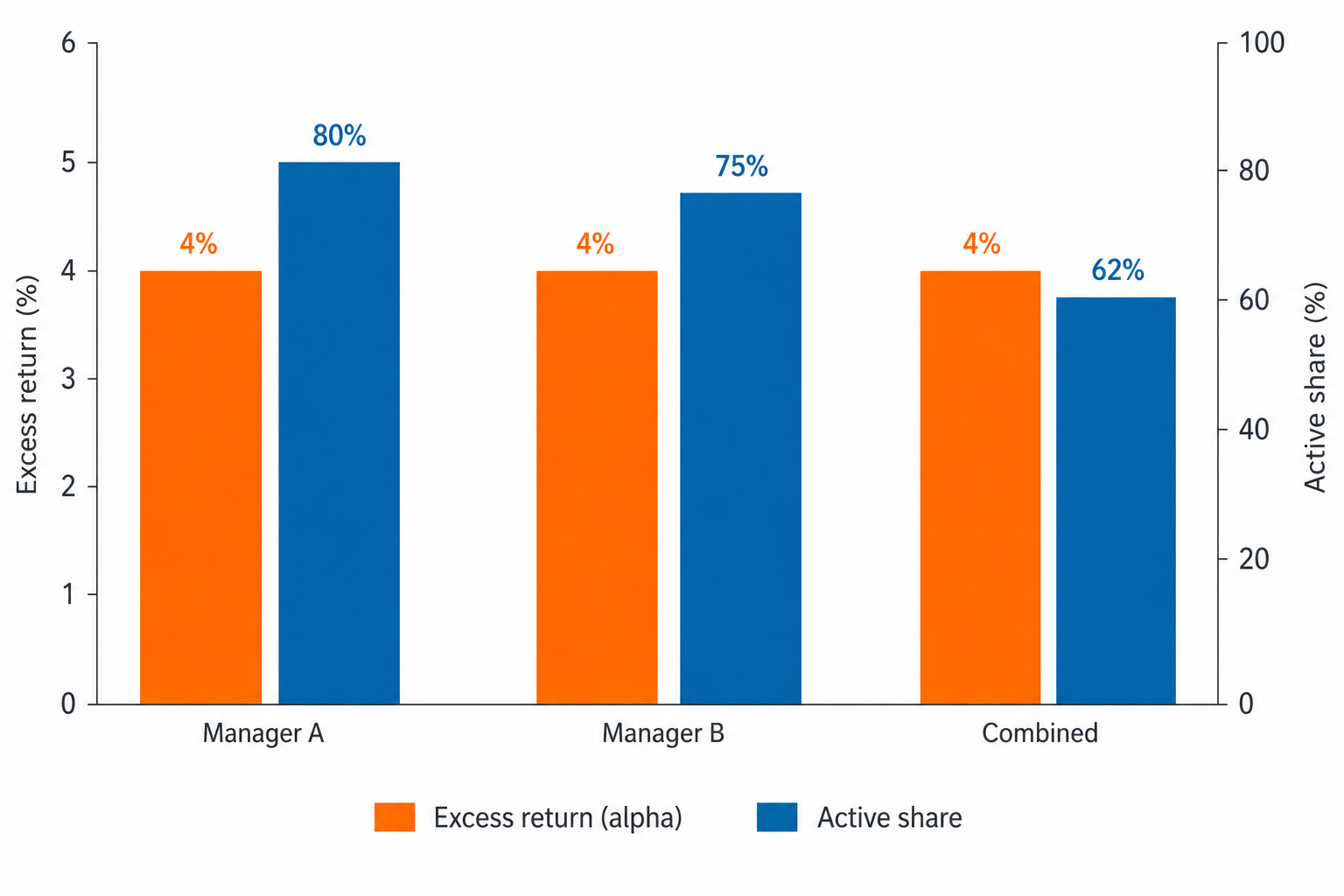
Illustrative only. Active-share figures are hypothetical and should be replaced with a live portfolio example if available.
The more important question is whether the active risk that remains is intentional, diversified, and tied to areas where managers have meaningful skill. High active share is not automatically good. Low active share is not automatically bad. The issue is whether the active risk is useful.
Currency provides a useful example. An equity manager may buy Honda because they believe the company is undervalued, not because they have a differentiated view on the Japanese yen. Yet the currency exposure arrives alongside the stock position. The investor may end up taking significant currency risk despite never intending to.
Fixed income presents a similar challenge through credit, duration, curve, liquidity, and issue-selection exposures. A manager may appear to generate attractive excess returns, but after adjusting for a structural overweight to credit risk or a persistent duration position, the amount of true alpha may be considerably smaller than it first appears. Credit and duration exposure can be purchased relatively cheaply. Investors should not pay active fees unless the manager is delivering something beyond the exposure itself.
Take for instance two periods in the last decade for fixed income managers. Russell’s manager research team tracks over 110 core plus fixed income strategies that we analyze for clients. This universe of managers performed exceptionally well from 3/31/2020 until 03/31/2021 as credit spreads fell dramatically from over 10% on high yield bonds to 3% average OAS. Returns from credit were exceptional and 90% of active managers outperformed.
Conversly, during Q2 of 2022, as credit spreads moved out from 3% to 6% on high yield bonds and returns to credit were negative, over 80% of active managers underperformed – is that skill or is that riding the credit wave and should you really pay for that ride?
Implementation determines whether skill reaches the portfolio
Identifying skill is only part of the challenge. Investors must also build portfolio structures that allow those skills to contribute to outcomes while minimizing unintended exposures.
To achieve this, portfolio-level oversight is critical. Individual managers operate within their own mandates and rarely have visibility into aggregate exposures. A growth manager may not know another manager holds similar technology positions. A fixed income manager may not understand how much total credit exposure already exists elsewhere in the portfolio.
Implementation tools help address these inefficiencies and unintended risks. Overlays can reduce unwanted currency, regional, duration, or market exposures. Completion portfolios can address benchmark gaps, offset unintended concentrations, and improve benchmark alignment without disrupting underlying manager allocations.
OCIO considerations
Governance plays an important role in this process. Many investment committees hire managers after periods of strong performance and become uncomfortable allocating additional capital after periods of underperformance, even when the forward-looking investment case remains intact. Winners are allowed to grow unchecked while underperformers are terminated before their investment process has an opportunity to recover.
Strong governance and implementation also require the discipline to rebalance exposures when necessary, even when doing so feels uncomfortable. The value of an OCIO model is not simply delegated manager selection. It is the integration of manager research, portfolio construction, risk attribution, implementation, rebalancing, and cost management within a single decision-making framework.
Active fees are also most defensible when they are tied to identifiable sources of skill rather than broad market exposures. Portfolio-level attribution can help identify unintended concentrations that emerge across managers and strategies.
Investor implications
As portfolios become more diversified across asset classes, managers, and implementation tools, performance alone provides an incomplete picture of value.
The most important question is not simply whether a manager outperformed, but what drove that outcome. By understanding the true sources of risk and return across the portfolio, investors can be more confident they are paying active fees for repeatable skill rather than market exposures that can be accessed more efficiently elsewhere.
Source notes:
1. Barron’s, “Interested in Active ETFs and Mutual Funds? 3 Takeaways,” March 2025, summarizing Morningstar U.S. Active/Passive Barometer data: more than 63% of active bond managers survived and beat their average passive peer in 2024; active intermediate core bond manager success rate was 79%; active large-cap U.S. equity success rate was 37% in 2024 and 7% over 10 years.
2. Barron’s, “Active Funds Trounced by Passive in the Past Year, Morningstar Finds,” August 2025, summarizing Morningstar Active/Passive Barometer data: active bond manager success rate was 31% for the 12 months through June 2025 and 42% over the decade.
3. Financial Times, “When it comes to bond funds, which is better: passive or active?”, January 2026, for market-structure discussion on why active fixed-income management may differ from active equity management.
4. S&P Dow Jones Indices Persistence Scorecard / SPIVA persistence research, as summarized by the Financial Times in 2025, for evidence that recent top-quartile active managers rarely remain top-quartile over subsequent periods.
Common client questions
Not necessarily. Combining managers can reduce some active positions through diversification, but it does not automatically eliminate alpha if managers generate returns independently. The more important question is whether the remaining active risk is diversified, intentional, and tied to distinct sources of manager skill rather than overlapping exposures.
Active share was designed primarily to evaluate individual equity managers relative to a benchmark. Multi-asset portfolios contain additional sources of risk, including duration, credit, factor, country, and currency exposures. Investors need broader portfolio-level attribution tools to understand what risks are actually driving outcomes.
Active management is harder to evaluate because institutional portfolios now combine multiple asset classes, managers, and implementation approaches. Risks that appear diversified within individual mandates can become concentrated when viewed across the entire portfolio. Understanding the true drivers of return requires looking beyond individual managers and examining aggregate exposures.
Paying for skill means compensating managers for repeatable capabilities such as security selection, issue selection, sector rotation, curve positioning, or liquidity provision. Paying for exposure means paying active fees for risks that could be obtained more efficiently through passive or systematic approaches. Investors benefit when portfolio construction helps distinguish between the two.
Investors should evaluate active risk at the total-portfolio level. This includes understanding how much risk comes from security selection versus broader factor, sector, country, currency, duration, or credit exposures. Portfolio-level attribution helps determine whether active fees are supporting differentiated insight or simply replicating exposures already present elsewhere.