

An overlay strategy uses derivative instruments such as futures, forwards, swaps, and options to adjust portfolio exposures without buying or selling the underlying assets. Institutional investors use overlays to manage risk, improve liquidity, maintain target allocations, implement hedging programs, and enhance portfolio efficiency while preserving their long-term investment structure.
Key Takeaways:
- As institutional portfolios become more complex, overlays are emerging as a powerful tool for improving implementation efficiency.
In faster-moving markets, overlays can help investors adjust exposures, manage liquidity, and stay aligned with strategic objectives.
Overlay strategies can unlock greater portfolio flexibility, including the ability to separate alpha generation from market exposure.
Once upon a time, institutional portfolios were relatively simple. Investors built portfolios from a handful of familiar building blocks—primarily domestic stocks and bonds—and achieving market exposure was often the primary objective.
Then the investment universe expanded. Global markets became more integrated and international investing became commonplace. As portfolios became more diversified and portfolio objectives became clearer, investors faced implementation challenges, including cash drag, allocation drift, and manager changes. Overlays emerged as a capital efficient solution to help address these challenges.
Modern institutional portfolios have continued to grow more sophisticated, with increasing allocations to private markets, hedge funds, and real assets. In parallel, overlay programs have evolved from specialized implementation tools into strategic portfolio management solutions that enhance flexibility and execution while helping investors manage risks, exposures, liquidity, and complex investment objectives.
This piece highlights three trends that are elevating the strategic importance of overlays today.
1. Flexibility in faster-moving markets
One of the clearest drivers behind the growing use of overlays is the increasing importance of flexibility.
Recent market cycles have highlighted how quickly conditions can change—sharp drawdowns followed by equally rapid recoveries, leaving investors with limited time to rebalance or adjust portfolios. For portfolios implemented primarily through physical securities, responding at speed can be operationally challenging.
Derivative-based overlays can offer a different level of responsiveness. Futures and other synthetic instruments typically require only a modest amount of capital (e.g., 5-20%) to establish exposure and can be traded with greater speed and liquidity than physical assets, particularly during periods of market stress. In some markets, trading is also available nearly around the clock.
The value of overlays extends beyond tactical positioning. Greater implementation flexibility can support a range of portfolio objectives, including more efficient rebalancing, liquidity management, and temporary adjustments to market exposure without materially disrupting underlying allocations.
This flexibility has become more relevant as institutional portfolios grow more complex. Allocations to private markets and alternatives have continued to rise, amplifying the importance of tools that can help investors manage overall portfolio liquidity and exposures efficiently while preserving long-term investment structures.
2. Greater familiarity with derivatives
The broader adoption of overlays also reflects a gradual increase in investor familiarity with derivatives-based implementation.
Historically, overlays were associated with specialist investment teams or large pension plans that possessed the governance frameworks, operational infrastructure, and expertise needed to manage derivatives programs.
Many institutional investors no longer view overlays solely through the lens of leverage or tactical trading. Instead, they increasingly see them as a mechanism for improving implementation efficiency, portfolio precision, and operational flexibility. Some have likened overlays to the oil in a machine that helps the entire investment program run more smoothly. As a result, overlays are becoming more deeply integrated into broader investment decision-making rather than treated as standalone strategies.
This evolution has expanded the range of applications beyond traditional uses such as cash equitization and currency hedging. Overlays are increasingly being explored in areas such as duration management, downside protection, dynamic asset allocation, and portable alpha implementation.
3. The search for alpha
The challenge of generating consistent alpha is another factor contributing to the growing use of overlays. In highly efficient markets such as U.S. large cap equities, the opportunity set for persistent outperformance has become progressively limited. For many institutional investors, this has reinforced the case for low-cost passive exposures. At the same time, investors continue to seek differentiated sources of return elsewhere. This has renewed interest in approaches that separate beta exposure from alpha generation, such as portable alpha. Through derivatives, investors can maintain strategic market exposure while allocating capital toward areas where alpha expectations may be stronger, including hedge funds, emerging markets, small cap equities, and dynamic currency strategies.
In this framework, overlays can help investors preserve policy allocations while introducing greater flexibility in how capital is deployed. Rather than relying on active management within a constrained set of asset classes, investors can pursue alpha wherever conviction is highest. In a market environment where alpha opportunities are unevenly distributed, the ability to separate portfolio construction decisions from implementation constraints can broaden the opportunity set available to institutional investors.
Practical applications of overlay strategies
The evolution of overlay programs is reflected in the expanding range of applications across a portfolio. While implementation approaches vary by investor type and objective, several common use cases have emerged.
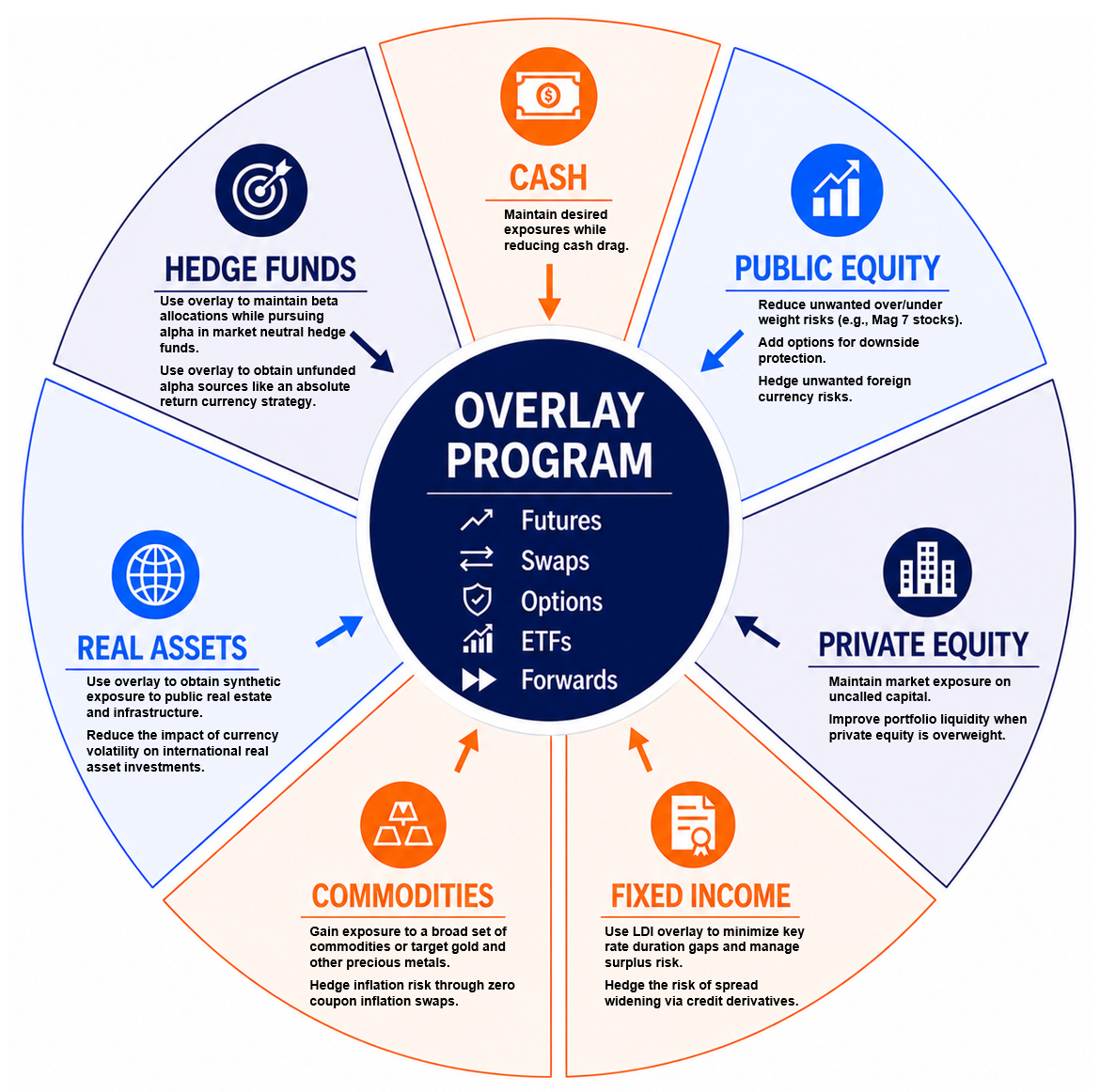
Source: Russell Investments 2026 - For illustrative purposes only.
Investment implications
The increased use of overlays reflects a broader shift in institutional investing. As portfolios become more complex and implementation demands continue to rise, investors are placing greater value on flexibility, liquidity, and capital efficiency. Overlay strategies can support those objectives by allowing institutions to adjust exposures more efficiently while preserving long-term portfolio structures.
The question is no longer whether overlays have a role to play, but how they can be used most effectively within an investment program. Whether supporting rebalancing, managing liquidity, implementing portable alpha, or enhancing risk management, overlays provide investors with additional tools to align portfolio implementation with strategic objectives.
Ultimately, overlays are not changing what investors are trying to achieve—they are changing how efficiently they can achieve it. As institutional portfolios continue to evolve, the ability to separate investment decisions from implementation constraints will be an increasingly important competitive advantage.
Common client questions
Overlay strategies are gaining popularity because institutional portfolios have become more complex, with larger allocations to private markets, alternatives, and global assets. Overlays provide flexibility, capital efficiency, and faster implementation, helping investors manage exposures, rebalance portfolios, and respond to changing market conditions without disrupting underlying investments.
Overlays can help manage a range of portfolio risks, including equity market risk, interest rate risk, currency exposure, and inflation sensitivity. By using derivatives to adjust exposures efficiently, investors can hedge unwanted risks, maintain strategic asset allocation targets, and improve portfolio resilience during periods of market volatility.
Portable alpha is an investment approach that separates market exposure (beta) from active return generation (alpha). Overlay strategies enable investors to gain efficient beta exposure through derivatives while deploying capital to active strategies where alpha potential may be stronger, such as hedge funds, emerging markets, or specialist investment managers.
Any opinion expressed is that of Russell Investments, is not a statement of fact, is subject to change and does not constitute investment advice.