Updated Thursday, April 3 at 8 a.m. Pacific time
U.S. stocks underperformed in the first quarter of 2025, hit by a double whammy from intensifying policy uncertainty and a U-turn in select mega cap stocks. Into this volatile backdrop, April 2—President Trump’s so-called Liberation Day—was circled on investors’ calendars as a catalyst.
Tariff talk
Yesterday’s announcement from the Rose Garden in Washington, D.C., marked another bold policy step, charging large reciprocal tariffs against many of the United States’ largest trading partners. For example, the policy includes:
- A new 10% base tariff on most trading partners, effective April 5
- A ramp-up a few days later to match half of the tariff and non-tariff barriers that countries impose on the U.S.
We estimate the average effective tariff rate could increase by almost 14%—a historically large increase in trade duties.
Two higher level observations are important here. First, the reciprocal tariffs leave room for the duties to get negotiated away. Case-in-point: Some very large exporters like Vietnam have already said that they will cut all tariffs on U.S. products. Second, the exemptions separate the reciprocal policy from Trump’s sector-level tariffs like steel, aluminum, and automobiles. This suggests to us that those sector-level tariffs are likely to be more permanent.

"We estimate the average effective U.S. tariff rate could increase by almost 14%—a historically large increase in trade duties."

Paul Eitelman, CFA
Global Chief Investment Strategist
Growth hit
The administration had already pushed harder than expected on trade policy with tariffs on imports from China, Canada, Mexico, steel, aluminum, and automobiles & parts. While the policies could support domestic manufacturing over the longer-term, we estimated these measures were likely to act as a drag on real GDP growth of 0.5-0.75% and a boost to core PCE inflation of 0.75%.
Today’s reciprocal tariffs could dent real GDP growth by another 0.75% and lift core PCE inflation by an additional 1%. That would likely leave the U.S. growth outlook at 1% or less for 2025 and push core inflation north of 3.5%. Accordingly, we’ve raised our estimate of U.S. recession risk in the year ahead from 30% to 35-40%.
Stunted growth?
Estimated tariff impacts on GDP for 2025 vary
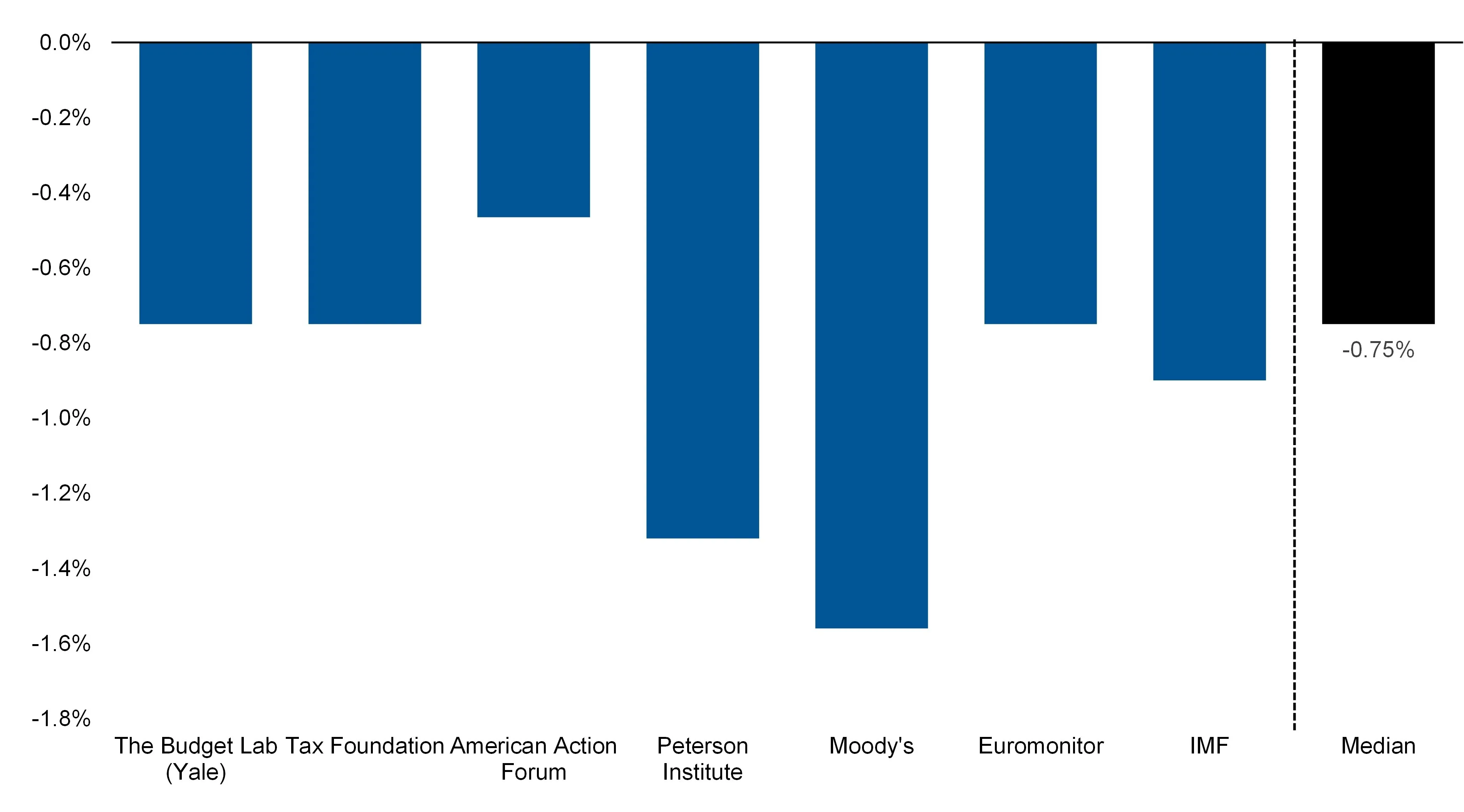
Source: Russell Investments adaptation of model-based estimates in "The Fiscal, Economic, and Distributional Effects of a 20% Broad Tariff" (The Budget Lab, 2025) and "How Will Trump's Universal and China Tariffs Impact the Economy?" (Tax Foundation, 2024). Our adaption assumes a 14-percentage-point increase in the U.S. effective tariff rate.
Pessimism not panic
U.S. markets were moderately risk-on through Wednesday's session, but sold off sharply Thursday morning. As of 8 a.m. Pacific time on Thursday, the S&P 500 was down approximately 4% and the Dow Jones had shed roughly 1,500 points. Meanwhile, Treasury yields declined by approximately 15 basis points as investors flocked to the safety of bonds.
We remain focused on holding diversified portfolio strategies into this period of extreme policy uncertainty. And we will be closely monitoring our measures of market psychology for potential dislocations in markets. Currently our signals show pessimism in the U.S. stock market but haven’t reached an extreme level of panic. Treasury yields at 4% are in line with our estimates of fair value for bonds.