

Key Takeaways
- We expect the early July tariff pause will be extended for most U.S. trading partners.
- The U.S. will probably leave in place across-the-board tariffs of 10% for most countries.
- This will likely lead to slower, but still positive, growth for the rest of the year. A recession does not appear imminent.
The clock is ticking on the tariff pause but good-faith negotiators are likely to get an extension.
The 90-day pause on President Trump’s largest reciprocal tariffs is set to expire on July 8. Our clients have been asking how this this deadline will impact financial markets, particularly with stocks recently reattaining all-time highs in the United States and globally.
Rewarding Good Faith
We don’t expect the Trump administration to boost tariffs materially again in coming weeks based on comments from U.S. officials. In mid-June, Treasury Secretary Scott Bessent told the House Ways and Means Committee that “it is highly likely” the U.S. would “roll the date forward to continue good-faith negotiations” with trading blocks like the European Union “who are negotiating in good faith.” Encouragingly this language was echoed again last week by Stephen Miran, chairman of the White House Council of Economic Advisors.
Our tracking of public comments revealed that all of the United States’ 18 largest trading partners—jointly representing 85% to 90% of U.S. trade—would likely meet this threshold for an extended pause on reciprocal tariffs.
Flat Tariff
More broadly, we believe the U.S. is converging toward a 10% across-the-board tariff with additional, strategic sector tariffs on products like automobiles and steel and aluminum. We estimate this trade package poses a manageable 0.6 percentage-point headwind to U.S. real GDP growth in 2025, allowing the economy to chug along with slower—but still positive—growth in the year ahead. This view has been bolstered by incoming economic data on the consumer and labor markets as well as corporate earnings which, through the end of June, do not signal an imminent recession.
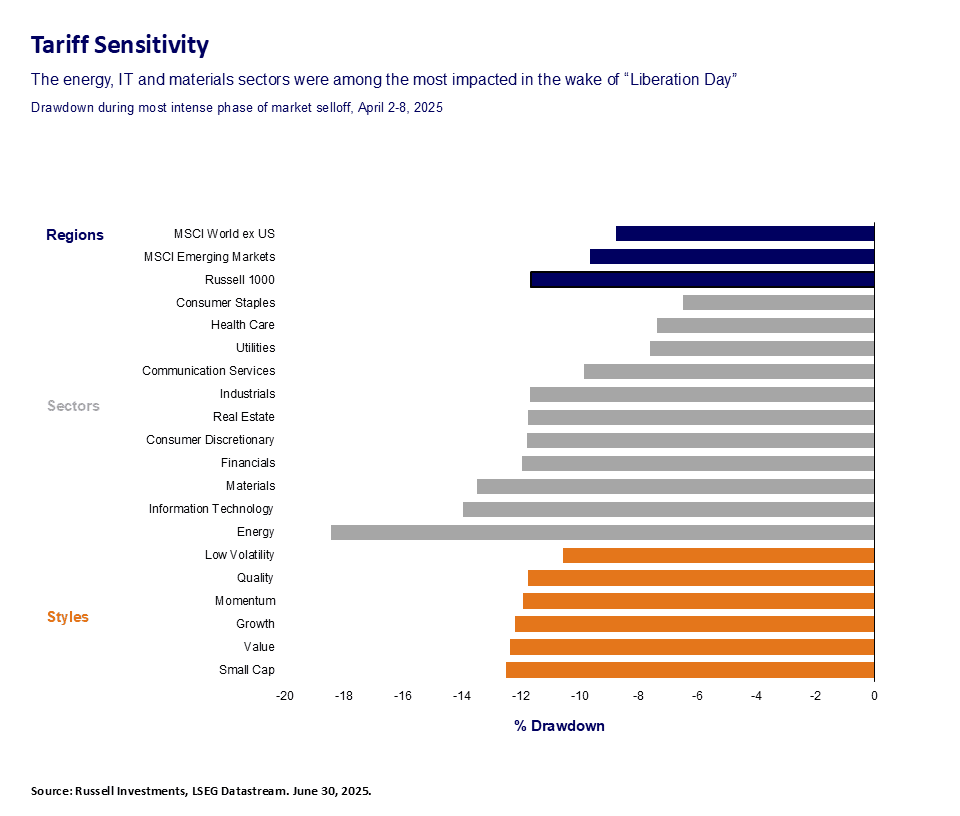
Practically, resilient fundamentals should allow markets to sustain new highs. We continue to advocate a “stay invested” approach with clients and the risk level in our portfolios is close to strategic targets. However, with the panic from early April now cleared, we expect the pace of forward returns to move back to normal levels.
Stay Invested, Stay Diversified
Still, our outlook is always subject to uncertainty, including the possibility that tariffs could move higher than we anticipate in the coming weeks. In this risk scenario, measured allocations to the low volatility style and an emphasis on global diversification could be useful to help smooth the ride in stock portfolios. Similarly, a small reduction in corporate credit would likely prove beneficial in fixed income, particularly now that investment-grade spreads have narrowed significantly.