


The investment opportunity extends well beyond AI developers. Companies that successfully use AI to improve productivity, expand margins, and redesign products and workflows may be positioned to outperform. Infrastructure providers and businesses enabling AI deployment also stand to benefit as adoption spreads across the broader economy.
Key takeaways:
- AI adoption is advancing rapidly, but labor-market adjustment remains gradual and uneven.
- Productivity gains are beginning to emerge before broad employment effects, supporting earnings growth and operating leverage.
- Labor-market pressure remains concentrated in hiring, early-career roles, and highly exposed white-collar occupations.
- The investment opportunity extends beyond AI developers to infrastructure providers and companies that successfully translate AI adoption into productivity gains and stronger margins.
A familiar technology cycle
Fears that technology will permanently displace workers are almost as old as the technologies themselves. During the internet era, many warned that information technology would reduce the need for labor and fundamentally reshape employment. Instead, productivity gains emerged first, new industries followed, and labor markets adapted over time. In 1995, U.S. nonfarm payroll employment stood at roughly 117 million jobs. Today, it exceeds 158 million, an increase of more than 40 million. 1
AI may be arriving faster than previous technological revolutions, but the early economic signals look surprisingly familiar. ChatGPT reached 100 million monthly users within two months of launch2, and AI is already used by 45% of U.S. workers, touching roughly 6% of total work hours.3 Despite the unique speed of adoption, AI appears to follow a familiar historical pattern of technology disruption. Broad technologies tend to diffuse through the economy in stages, with productivity gains emerging before payroll adjustments, infrastructure buildouts preceding widespread adoption, and benefits accruing first to adopters and complementary businesses.
For investors, the first phase of the AI cycle may be defined more by earnings dispersion than labor disruption. Early opportunities are emerging across firms that successfully convert adoption into stronger margins and productivity growth.
Productivity gains emerge before labor disruption
Productivity improvements often emerge before broader labor-market adjustments because firms need time to redesign workflows, train employees, and integrate new technologies into daily operations. Research from the St. Louis Fed finds that industries with higher AI adoption have experienced faster productivity growth without a corresponding decline in employment. A 10-percentage-point increase in worker AI adoption is associated with roughly 2.9% additional cumulative productivity growth since 2022. 4
Productivity growth remains one of the most important drivers of long-term economic potential and corporate profitability. As adoption expands, the upside to productivity may prove more significant than the downside risks currently associated with labor displacement.
Labor pressures remain concentrated
Despite growing concern around job displacement, aggregate employment remains resilient. U.S. nonfarm payrolls have increased from roughly 154 million at the end of 2022 to more than 159 million today.5 Official payroll data and alternative hiring indicators show that while hiring has cooled meaningfully from post-pandemic highs, there is no sign of sharp contractions typically associated with widespread labor displacement.
The labor market has stabilized
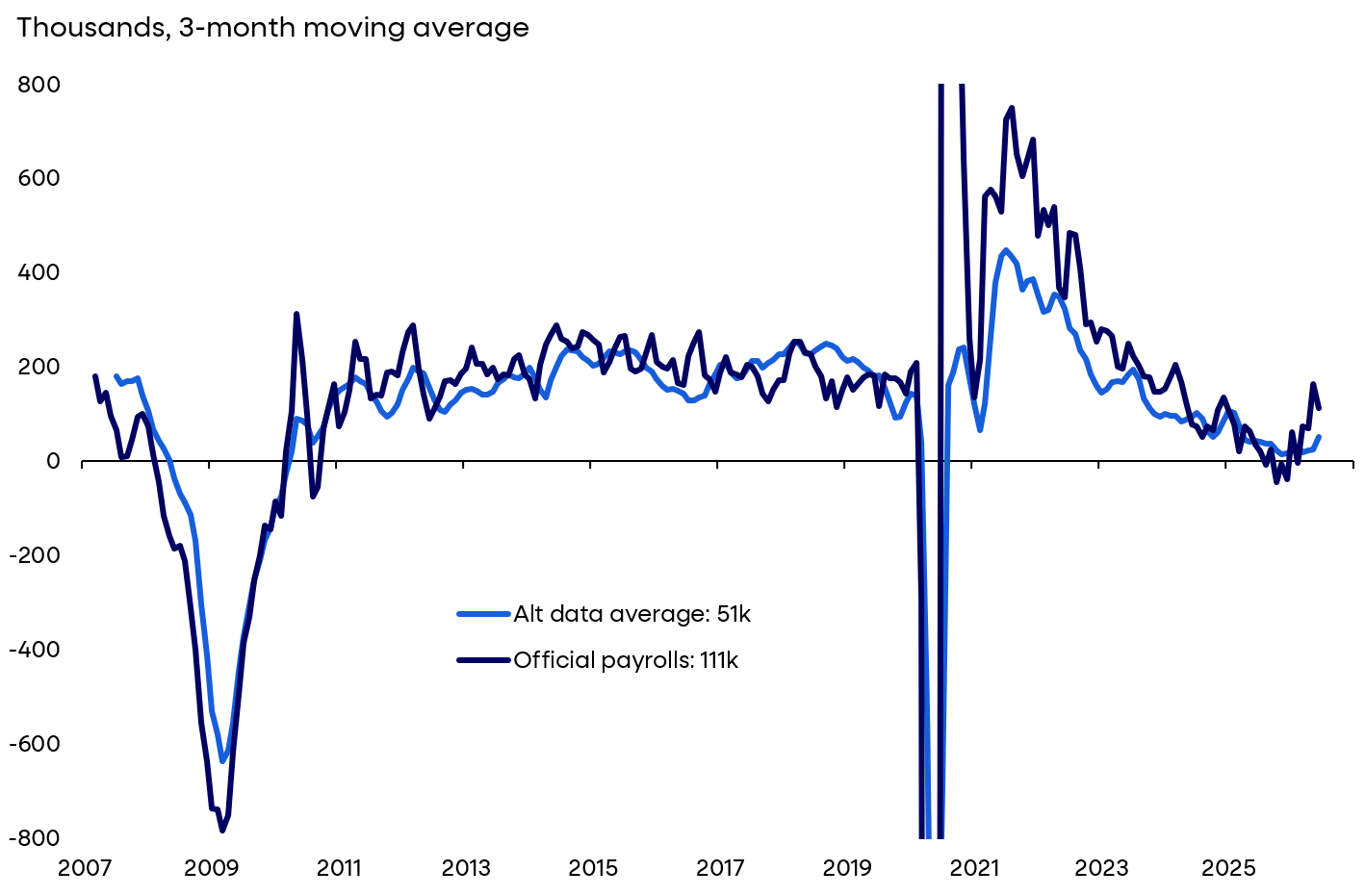
Source: Russell Investments, ADP, Revelio Labs, LinkUp, LSEG, Institute for Supply Management, S&P, Federal Reserve Banks of New York, Philadelphia, Dallas, Richmond, and Kansas City. June 2026.
AI's labor-market effects have also largely been concentrated in specific occupations rather than broad-based job losses. The greatest exposure is found in roles where AI can perform a meaningful share of day-to-day tasks. The most exposed occupations include software development, business and finance, legal services, administrative work, customer support, and other research-intensive functions. Physical occupations and skilled trades remain comparatively insulated because many of their core tasks are difficult to automate with current AI capabilities.
At the same time, a significant gap remains between what AI can theoretically do and how extensively it is used in practice. In computer and mathematical occupations, for example, AI capability approaches 94% of tasks, while observed workplace adoption remains closer to 33%6. Companies are still learning how to redesign workflows, operating models, and processes around the technology.
One area where labor-market pressures appear most concentrated is among younger workers entering the workforce, as hiring among workers ages 22 to 25 entering highly AI-exposed occupations is running 14.3% below its 2022 baseline.7 The widening gap between employment growth for junior and senior employees has accelerated, particularly since 2023, pointing to a labor market that favors established talent as AI adoption expands.
Employment differences between adopter and non-adopter firms over time
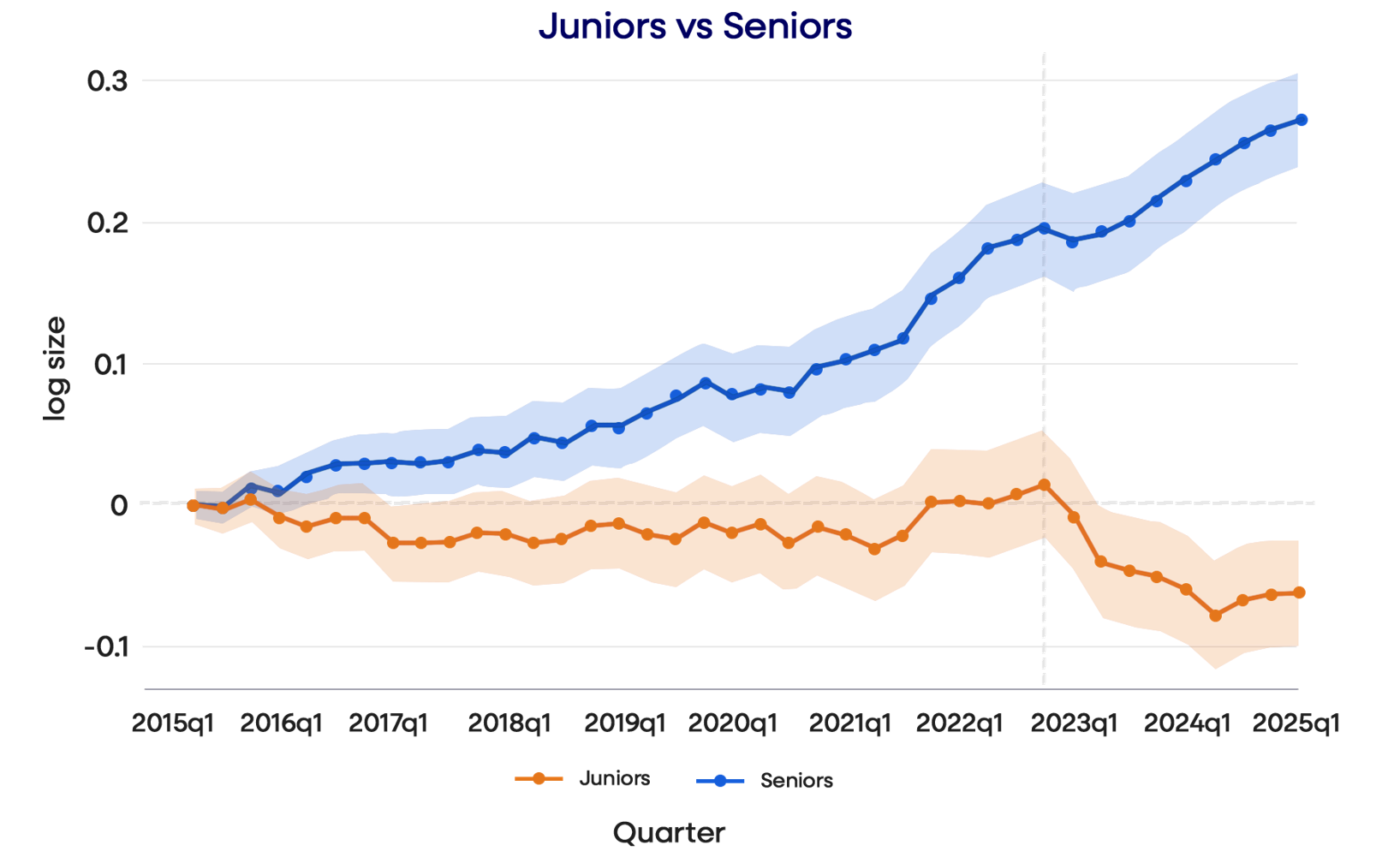
Source: Harvard University 8
AI is rewiring work
AI is changing work far faster than it is eliminating it. The biggest near-term impact may be on the composition of work rather than the size of the workforce. There are estimates that 40% of job skills will change by 2030 while employers expect a net increase of 78 million jobs globally.9
As AI takes over more routine cognitive tasks, the value of human work shifts toward judgment and oversight. Some jobs will disappear, many will change, and entirely new roles will emerge to build, govern, and deploy AI. The defining story of the next decade may be less about job loss than the rewiring of work itself.
There will also likely be a greater premium on hiring and retaining talent with complementary skills—creating wider performance gaps between companies that adapt quickly and those that do not.
Investor implications
It remains too early to draw definitive conclusions about AI's long-term impact on employment, but the early evidence suggests adjustment is occurring more gradually than many expected.
For companies, the opportunity extends beyond cost savings. The firms that successfully redesign products, workflows, and customer experiences around AI are likely to strengthen their competitive position and create lasting earnings advantages.
For portfolios, investors should look beyond AI developers alone. Opportunities will likely continue to emerge across the broader ecosystem and among companies that successfully embed AI into their businesses. Because adoption will vary widely, the biggest winners and losers are expected to emerge within industries, reinforcing the importance of active management and security selection.
1 https://fred.stlouisfed.org/series/PAYEMS
2 https://www.reuters.com/technology/chatgpt-sets-record-fastest-growing-user-base-analyst-note-2023-02-01/
3 https://www.genaiadoptiontracker.com/
4 https://www.stlouisfed.org/on-the-economy/2026/mar/mind-gap-ai-adoption-europe-us
5 https://fred.stlouisfed.org/series/PAYEMS
6 https://www.anthropic.com/research/labor-market-impacts
7 https://digitaleconomy.stanford.edu/app/uploads/2025/11/CanariesintheCoalMine_Nov25.pdf
8 Lichtinger, Guy and Hosseini Maasoum, Seyed Mahdi and Hosseini Maasoum, Seyed Mahdi, Generative AI as Seniority-Biased Technological Change: Evidence from U.S. Résumé and Job Posting Data (August 31, 2025). Available at SSRN: https://ssrn.com/abstract=5425555 or http://dx.doi.org/10.2139/ssrn.5425555
9 https://www.weforum.org/press/2025/01/future-of-jobs-report-2025-78-million-new-job-opportunities-by-2030-but-urgent-upskilling-needed-to-prepare-workforces/
Common client questions
AI is changing work faster than it is eliminating jobs. Productivity gains are emerging before broad labor-market disruption as companies redesign workflows and integrate AI into daily operations. Early impacts remain concentrated in hiring, entry-level positions, and highly exposed white-collar occupations rather than widespread job losses, suggesting a gradual adjustment similar to previous technology cycles.
AI exposure varies significantly across industries and occupations. Software development, business and finance, legal services, administrative work, customer support, and research-intensive roles face the greatest disruption because many of their daily tasks can be automated. Physical occupations and skilled trades remain comparatively insulated, while differences in adoption are creating wider performance gaps within industries.
AI adoption is unlikely to benefit every company equally. Differences in execution, investment, and organizational change are creating wider earnings dispersion both across and within industries. That increases the importance of active management and security selection to identify companies that convert AI adoption into durable productivity gains and competitive advantages.