

Key takeaways
- Starting Dec. 6, U.S. equities are expected to move closer to a 23-hour, five-day trading market. Institutions will have a longer window to respond to portfolio changes outside the core session.
- Liquidity will vary throughout the extended trading day. Differences in market depth and spreads will affect how much institutions can execute and at what cost.
- Institutions should prepare for after-hours access before they need it. That includes establishing how they will access overnight liquidity and who can authorize a trade.
When will near-continuous trading begin for U.S. equities?
Starting December 6, 2026, Nasdaq and NYSE Arca will officially launch extended trading sessions, expanding U.S. stock trading to up to 23 hours a day, five days a week.
U.S. equities attract investors worldwide, yet the core trading session remains tied to the U.S. business day. For institutions in Asia-Pacific, much of that session falls outside local working hours. Expanded access could allow those investment teams to trade U.S. equities during more of their own business day. The Securities Information Processor (SIP), which consolidates prices and trade information from U.S. exchanges to provide a unified view of the market, is extending its operating hours, making consolidated market data available during overnight trading. Changes to clearing infrastructure will support the processing of those trades. Together, these developments will support a 23.5-hour weekday market.
A fully 24-hour market would require further changes. The planned schedule retains a one-hour daily pause from 8 p.m. to 9 p.m. ET, while weekend trading still faces settlement constraints.
Recent markets show how quickly execution conditions can change. Russell Investments' 1H 2026 Global Trading Report found that market depth and execution windows changed as investors responded to policy uncertainty, the Iran conflict and major capital-markets events such as the SpaceX IPO. For large allocators, trade timing affected the liquidity available to implement portfolio changes. Longer trading hours create more opportunities to act during these events, but investors will still need to determine whether available liquidity can support the order.
Will overnight markets offer enough liquidity for institutional orders?
Liquidity will vary throughout the extended trading day, making some overnight windows more suitable for institutional orders than others. Futures and foreign-exchange markets provide a useful comparison: both trade across much of the day, yet market depth and participation vary by trading window.
Opening and closing auctions are likely to remain important sources of liquidity and reference prices. Outside those periods, available depth will vary by security, time of day and market participation. Overnight liquidity may also be spread across exchanges and alternative trading systems (ATSs), making connectivity and order routing important to accessing liquidity across venues. As regulated exchanges expand overnight trading, institutions will also need to understand which market safeguards apply outside the core session, including trading halts and price-limit mechanisms. For institutional orders, the quoted price is only one consideration. Market depth and spreads determine how much can be executed without materially moving the price and at what cost.
Current overnight activity remains small relative to the core market. In August 2026, the overnight session represented 0.9% of NMS share volume and 0.8% of dollar volume on an average trade date.
Figure 1. Average daily U.S. equity share volume by session
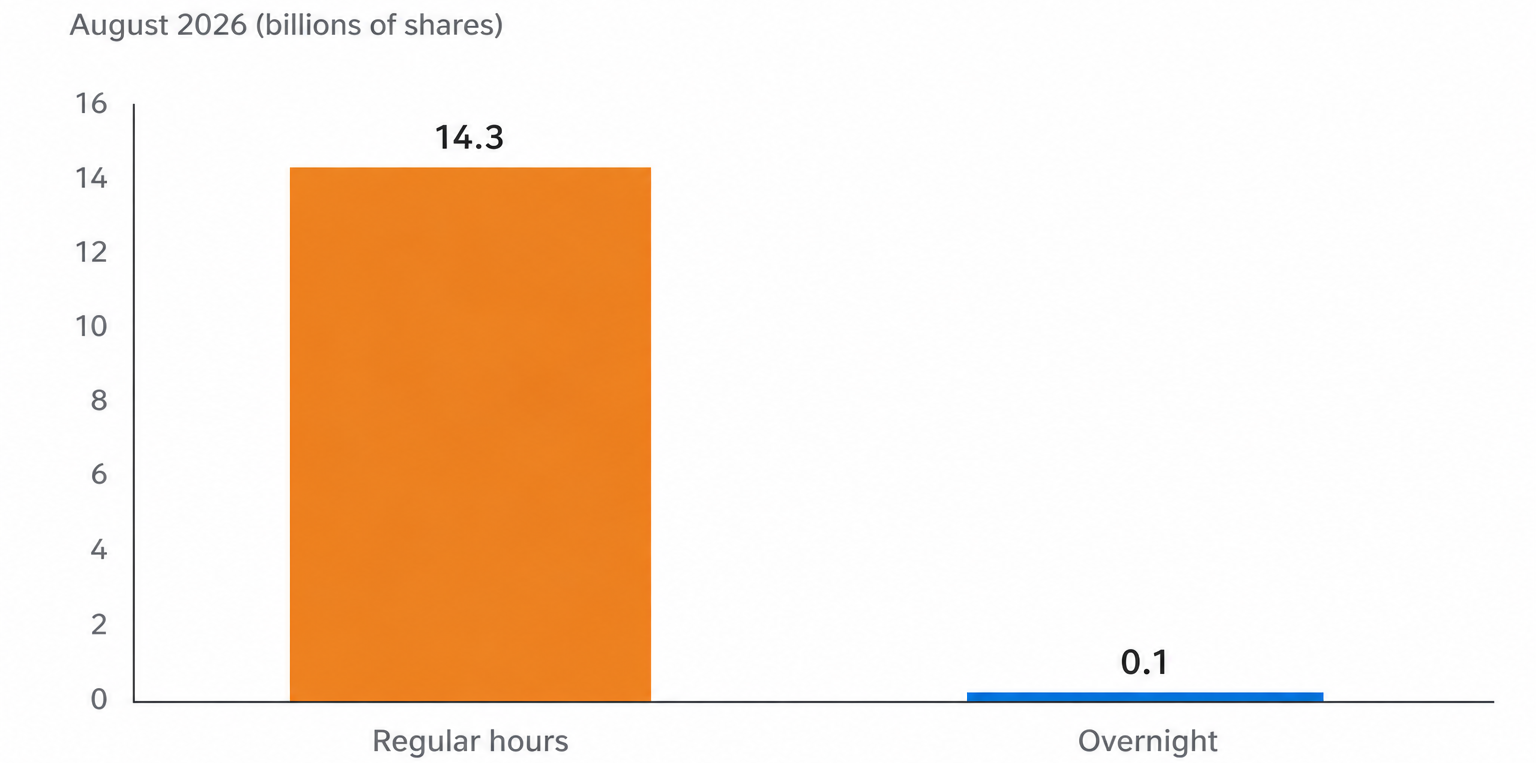
Source: U.S. Securities and Exchange Commission, September 2026.
Institutions should weigh the cost of executing in those conditions against the portfolio risk of waiting. If an event after the U.S. close creates an unwanted exposure, overnight execution may reduce that risk sooner; limited depth or wider spreads may instead favor waiting for the core session. Overnight prices can also provide information even when an institution does not trade, showing how the market is pricing new developments between the traditional close and open.
How should institutions approach overnight execution?
For most institutions, preparing for overnight execution will mean having access when needed, rather than staffing an internal trading desk around the clock. Many institutions may continue to execute primarily during traditional U.S. hours while maintaining overnight coverage for specific securities or events. The SEC's recent roundtable on 24-hour trading highlighted broker-dealer readiness, staffing, systems resiliency and investor protections among the issues firms are addressing as overnight trading expands.
Institutions that rely on external trading providers should understand which overnight venues they can access and how orders will be routed when liquidity is dispersed. As exchanges and ATSs develop connections across overnight markets, a provider's ability to access available prices across venues could affect execution quality . Electronic execution also needs to account for differences in participation and market depth, while best-execution obligations remain regardless of the hour.
Institutions should establish trading authority before an overnight event requires action. Execution review may need to account for liquidity conditions that differ from the core session.
When is trading overnight worth the cost?
Trading overnight may make sense when the portfolio risk of waiting for the core session outweighs the higher expected cost of executing in thinner liquidity.
An event after the U.S. close can change an institution's desired exposure before deeper liquidity returns. Wider spreads and limited depth can increase the cost of acting immediately, while waiting leaves the portfolio exposed to further price movement.
The relevant comparison is specific to the order and portfolio: the expected cost of executing now versus the potential consequence of maintaining the exposure until deeper liquidity returns. For many investors, that may mean concentrating most execution during the core session while maintaining overnight access for situations where earlier action is justified.
What should institutions ask of their trading providers?
The ability to maintain coverage outside the core session and access liquidity across overnight venues will be important considerations when evaluating trading providers. Beyond market access, investors need to understand how a provider assesses execution quality when available liquidity cannot accommodate the full order at the quoted price. That includes deciding whether to execute immediately, work an order over time or wait for deeper liquidity.
The appropriate level of support will depend on the institution's trading needs. Occasional event-driven activity may require limited overnight coverage, while global portfolios or strategies with more frequent exposure changes may benefit from broader access.
Investor implications
Institutions can prepare for longer trading hours even while overnight liquidity is still developing. Investment teams can establish the conditions under which they would consider an overnight trade and confirm that their execution arrangements can support it.
For many investors, the core U.S. session may remain the primary execution window. Having an established process allows them to respond when an event changes the portfolio's desired exposure outside traditional market hours.