


A company's benchmark weight is generally determined by its float-adjusted market capitalization, which reflects only the shares available to public investors. As a result, companies with larger investable share bases can have a greater influence on benchmark performance than headline valuations alone might suggest. As additional shares become available after an IPO, benchmark weights can increase even if the company's overall valuation remains unchanged.
Key takeaways
- The next generation of AI-related IPOs could materially increase concentration in major growth benchmarks, even if valuations remain below SpaceX's estimated market value.
- Free float, rather than headline valuation alone, is likely to determine the size of initial benchmark weights and subsequent index influence.
- As investable shares expand over time, benchmark concentration may increase through multiple index rebalances instead of occurring solely at the IPO date.
- Growing exposure to a small group of AI companies could create new portfolio construction and implementation considerations for benchmark-aware investors.
Free float, not valuation, drives benchmark impact
SpaceX's earnings and the expiration of its first lockup this week underscore why free float matters as much as valuation. The next wave of AI IPOs could reshape major equity benchmarks by increasing both exposure to generative AI and market concentration.
Anthropic and OpenAI are both expected to pursue public listings, as early as the fourth quarter of 2026. Their most recent private funding rounds valued the companies at approximately $965 billion and $852 billion (as of July 20), respectively, but their eventual IPO valuations could be closer to $1 trillion. While still below SpaceX’s roughly $2 trillion valuation, both companies could make a larger proportion of their equity available to public investors.
Because major equity indexes are weighted by float-adjusted market capitalization, the proportion of shares available to public investors can have as much influence on benchmark weight as a company's overall valuation, secondary sales or future capital raising. The recent FTSE Russell reconstitution demonstrated how changes in benchmark methodology and constituent weights can alter portfolio exposures. The next wave of AI IPOs could introduce another source of benchmark change, driven by expanding public float rather than style reclassification.
Free float % of market cap
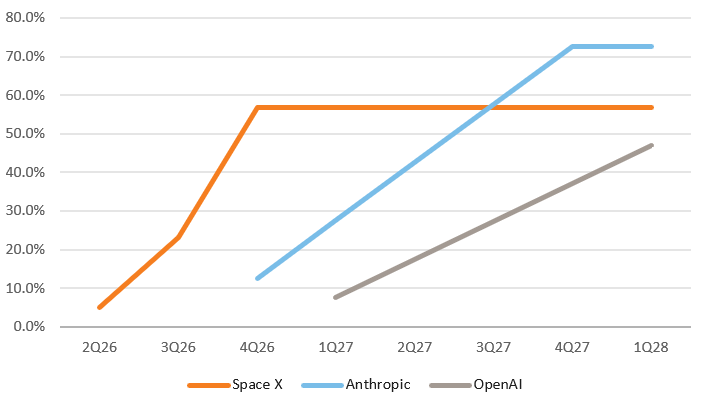
*Timing assumption: Anthropic lists in the fourth quarter of 2026 and OpenAI in the first quarter of 2027
Source: Russell Investments
Benchmark concentration could build over time
Although the initial free floats of Anthropic and OpenAI have not been finalized or disclosed by management, both could expand materially after listing as employee and investor lockups expire and additional shares become available through secondary sales or future capital raising. Anthropic’s estimated initial free float of 10%–15% could be roughly two to three times SpaceX’s initial 4%–5%, while OpenAI’s estimated 5%–10% could be as much as twice as large. The result could be greater benchmark exposure to generative AI alongside a further increase in concentration across major growth indexes.
If Anthropic reaches a free float of approximately 70%–75%, assuming sizable holdings by Google, Amazon, founders, and governance-related entities remain outside the investable share base, its benchmark weight could increase materially over time. OpenAI’s free float may be lower. If the substantial stakes reportedly held by Microsoft and the OpenAI Foundation remain strategic, its broadly investable float could be capped at approximately 47%.
As free float expands, the companies' float-adjusted market capitalizations and benchmark weights would rise even if their overall valuations remained unchanged. Index concentration would therefore likely build over multiple rebalancing events rather than occur entirely on the listing date.
By early 2028, SpaceX, Anthropic and OpenAI could collectively represent approximately 3.0% of the Russell 1000, 5.6% of the Russell 1000 Growth Index, and 2.5% of the MSCI World Index under the illustrative assumptions shown. The impact would be especially pronounced in growth benchmarks, where Anthropic and OpenAI could receive substantial allocations if classified predominantly as growth companies.
Benchmark weight
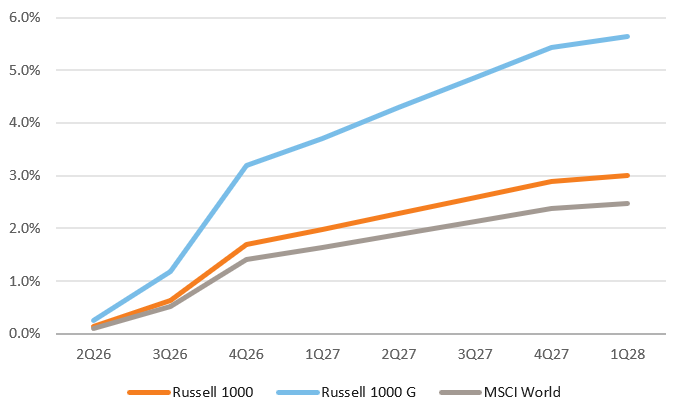
*Note: The illustration assumes the latest private-market valuation, where changes reflect only the estimated increase in free float for SpaceX, Anthropic and OpenAI collectively.
Source: Russell Investments
Growth benchmarks face the greatest concentration risk
As their investable floats expand, the new AI IPOs would also dilute the weights of existing constituents. The concentration implications could be particularly significant for the Russell 1000 Growth Index, where Information Technology now represents roughly half the index, compared to just 20% a decade ago.
Technology’s rising share of the Russell 1000 Growth Index
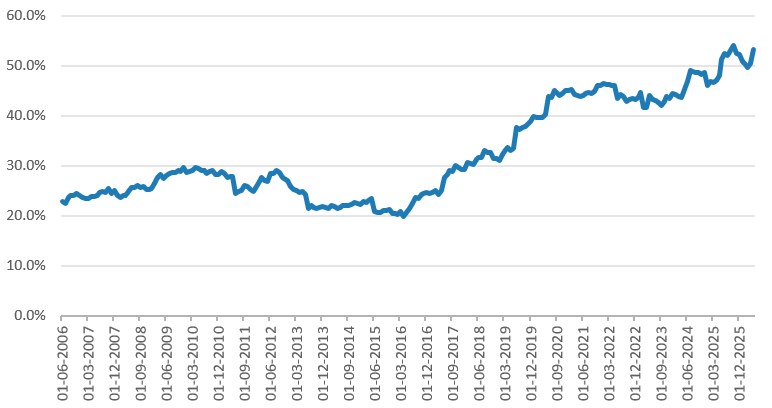
Source: Russell Investments
A combined IPO weight of 5 – 6% from Anthropic and OpenAI would, all else equal, reduce the collective weight of existing constituents by the same amount, further compressing the representation of other sectors. Active large-cap growth managers appear to be responding by looking beyond the benchmark’s largest technology holdings. Aggregate positioning has moved from a modest Information Technology underweight in 2018 to a materially larger underweight today, while exposure to Industrials has shifted from underweight to overweight and the Real Estate underweight has narrowed. This positioning is consistent with managers seeking exposure to a broader set of AI beneficiaries, including the industrial equipment, electrical infrastructure, data-center and property-related businesses supporting the buildout.
Large cap growth managers are broadening beyond technology
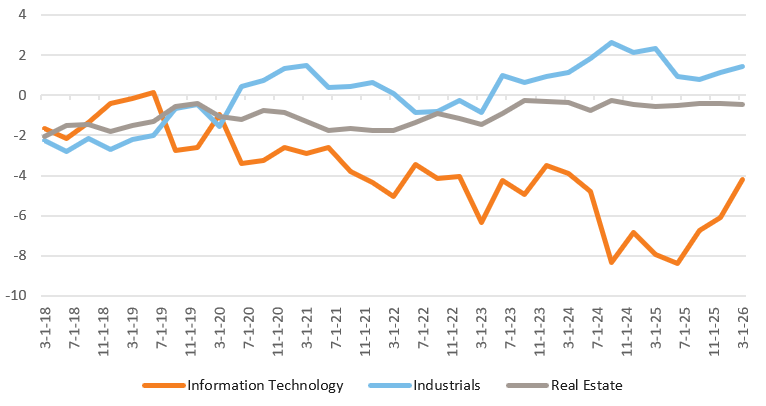
Source: Russell Investments
The benchmark could therefore become increasingly dependent on a common set of AI investment, capital-spending and valuation drivers, while active portfolios seek to capture the same theme through a wider range of companies. For active managers, that creates opportunities to differentiate through exposure to infrastructure and second-order beneficiaries. For benchmark-oriented investors, it increases dependence on a smaller group of mega-cap companies and common return drivers.
Investor implications
Large AI IPOs could reshape benchmark composition over time as investable share bases expand and index weights adjust through successive rebalancing events. For benchmark-aware investors, that creates an opportunity to reassess whether growing exposure to a concentrated group of AI companies remains aligned with portfolio objectives and risk budgets. Where concentration becomes a concern, implementation tools such as index overlays or completion strategies can help manage unintended exposures while preserving the benefits of a benchmark-oriented investment approach.
Common client questions
Large AI IPOs could increase concentration in growth benchmarks as they are added to major indexes and their public floats expand over time. That could increase exposure to a relatively small group of AI-related companies while reducing the relative weight of existing constituents, making benchmark returns more dependent on a narrower set of economic and earnings drivers.
Both active and benchmark-oriented investors could be affected, although in different ways. Active managers may need to take larger relative positions to differentiate from increasingly concentrated benchmarks, while benchmark-oriented investors may wish to evaluate whether evolving benchmark exposures remain aligned with their portfolio objectives and risk parameters.
Managing benchmark concentration does not necessarily require changing a core investment strategy. Depending on investment objectives, implementation tools such as index overlays, completion strategies, or active extensions can help manage unintended concentrations while maintaining broad benchmark exposure and overall portfolio alignment.