Our extensive manager research, scale, infrastructure, and industry experience enable Russell Investments to secure favorable capacity terms well in advance for our clients.
Unlisted infrastructure
Unlock opportunities and expand new horizons
What is unlisted infrastructure investing?
Infrastructure is the backbone of our society. It provides the essential services that we rely on every day, such as transportation, connectivity, energy, water, and sanitation. Infrastructure also plays a vital role in economic growth and development.
However, unlisted infrastructure remains underutilised as a diversifier. Traditional asset classes like equities and fixed income play crucial roles but are more susceptible to broader market volatilities and may be supplemented to meet the long-term return objectives of investors.
The global infrastructure landscape is diverse, encompassing transportation, utilities, and social infrastructure. Unlisted infrastructure within the broader infrastructure sector has a valuation surpassing $10 trillion and is expected to experience substantial growth. Key drivers include the need for enhanced energy efficiency, rising data demands, challenges in digital communications from changing work and lifestyle dynamics, and evolving demographics.

Benefits of investing in unlisted infrastructure

Diversification
As a real asset category, infrastructure offers a distinct risk, return, and diversification profile relative to other asset classes, and thus merits consideration for a discrete allocation in a diversified portfolio.

Income generation
Infrastructure investments typically feature steady cash flows derived from tangible, long-life assets with monopoly-like pricing power; many are regulated and may feature income linked directly to inflation.

Long-term return potential
Secular growth trends in renewables, digital and social. Business models that are effective at harvesting these long-term trends are difficult to access in the listed market.
Risk management
Managing risk across vintages and profiles
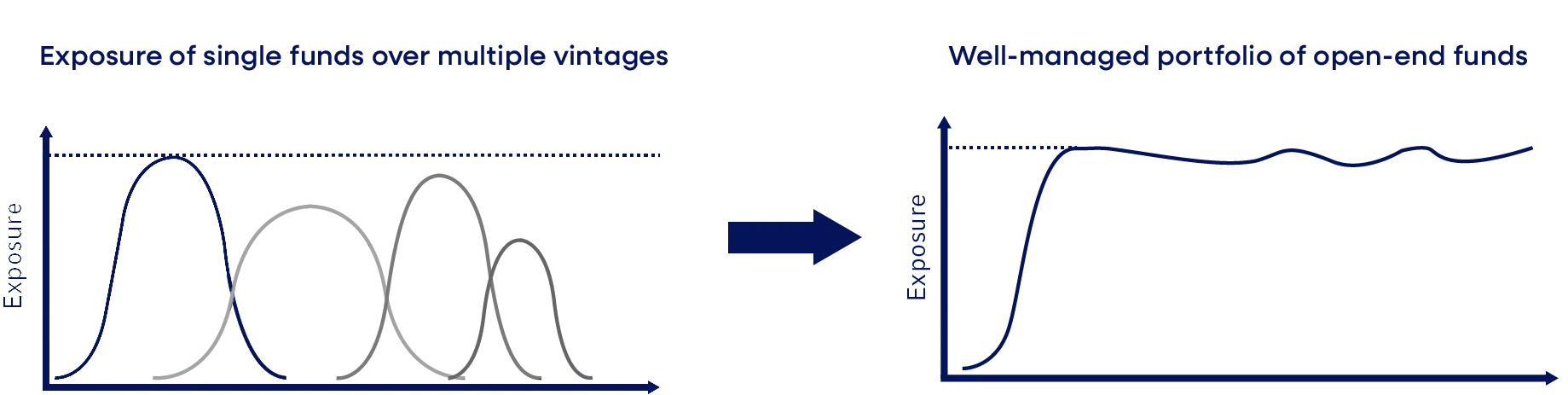
Creating an unlisted infrastructure portfolio requires investors to maintain the designated exposure in capital and strategic allocations. Closed-end funds, commonly used for this purpose, present challenges due to their fixed legal duration. Navigating commitments, predicting capital calls and distributions is complex, especially with unpredictable business scenarios and blind pool commitments. Closed-end funds' continuous asset changes disrupt portfolio diversification metrics, necessitating ongoing oversight. Conversely, an open-end fund structure provides a streamlined and less complex approach, alleviating these challenges.
Why Russell Investments for unlisted infrastructure?
For 50+ years, Russell Investments has adeptly integrated private markets into institutional portfolios. Our robust governance culture, consulting legacy, and fiduciary mindset ensure that tailored solutions align with client returns, risk preferences, and regulatory obligations
Utilizziamo analisi approfondite e competenze specialistiche per costruire portafogli che includono fonti di rendimento diversificate, creano valore e riducono al minimo il rischio di perdite. Collaboriamo con gestori specializzati in strategie distintive e difficili da replicare.
Types of unlisted infrastructure assets

Our unlisted infrastructure solution
Russell Investments Global Unlisted Infrastructure Fund
The Global Unlisted Infrastructure Fund invests in assets that provide essential services to enable, sustain or enhance economic activity and standards of living, such as Renewables, Digital, Social Utilities, Transportation, and Energy.
Unlisted infrastructure videos
Russell Investments' Chairman and CEO, Zach Buchwald sits down for a conversation with Michael Steingold, CFA, Director of Private Markets, to get his perspective on how we're investing in infrastructure and its impact to our daily lives if we invest now.
Part 1: Infrastructure projects that will help create a more renewable world
Part 2: How investing in infrastructure now, will impact our daily lives in the future
Frequently-asked questions
Unlisted Infrastructure investments are suitable for both individual and institutional investors seeking portfolio diversification, income stability, and exposure to long-term assets.
Unlisted infrastructure investments often involve long-term contracts, concession agreements, or regulatory frameworks that provide a degree of revenue predictability, contributing to stable returns.
Unlisted infrastructure investments often exhibit lower volatility, have longer investment horizons, and generate steady income streams compared to the more fluctuating returns of stocks and bonds.
Investing in unlisted infrastructure can be beneficial as it offers the potential for stable returns, long-term income streams, and the opportunity to contribute to critical developments that benefit society.
Unlisted infrastructure investing involves allocating capital to projects or assets that support essential services and physical structures such as transportation, utilities, energy, communication, and social infrastructure.
Unlisted infrastructure assets include toll roads, bridges, airports, ports, power plants, water utilities, renewable energy projects, telecommunications networks, and social infrastructure like schools and hospitals.
Investing in unlisted infrastructure assets can provide a hedge against inflation, low correlation with traditional asset classes, and exposure to essential services that are less sensitive to economic cycles.
Explore more alternative investment strategies
For investment solutions that are built to deliver your desired outcomes, access our innovative range of multi-asset products to address your portfolio needs.

Any opinion expressed is that of Russell Investments, is not a statement of fact, is subject to change and does not constitute investment advice.
The value of investments and the income from them can fall as well as rise and is not guaranteed. You may not get back the amount originally invested.
There are no assurances that the investment goals and objectives stated in this material will be met.
Investments in private market securities are generally illiquid as such investments are neither tradable on any exchange or in the secondary market nor would they be transferrable.
Applications for shares in the fund are subject to the terms and conditions set out in the fund’s prospectus, Key Investor Information Document (KIID), memorandum and articles of association. Investors and potential investors are advised to read these documents (and in particular the risk warnings), as well as the further information contained in the annual and half-yearly reports before making an investment.
