



The dollar has recently behaved like a safe haven, particularly during geopolitical shocks that benefit the U.S. economy, such as energy disruptions. However, this role is becoming more conditional and may not hold in all scenarios.
Key Takeaways:
- Recent U.S. dollar strength reflects cyclical forces like geopolitics and energy, not a full structural reset
- The dollar’s safe-haven role is becoming more conditional, not universally reliable
- For investors, this reinforces the case for reviewing hedge ratios and considering more dynamic approaches, as short-term dollar strength can persist even within a longer-term weakening trend
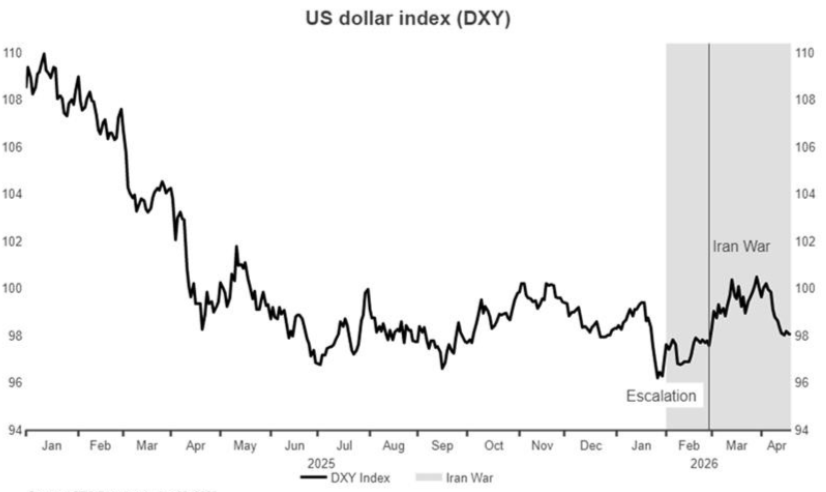
For much of 2025, the U.S. dollar looked vulnerable: expensive, less supported by the exceptionalism narrative and heading toward a weaker regime. Then the war in the Middle East changed the picture. Energy prices rose, risk sentiment shifted and the dollar reclaimed its safe-haven role.
For investors this raises a key question. Is this a temporary, conflict-driven move or is the dollar back for good? We address this question through three lenses: macro, FX management and FX trading.
U.S. dollar rebounds
Source: LSEG Datastream, Apr 20, 2026
Macro: a stronger dollar, but not a clean break
The recent rebound in the U.S. dollar reflects cyclical forces more than a lasting regime change. Higher oil prices, geopolitical risk and the U.S. position as a net energy exporter have all supported the dollar in the short-term even as rate spreads have moved against it.
However, the structural picture has not changed materially. The dollar remains expensive on valuation and longer-term forces still point toward a gradual weakening over time. Fiscal deficits remain elevated, capital flows are evolving and the global system is slowly adjusting. Questions around oil invoicing, defense spending and the allocation of capital outside the U.S. may all reduce demand for dollar assets over time.
While the dollar has clearly shown it still has defensive qualities, those qualities now appear more conditional than universal. In some shocks, especially those that benefit the U.S. as an energy producer, the dollar can strengthen sharply. In others, it may not offer the same protection as it once did.
FX management: flexibility matters
The more conditional dollar backdrop is already influencing investor behavior. We have seen some non-U.S. investors increase their U.S. dollar hedge ratios over the past year and interest in dynamic currency hedging has also grown.
For many institutional investors, the purpose of a passive currency hedge is to reduce portfolio volatility, yet that relies on assumptions about the future correlation between the dollar and global risk assets. If that relationship is changing then the hedge ratio that once looked sensible may no longer be optimal.
That is why dynamic hedging is attracting attention. Rather than using fixed hedge ratios, dynamic approaches adjust exposures over time in response to shifting market conditions. For investors who believe the long-term dollar trend may be lower but also expect periods of sharp dollar strength and higher volatility, this offers a more adaptive way to manage currency risk.
FX trading: execution discipline is part of the edge
When currency markets grow more volatile, execution becomes critical. This holds true whether an investor is hedging currency exposure, repatriating capital, investing in international assets, or using FX as a source of return.
Periods of stress can quickly widen bid-ask spreads and reduce liquidity. During COVID, for example, market conditions deteriorated dramatically and execution became much more difficult. The lesson from those environments is that cost and discipline are inseparable from performance.
In volatile markets, effective execution depends on access, process and judgment. Smaller trade clips, careful timing, broad counterparty relationships and active liquidity sourcing all become critical, as well as minimizing information leakage and preserving anonymity for the client.
Investor implications
The dollar is back in one sense. It has shown that it can still behave like a safe haven when geopolitical shocks hit. However, that doesn’t mean the long-term structural case for a weaker dollar has disappeared. Valuation remains stretched, fiscal pressures persist and capital flows continue to evolve.
For investors, the implication is not to make a binary call on the dollar but to stay flexible. That means thinking carefully about hedge policy, considering dynamic approaches where appropriate and paying close attention to execution quality.
The dollar may be stronger today than it looked before the war, but the bigger lesson is that FX regimes can change quickly and portfolios need the tools to adapt with them.
Common client questions
In the short term, the dollar can strengthen during periods of risk aversion or geopolitical. Over the long term, structural factors such as valuation, fiscal deficits and shifting global capital flows still point toward a gradual weakening trend.
Rather than relying solely on static hedge ratios, investors may want to consider more flexible approaches such as dynamic currency hedging. Combining this with strong execution discipline can help manage volatility and capture opportunities in a more uncertain FX environment.
Any opinion expressed is that of Russell Investments, is not a statement of fact, is subject to change and does not constitute investment advice.