

Key takeaways
- Timing in equity markets is not one decision. It means different things at long-term, medium-term, and short-term horizons.
- For long-term investors, timing is mainly about discipline, rebalancing, and risk governance, not repeatedly calling market tops and bottoms.
- At medium-term horizons, timing is more often about factor, style, and exposure management within the equity portfolio.
- At short-term horizons, timing becomes an implementation exercise: liquidity, market impact, capacity, and trading costs can determine realised outcomes.
- The most effective timing decisions sit inside a broader portfolio management framework with clear objectives, risk budgets, implementation tools, and review rules.
When investors talk about equity market timing, what often comes to mind is the idea of buying low and selling high. In practice, that means deciding when to increase or reduce equity exposure, identifying when markets appear overextended, and recognising when risks are beginning to build.
Recent geopolitical events have prompted investors to ask these questions. In uncertain environments, markets can reprice rapidly as new information emerges, tempting investors to react. Yet this view of market timing is often too simplistic. It assumes timing is a single decision based on predicting the next market move, when in practice investors face very different timing decisions depending on their objectives, time horizon and implementation approach.
This article argues that the more useful question is not whether market timing works, but what is being timed, over what horizon and for what purpose. By distinguishing between long-, medium- and short-term timing decisions, investors can better understand where timing can add value and where its limitations lie.
Why time horizon matters
Market timing in equity can be understood on at least three levels.
- The first is timing within long-term investing, which focuses on low-frequency adjustments to overall equity exposure or core allocations.
- The second is medium-term timing, which often involves dynamically adjusting portfolios’ factor exposures such as value, growth, quality, momentum, and low volatility.
- The third is timing in short-term trading, which is more concerned with entry and exit points, execution pace, and the efficiency with which signals are translated into realised returns.
Importantly, the word ‘timing’ can mean very different things across different investment horizons, with investors frequently referring to fundamentally different investment decisions.
Market timing in long-term investing
In long-term investing, the primary drivers of equity returns are corporate earnings growth, the long-term alignment between valuations and fundamentals, and the accumulation of compounding. The greatest risk is often not a single short-term drawdown, but the decision to exit during volatility, and miss the recovery that allows compounding to resume.
Taking the United States as an example, historical data over the past 125 years show that U.S. equities have significantly outperformed U.S. bonds, gold, and cash over the long term.
Evidence of the long-term equity risk premium
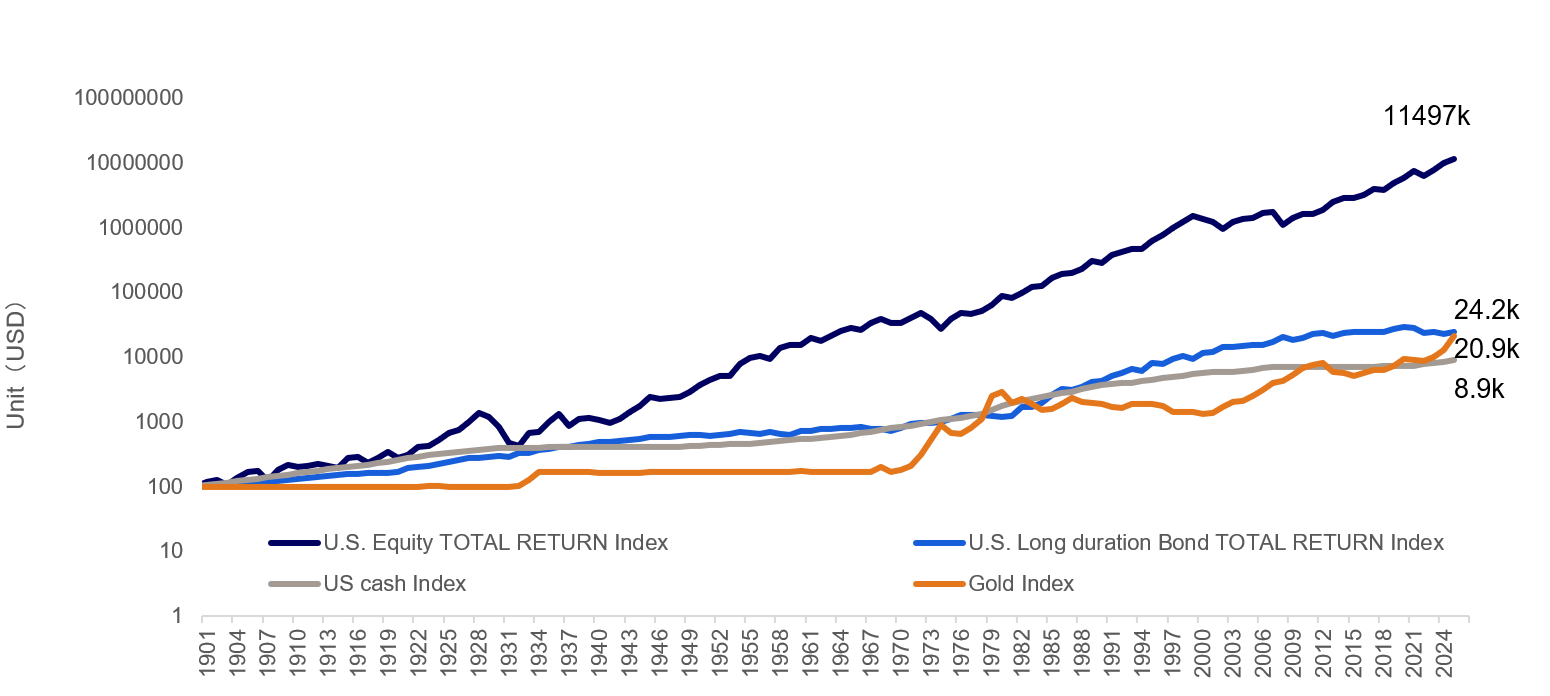
Data sources: DMS, IMF, S&P, WIND, CMI Gold & Silver, and Russell Investments. Data as of December 2025
Note: All asset-class indices use 1900 as the base year, with index values rebased to USD 100 in that base year. For U.S. equities, the index from 1900 to 2002 is based on the U.S. equity index calculated by DMS, while the 2002–2025 period uses the S&P 500 Total Return Index. The U.S. bond index is based on the U.S. bond index calculated by DMS and the S&P U.S. 10-Year Treasury Bond Index. The cash return index is calculated by compounding U.S. short-term interest rates, using U.S. short-term 3-month Treasury bill rates calculated by DMS, as well as data from the IMF and WIND databases. Gold data are sourced from CMI Gold & Silver and the WIND database.
When viewed through a traditional interpretation of market timing, the nature of returns in long-term investing suggests that timing might not have a significant role to play, as the focus is on remaining invested. However, there are several investment frameworks that define the role of ‘timing’ in different ways, making it a valuable consideration for investors.
- A valuation-led active framework. This approach uses timing through the discipline of price versus value. It does not rely on short-term market forecasts, but allocates capital in a contrarian way, making bets when valuations deviate significantly from fundamentals or when market sentiment becomes extreme.
- Specialists in passive investment strategies represent another long-term investment philosophy. Within this framework, timing is usually not a core source of return, with disciplined rebalancing being far more important. The priority is not making more frequent judgments, but making as few mistakes as possible due to emotion and trading impulse.
- Russell Investments applies a total-portfolio approach that combines strategic asset allocation with dynamic portfolio management and risk oversight. Within this framework, timing is not an objective in itself, but one component of portfolio governance, used to support long-term investment objectives and risk boundaries.
Although these approaches express timing differently, they share a common principle: long-term investors should not treat timing as a recurring attempt to forecast short-term market direction. Its more defensible role is disciplined, low-frequency adjustment within a strategic framework—using valuation, rebalancing and risk budgets to keep the portfolio resilient across market cycles.
Timing over a medium-term horizon
Compared with long-term market timing, “getting the direction right” tends to play a more important role in medium-term timing decisions. For most institutional investors, medium-term timing is not about making binary market calls. Rather, it is about dynamically adjusting portfolio positioning in response to evolving market conditions.
Medium-term timing for institutional investors involves calibrating the appropriate style biases and factor tilts within the portfolio. Instead of rotating between “risk-on” and “risk-off,” the emphasis is on identifying which styles, factors, or segments within the same asset class are likely to be most rewarded under the prevailing macroeconomic and market environment.
The appeal of factor timing rests on at least three foundations:
The first is interpretability. Factors such as value, growth, quality, momentum, and low volatility typically correspond to relatively clear economic concepts, and their long-term effectiveness has been repeatedly validated in academic research.
The second core foundation is persistence. Overall market direction is often heavily influenced by exogenous factors and is therefore extremely difficult to predict. By contrast, the relative strength among equity styles can sometimes exhibit greater persistence.
The third foundation is implementability. Compared with increasing or reducing exposure to the market, dynamic adjustment at the factor level is more like structural optimization within the portfolio. The path is often smoother and easier to incorporate into institutional investment processes.
Turning factor insights into portfolio decisions
Successful factor timing needs a disciplined process that combines three complementary approaches:
- Macro signals: Assessing growth, inflation, interest rates and liquidity to identify which factors are likely to benefit from the current market environment.
- Quantitative signals: Using data such as valuations, momentum, volatility and crowding to identify attractive or overstretched factor exposures.
- Fundamental analysis: Evaluating company profitability, balance sheets and cash flows to determine which investment styles are best supported by underlying fundamentals.
No single approach is sufficient on its own. The three approaches have different limitations. Macro signals operate through long and sometimes unstable transmission channels. Fundamental views may take time to be reflected in relative performance, and quantitative signals can be eroded by turnover, transaction costs, crowding, market impact and out-of-sample decay. Effective factor timing therefore requires understanding not only signals, but validation, implementation constraints and having an explicit process for managing model failure and drawdowns.
At Russell Investments, factor timing is used in two ways. First, it helps capture tactical opportunities by adjusting factor exposures as market conditions evolve. Second, it supports portfolio completion, using factor exposures to complement high-conviction active managers, reduce unintended style biases and improve overall portfolio resilience.
Timing in short-term trading
Market timing in the short term holds the closest resemblance to traditional views on market timing. Short-term returns are driven less by long-term fundamentals and more by sentiment, news, fund flows, positioning and market dynamics. As a result, success depends on timing, execution and the ability to capture short-lived opportunities.
Institutional investors typically use two approaches:
- Discretionary trading: Human decision-making based on market experience, macro views, technical analysis and investor sentiment.
- Systematic trading: Quantitative models that identify opportunities using data, statistical signals and algorithmic execution.
In practice, many investors combine both, using quantitative models to generate ideas while applying human judgment to portfolio construction and risk management.
Systematic strategies tend to have the advantage over shorter time horizons, where opportunities emerge and disappear too quickly for manual execution. They also scale more effectively across large investment universes. However, discretionary investors can outperform during periods of structural change, when historical relationships become less reliable.
Neither approach is without challenges. Short-term alpha is increasingly competitive, with returns often reduced by transaction costs, market impact, crowded positioning and limited market capacity. Sustaining an edge therefore requires robust research, disciplined execution and continuous refinement of the investment process.
The shorter the horizon, the more important timing becomes
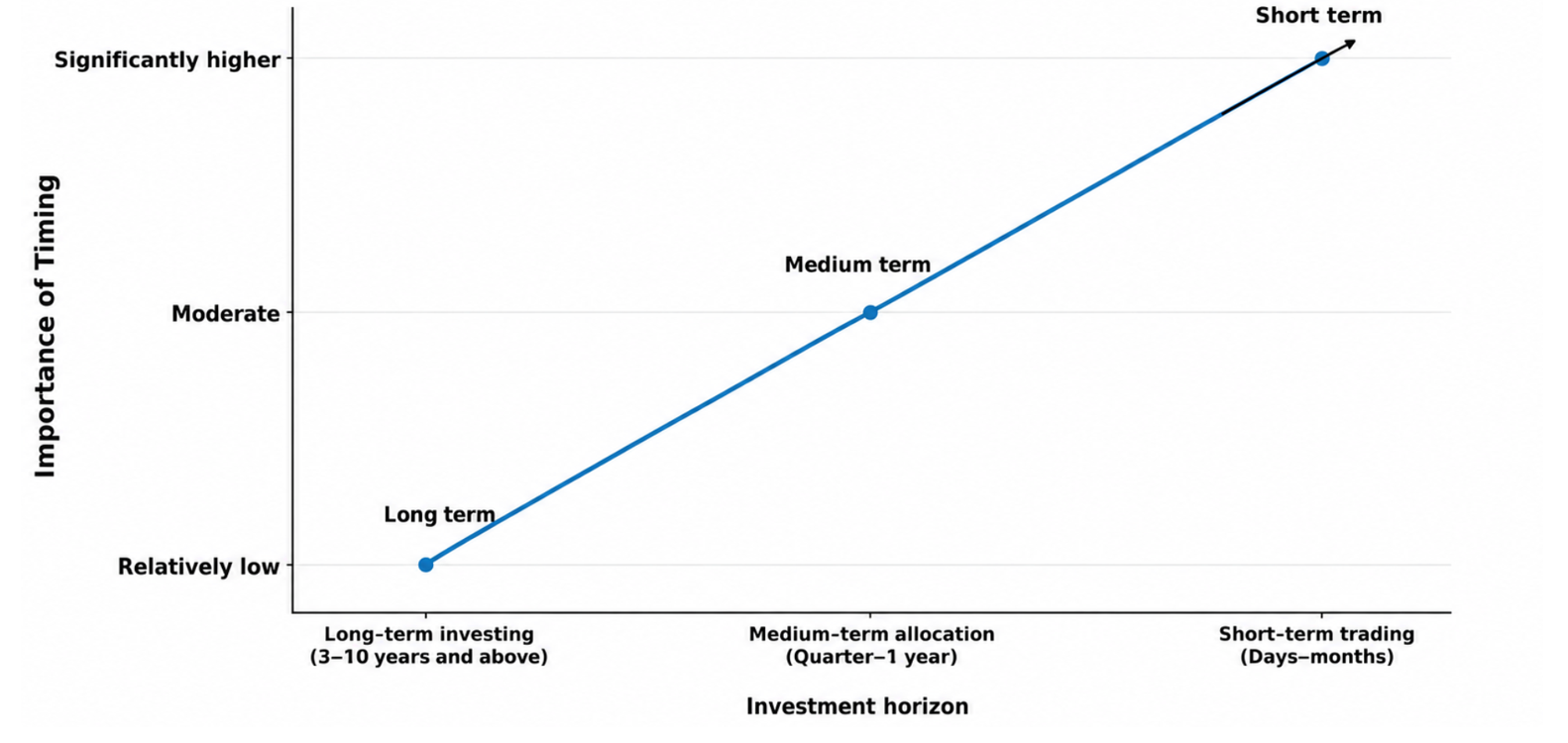
Illustrative framework
Investor implications
Market timing is not a standalone investment strategy or concept—its value depends on the objective. In long-term investing, it is primarily a tool for managing risk and improving portfolio resilience. Over the medium term, it can enhance portfolio efficiency through dynamic factor allocation. In short-term strategies, timing and execution become much more important, although returns are often constrained by market capacity and competition.
Many apparent disagreements about market timing are therefore not genuine disagreements about investment philosophy. They often reflect differences in investment horizon, objectives, liabilities and implementation tools. The practical question is not simply whether timing works, but what is being timed, for what purpose and under what risk and implementation constraints.
For investors, the key is to view timing as one part of a broader portfolio management framework, supporting asset allocation, risk management and disciplined implementation rather than replacing them.