

Market concentration can increase a portfolio’s dependence on a small number of companies, sectors, or common return drivers, particularly when those exposures dominate the benchmark. Investors can address that risk through portfolio construction that combines complementary active managers, broader sources of return, and, where appropriate, completion strategies or overlays to manage unintended benchmark-relative exposures.
Key takeaways
Market concentration has remained elevated throughout the AI-led market cycle and could sustain further if another generation of large AI companies enters public benchmarks.
Although benchmarks are concentrated, the investment opportunity linked to AI is burgeoning across infrastructure, industries, styles and regions.
Active multi-manager portfolios can diversify sources of return and reduce dependence on any one company, sector or market outcome.
Benchmark changes can also alter relative risks without holdings changes in portfolios, bringing benchmark alignment into the portfolio construction question.
Jonathan Woo, Senior Research Analyst at Russell Investments, examines how rising market concentration is reshaping the opportunity set for active managers and why a multi-manager approach can help investors prepare for different paths for market leadership.
Why market concentration could continue rising
Market concentration has become one of the defining features of the equity landscape, and there are reasons to believe in the possibility it could continue. SpaceX has already listed, while expected IPOs from Anthropic and OpenAI could bring another generation of large AI-related companies into public benchmarks.
Timing matters: concentration is already high across U.S. and global equities, especially in growth benchmarks. Information Technology now represents roughly half of the Russell 1000 Growth Index, compared to 20% a decade ago. The latest HHI data below shows concentration being elevated across U.S. and global equities, while emerging markets have overtaken this with an especially sharp increase.
For many investors, concentration creates a difficult trade-off. Staying close to the benchmark increases exposure to a small group of companies and common AI-related drivers. Moving too far away creates significant relative risk if AI leadership persists. This creates a challenge for active managers.
At the same time, the underlying opportunity set is broadening. Portfolios therefore need to balance their level of participation in today’s market leaders and themes.
HHI: Market concentration extends beyond U.S. Equities
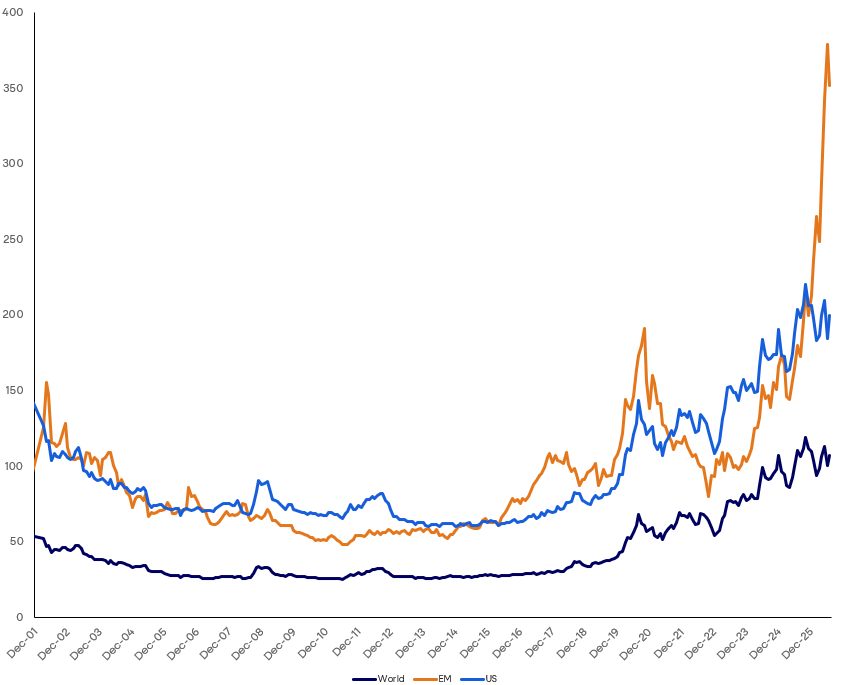
Source: Russell Investments
How concentration impacts active management
Historically, highly concentrated markets have presented a more difficult backdrop for active management. Periods of rising concentration have often corresponded with weaker active outcomes, while some of the strongest excess returns have occurred as concentration declined.
Active managers have flexibility to invest outside the largest benchmark constituents, which can become more valuable as market participation broadens.
The historical relationship has also been asymmetric: improvements in active manager outcomes during periods of declining concentration tend to be greater than the deterioration during equivalent increases in concentration.
A dramatic reversal in market leadership may therefore not be necessary for the active environment to improve. A plateau in concentration, more mixed AI-related earnings, or dispersion between companies could be enough to remove the headwind facing active managers. Investors need not forecast the timing of a regime change, but to understand how their portfolios would behave with changes in concentration levels.
What could sustain market concentration
Concentration could remain elevated for several reasons. Today’s largest companies have grown earnings faster than the rest of the market, providing stronger fundamental support compared with the past dot-com era. As the AI investment cycle develops, the durability of that leadership will depend increasingly on whether high levels of capital spending translate into sustainable earnings growth.
The market is also vulnerable to shifts in expectations. Changes in the pace of AI adoption, the economics of model development, competitive dynamics or productivity gains could all affect sentiment and valuations.
Another generation of large AI listings, further technological breakthroughs or more evidence of productivity growth could sustain concentration.
Geopolitical and trade uncertainty could add another variable. Renewed sanctions, trade restrictions, or other policy shifts could change risk appetite or disrupt the capital spending that supports the AI investment cycle, potentially accelerating a change in market leadership. Upstream developments on energy costs, server availabilities, or even rare earth procurement may also contribute to price and earnings volatility. Rather than trying to identify exactly when the current regime will change, portfolios can be positioned for more than one outcome.
S&P 500 Top 10 index weights: Earnings vs. market value (%)
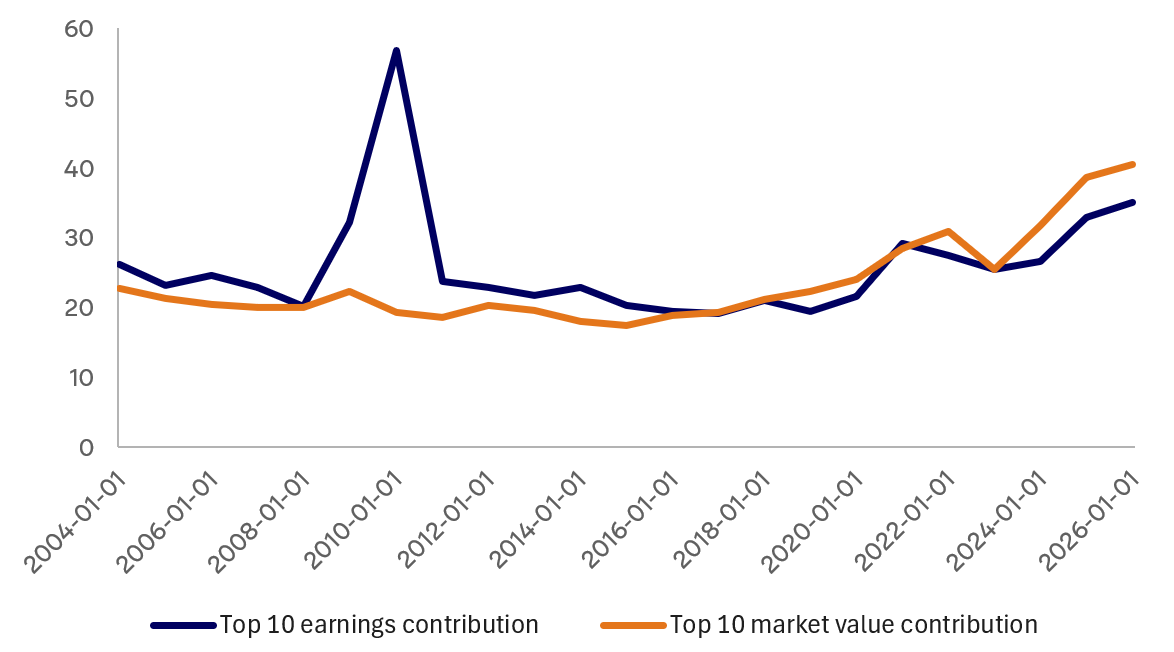
Source: Russell Investments
How benchmark changes alter risk without changing portfolios
Market concentration also matters because style benchmark concentration is changing. The June 2026 FTSE Russell reconstitution shifted several mega-cap companies across growth and value benchmarks. Amazon became approximately 7% of the Russell 1000 Value Index, while Apple and Microsoft moved from exclusively growth to having roughly equal representation across growth and value indices.
These changes create new conundrums to active positions despite no changes to portfolios or processes. Benchmark-relative risk can therefore shift without a manager changing their investment view. Future AI listings could exacerbate this discomfort.
For investors, managing concentration is about more than deciding which securities to own. It means understanding where benchmark construction is changing portfolios’ relative exposures.
Where active managers see opportunities
While benchmarks remain concentrated, active managers are finding opportunities across a much wider range of companies.
AI remains an important structural growth theme, but the investment opportunity now extends well beyond hyperscalers, semiconductors, and memory producers. Electricity generation, grid infrastructure, cooling systems, networking equipment, enterprise software, industrial automation, and data centers provide different ways to participate in the AI buildout. The growing demands on energy and infrastructure also bring renewed attention to energy efficiency and green technologies.
Manager positioning reflects this broader opportunity set. Large-cap growth managers have moved from a modest Information Technology underweight in 2018 to a materially larger underweight today. Meanwhile, Industrials have generally shifted from an underweight to an overweight, and a previous Real Estate underweight has since narrowed.
Opportunities also extend beyond AI. With longer-term normalization and fundamental breadth in mind, attention may shift to overlooked opportunities generated by recency bias. Managers are identifying opportunities across healthcare, financials, industrials and consumer staples, where valuations and crowding risk are less pronounced. Europe provides exposure to areas including electrification, defense, automation and AI infrastructure. Taiwan and Korea remain important parts of the AI supply chain, while Japan’s market-friendly policies offer a broad opportunity for stock selection.
Participating in the AI theme does not have to mean relying on the same companies that currently dominate the index. Active managers can access the theme through different parts of the value chain while also identifying opportunities outside it.
How multi-manager portfolios diversify outcomes
A concentrated benchmark creates difficult choices for active investors.
Following the index closely can leave a portfolio dependent on the same small group of companies, while moving meaningfully away from them creates larger active positions that can detract if current leadership persists.
Active management provides flexibility to make these decisions based on fundamentals rather than benchmark weight alone.
That flexibility can take different forms. Some managers may retain meaningful exposure to today’s mega-cap leaders where earnings support their conviction, while others may find better opportunities among AI infrastructure beneficiaries, value-oriented companies, smaller businesses, or regions where valuations offer a different source of potential return.
These views do not have to be mutually exclusive.
Combining complementary managers can diversify investment perspectives across a portfolio. If today’s largest companies continue to lead, some managers may maintain selective exposure. If leadership broadens, others will be positioned to capture alternative opportunities elsewhere. And if concentration declines, a wider opportunity set and greater stock-level dispersion could create a more supportive environment for stock selection and active management in general.
The aim is to diversify the ways a portfolio can succeed. A multi-manager approach that combines different investment styles and sources of active return will reduce reliance on any one manager’s positioning or response to the current market environment.
Investor implications
It is difficult to predict how concentrated we will see market leadership rise, or how long it will last. Investors do not need to make that prediction to prepare their portfolios, and to necessitate doing so would indicate poor construction.
The more important consideration is to ensure that a portfolio has sufficiently diverse sources of return to participate across a range of market environments.
Active management provides the flexibility to make those choices rather than to passively inherit a benchmark. Combining complementary managers takes this further by bringing together different investment perspectives, styles and potential sources of excess return.
Manager selection is one part of the portfolio construction challenge. Completion strategies, index overlays and targeted factor adjustments can help investors retain desired active positions while managing unintended security, sector or style risk.
Common client questions
Active management can benefit as market leadership broadens because managers have greater flexibility to invest outside the largest benchmark constituents. The historical evidence cited in the draft suggests active-manager outcomes have improved during periods of declining concentration. Investors may not need a dramatic market reversal: a plateau in concentration combined with greater stock-level dispersion could create a more supportive environment.
Investors can diversify how they participate in AI rather than relying exclusively on the largest technology companies. The opportunity set extends into electricity generation, grid infrastructure, cooling, networking, software, industrial automation, and data centers. A multi-manager portfolio can combine selective mega-cap exposure with different AI beneficiaries and opportunities outside the theme, reducing dependence on one path for market leadership.
Benchmark changes can alter a manager’s relative exposures even when the underlying portfolio does not change. The draft’s June 2026 reconstitution example shows how large companies shifting between growth and value benchmarks can change benchmark-relative security, sector, and style risk. Investors therefore need to evaluate concentration not only at the security level, but also through the changing composition of the portfolio’s benchmark.