

Consolidation is creating fewer, larger wealth management firms with more complex investment operations. As businesses grow through acquisitions, they must harmonise investment processes, governance frameworks, and client propositions while maintaining consistent investment outcomes and meeting increasing regulatory expectations.
Key takeaways
- Consolidation is creating larger wealth firms, but also more complex investment organisations.
Repeatable investment processes and harmonised operating models are becoming crucial for governance and consistent client outcomes.
Long-term success will depend on recognising where firms can create genuine investment value internally and where strategic partnerships can enhance scale and implementation.
The UK wealth management industry is undergoing an evolution. Competitive pressures, rising regulatory expectations and the pursuit of greater efficiency are driving firms to become larger, more institutionalised organisations.
The industry's structure is beginning to reflect this shift. According to the Financial Conduct Authority's latest Financial Advice Market Survey, the number of authorised advice firms has fallen by around 15% since 2021, while adviser numbers have remained broadly stable at approximately 31,000.1
As wealth firms grow through acquisition, new challenges arise. As organisations expand and propositions improve, investment governance, decision-making and portfolio implementation become more complex.
Often these scaling organisations face three important questions:
- How do they create repeatable investment processes?
- Where should they choose to focus internal expertise versus partnering?
- How can operating models translate greater scale into better client outcomes?
UK wealth advice is becoming fewer, but larger
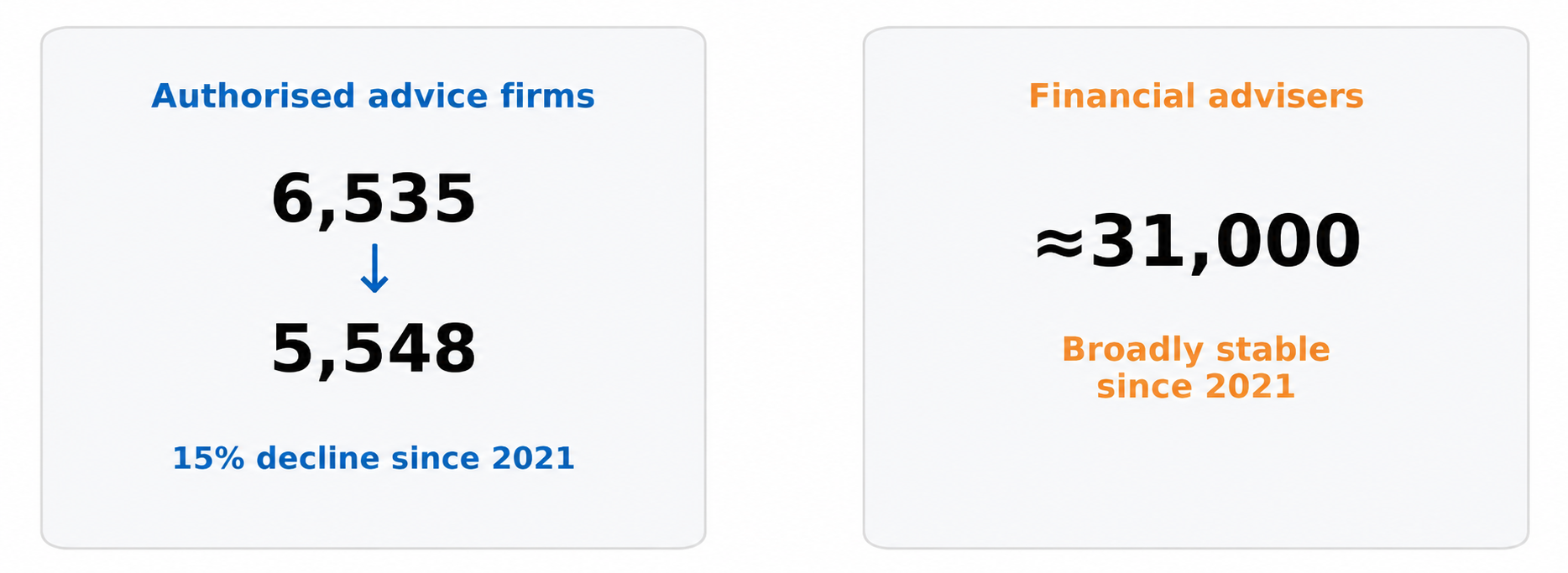
Large advice groups represent just 1% of firms but advise on around 50% of all client assets.
Source: Financial Conduct Authority: Understanding the advice market: financial advice firms survey 2025
How do firms create repeatable investment processes?
As firms expand (both organically and inorganically), they need to address a wider range of client challenges, consolidate investment and planning practices, and bring differing investment preferences together – and that’s before considering the practical challenges of consolidating investment propositions.
At the centre of a growing business and team, is the importance of having a strong investment process.
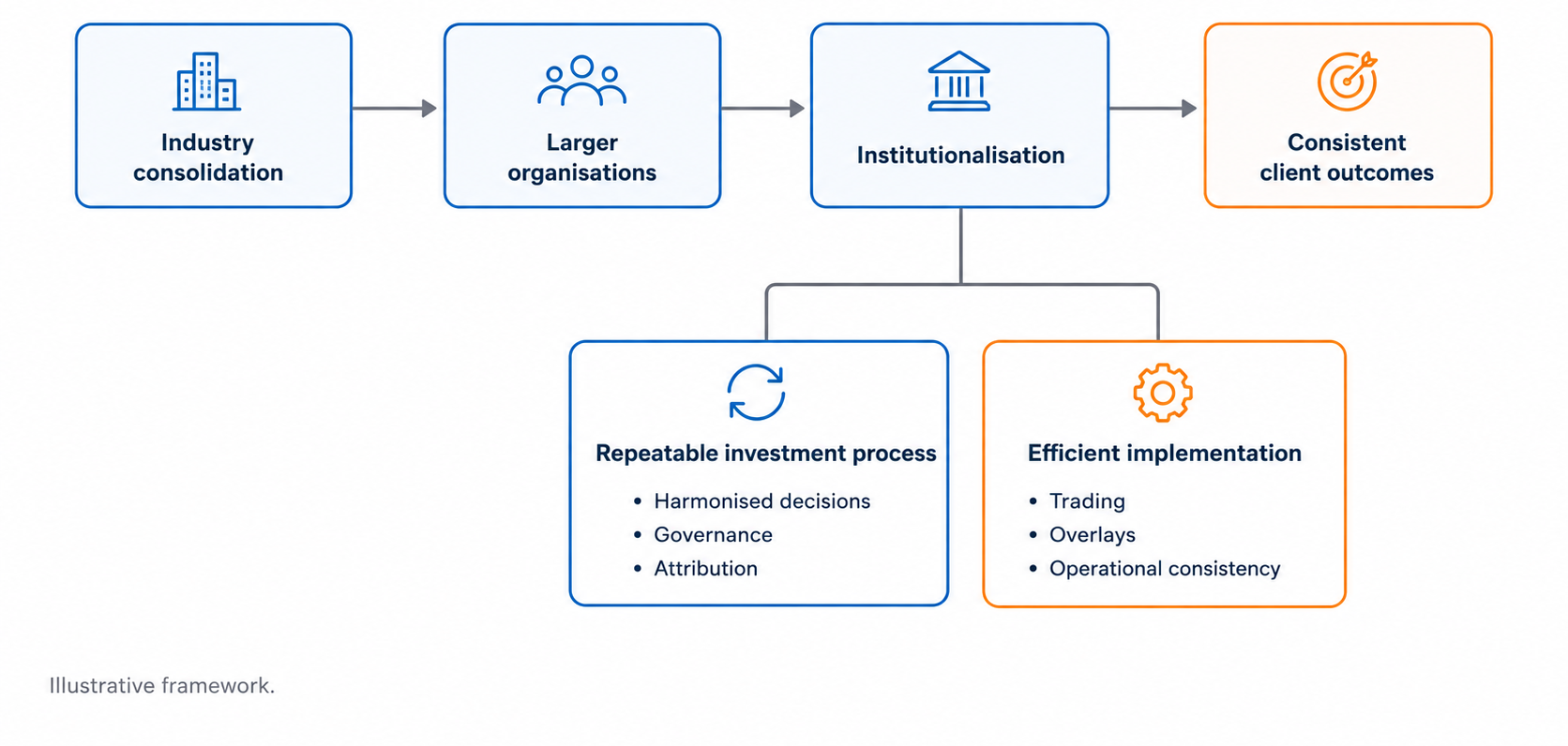
Moving from a (relatively) smaller investment team to a larger one naturally creates the opportunity for greater specialisation. Clearly defined roles and responsibilities help strengthen governance by reducing ambiguity around decision ownership and accountability. Portfolio construction, manager research, strategic asset allocation, tactical positioning and implementation become more specialised disciplines.
Yet greater expertise alone does not guarantee better decisions. What matters is whether those decisions are made within a repeatable framework. A repeatable investment process enables firms to understand why outcomes occur, distinguish skill from chance and maintain consistency as teams evolve and market conditions change. Rather than relying on individual judgement, robust governance creates decision-making frameworks that can be applied consistently across portfolios and through market cycles.
This becomes particularly important following acquisitions, where firms may inherit multiple investment philosophies, legacy products and different governance structures that need to be harmonised.
Scale alone doesn't create better investment outcomes
Where do you create the greatest value?
As firms grow, there can be a natural temptation to internalise more investment functions, whether through dedicated trading teams, manager research, portfolio implementation or specialist investment capabilities. However, scale remains relative. Even larger wealth managers often operate with finite specialist resources compared with the largest global investment organisations.
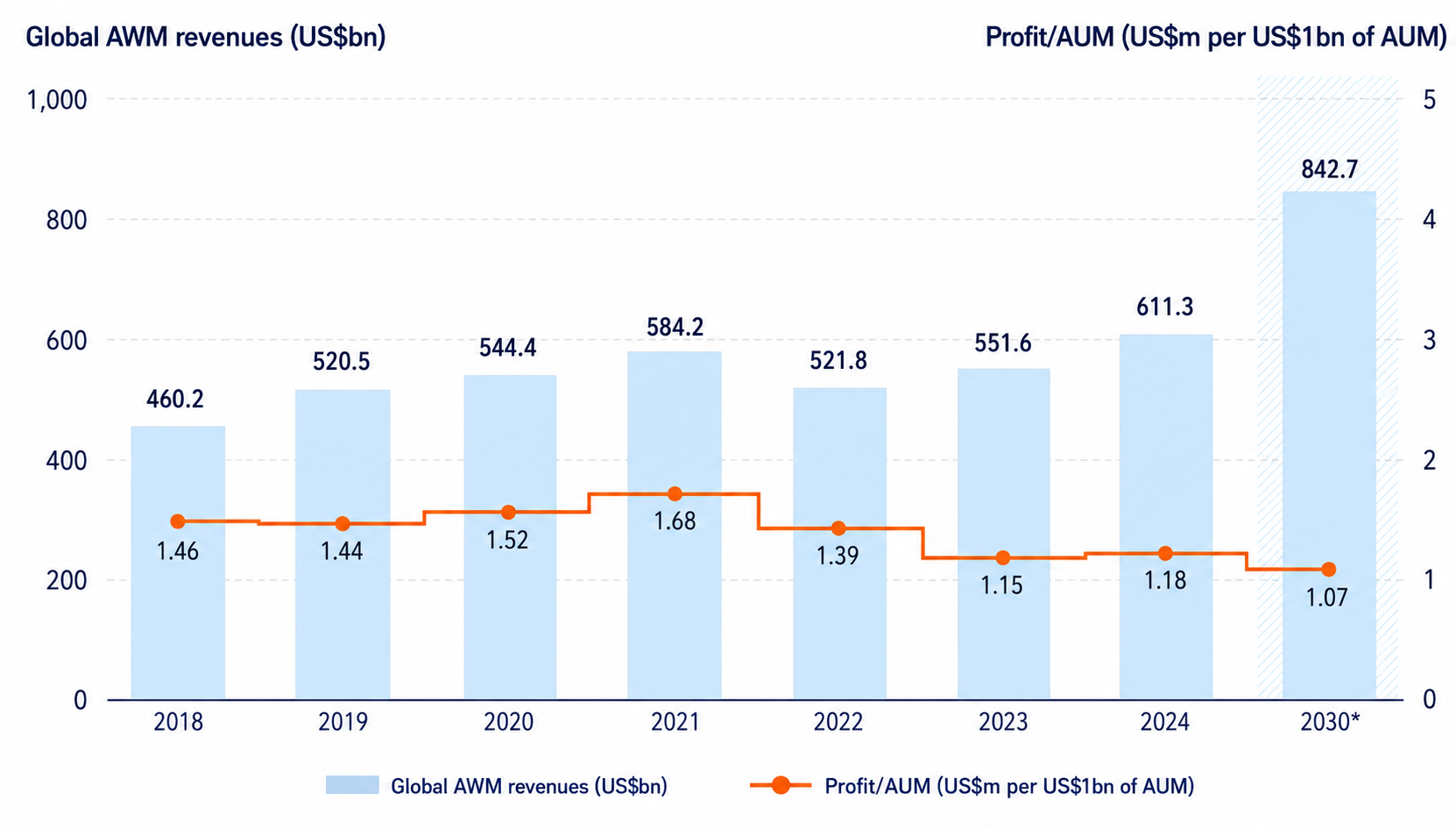
That makes prioritisation important as margins come under pressure. PwC estimates that profit as a share of assets under management has fallen by approximately 19% since 2018 and expects it to decline by a further 9% by 2030.2
The strongest investment organisations are often those that clearly identify where they can create genuine competitive advantage and concentrate internal resources accordingly. Core investment philosophy, client relationships and governance may represent areas of differentiation, while other capabilities can often benefit from specialist expertise and external scale.
Rather than viewing partnerships as a compromise, many firms are recognising them as another way of extending organisational capability while maintaining strategic focus.
Wealth management industry is under pressure
*Forecast
Sources: PwC Global AWM & ESG Research Centre, LSEG Lipper, Preqin
How can operating models/implementation translate scale into better client outcomes?
As investment propositions mature, implementation itself is becoming an important source of value. Historically, implementation was often viewed as an operational function. Today, it plays a much greater role in determining net client outcomes. Trading efficiency, portfolio overlays, currency management, transition management and execution quality all influence how effectively investment decisions are translated into portfolio performance.
Portfolio overlays, for example, allow firms to adjust market exposures or manage risks without disrupting underlying portfolios, while transition management helps minimise trading costs, market impact and operational risk when moving assets between managers or investment strategies. These capabilities become valuable as firms integrate acquisitions, rationalise legacy portfolios or evolve investment propositions over time.
At the same time, larger wealth firms are exploring broader opportunity sets beyond traditional public equities and bonds. Accessing private markets, alternative assets, emerging markets or specialist equity segments such as small caps can enhance portfolio diversification, but these capabilities often require dedicated research, manager selection, operational oversight and implementation expertise. Building every capability internally is not always the most effective use of resources.
Implementation partners can provide access to institutional-quality capabilities

Augmenting internal capabilities
Firms have several options as they determine which capabilities to build internally and where strategic partnerships can enhance their offering. The decision extends beyond whether to build, buy or borrow capabilities. It also involves augmenting existing capabilities to increase flexibility, improve scalability and retain control over investment outcomes.
Case Studies
Investment implications
Consolidation is reshaping UK wealth management, but scale alone is unlikely to determine long-term success. As firms continue to institutionalise, the focus is shifting towards governance, repeatable investment processes and operating models capable of delivering consistent client outcomes across increasingly complex organisations.
At the same time, institutional-quality investment propositions do not necessarily require every capability to sit in-house. The firms most likely to succeed will be those that clearly define where they create the greatest value, while using strategic partnerships to strengthen areas where external scale, specialist expertise and implementation capabilities can further improve outcomes.
Any opinion expressed is that of Russell Investments, is not a statement of fact, is subject to change and does not constitute investment advice.
1. https://www.fca.org.uk/data/understanding-financial-advice-market
2. https://www.pwc.com/gx/en/issues/transformation/asset-wealth-management/pwc-awm-revolution-2025.pdf?
Common client questions
A repeatable investment process helps wealth managers make consistent, well-governed decisions across portfolios and market cycles. It reduces reliance on individual judgement, strengthens accountability, and makes it easier to integrate acquired firms while delivering consistent outcomes for clients.
The strongest wealth managers focus internal resources where they can create genuine competitive advantage, such as investment philosophy and client relationships. Specialist capabilities, including implementation, manager research, and trading, can often be delivered more efficiently through strategic partnerships that provide greater scale and expertise.
Implementation influences how effectively investment decisions are translated into portfolio performance. Capabilities such as transition management, portfolio overlays, currency management, and efficient trading can reduce costs, manage risk, and improve execution, helping deliver stronger net outcomes for clients over time.
Long-term success will depend on more than scale. Wealth managers will need robust governance, repeatable investment processes, and operating models that combine internal expertise with specialist partnerships. This approach helps firms manage growing complexity while delivering consistent, institutional-quality investment outcomes for clients.