

Key takeaways
- Japan and the U.S. carried out their first joint FX intervention since 1998, signalling a stronger commitment to supporting the yen when currency moves become extreme.
- While the intervention boosted the yen in the short term, a sustained recovery will likely require tighter Bank of Japan (BoJ) policy and improving economic fundamentals.
- A stronger yen could reduce returns on unhedged foreign assets, increasing the importance of active currency management.
- In our quarterly discussions, active managers remained constructive on Japan's long-term outlook but emphasized that greater selectivity is warranted, particularly following the strong rally in AI-related stocks.
Joint FX intervention – What happened?
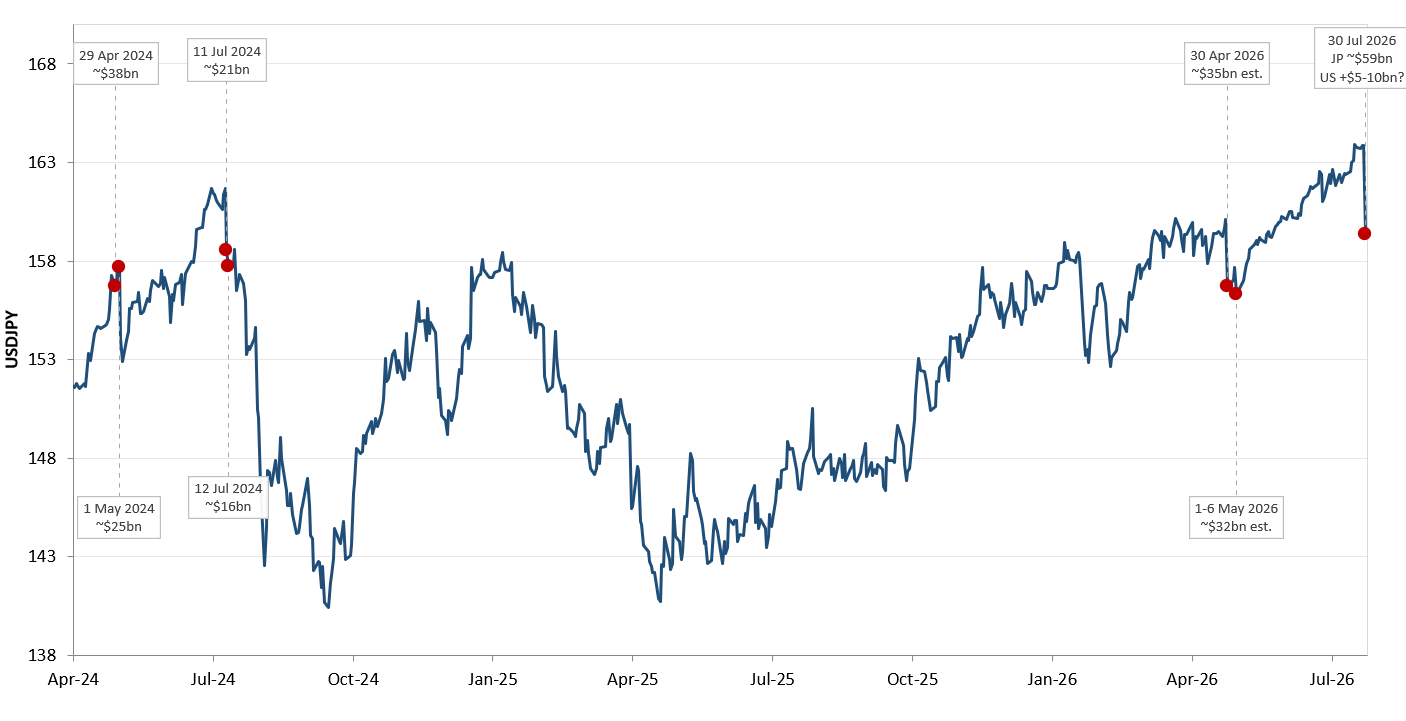
For the first time since 1998, Japan and the U.S. carried out a joint foreign exchange intervention to strengthen the Japanese yen (JPY). The move late last week came as the yen slumped to nearly 164 against the dollar the prior week, its weakest level since 1986, driven by still-low interest rates in Japan and concerns over the country’s expansionary fiscal policy.
Japan’s Ministry of Finance bought yen against the dollar to the tune of nearly $59bn in dollars in New York markets. The U.S. did not disclose its contribution, although reports placed it between $5bn and $10bn. During the interventions, the yen surged against the dollar, with USDJPY dropping from 163 to 157.
While the two countries had been involved in coordinated currency intervention in 2011, they then worked with their G7 counterparties to weaken the yen after a surge in the currency following earthquakes in Eastern Japan. In the most recent action, it was the first time ever that the U.S. Treasury used its euro currency reserves rather than U.S. dollars to buy yen.
For investors, this marks a notable shift in FX policy, with policymakers demonstrating a readiness to step in together when markets push currencies to extremes.
Protecting the dollar
The fact that the intervention was coordinated between Japan and the U.S. was more significant than the fact that the U.S. used euros to buy yen. Coordinated FX interventions have in the past had a more sustainable impact than unilateral interventions.
The U.S. Treasury likely used euros during the intervention to not weaken the dollar. Moreover, U.S. policymakers were concerned that Japan’s FX interventions could involve sales of U.S. Treasuries, undermining confidence at a delicate time for the world’s largest bond market.
Assessing dry powder for future intervention
Since the start of 2024, Japan has spent an estimated $225bn on foreign exchange interventions to prop up the yen, including the latest joint effort with the U.S. in July 2026. The Ministry of Finance conducted large operations in April through July of 2024 and again in April, May, and July of this year.
The total amount deployed is substantive, but represents a fraction of Japan’s $1.3tn in foreign exchange reserves, the world’s second-largest after China’s. The scale of intervention underscores Tokyo’s determination to stabilise its currency, yet the size of its reserves suggests it retains some firepower for future measures.
USDJPY currency interventions
Source: Russell Investments, LSEG Datastream, Ministry of Finance (Japan)
While the U.S. involvement carries symbolic weight, its financial impact pales in comparison to Japan’s deep pockets. If the Treasury wants to continue using euros against yen for future interventions, it is limited by the size of the euro currency reserves.
The U.S. holds a far smaller war chest for such operations. As of 24 July, the Exchange Stabilisation Fund (ESF) and System Open Market Account (SOMA)—the primary tools for FX intervention—together hold foreign currency reserves of about $38bn, with a 70/30 split between euros and yen. The ESF is easier to access for the U.S. Treasury since it does not require coordination with the Federal Reserve. By contrast, if the U.S. were to sell its own currency to strengthen the yen, it would not be limited by its foreign exchange reserves.
Will the yen sustainably reverse its weakness?
For markets, the question remains whether FX interventions alone will be enough to counter broader rates and economic pressures weighing on the yen. Based on past experience, we think the answer is no. Currency interventions can initiate or support a move in the yen that is underpinned by economic fundamentals and positioning.
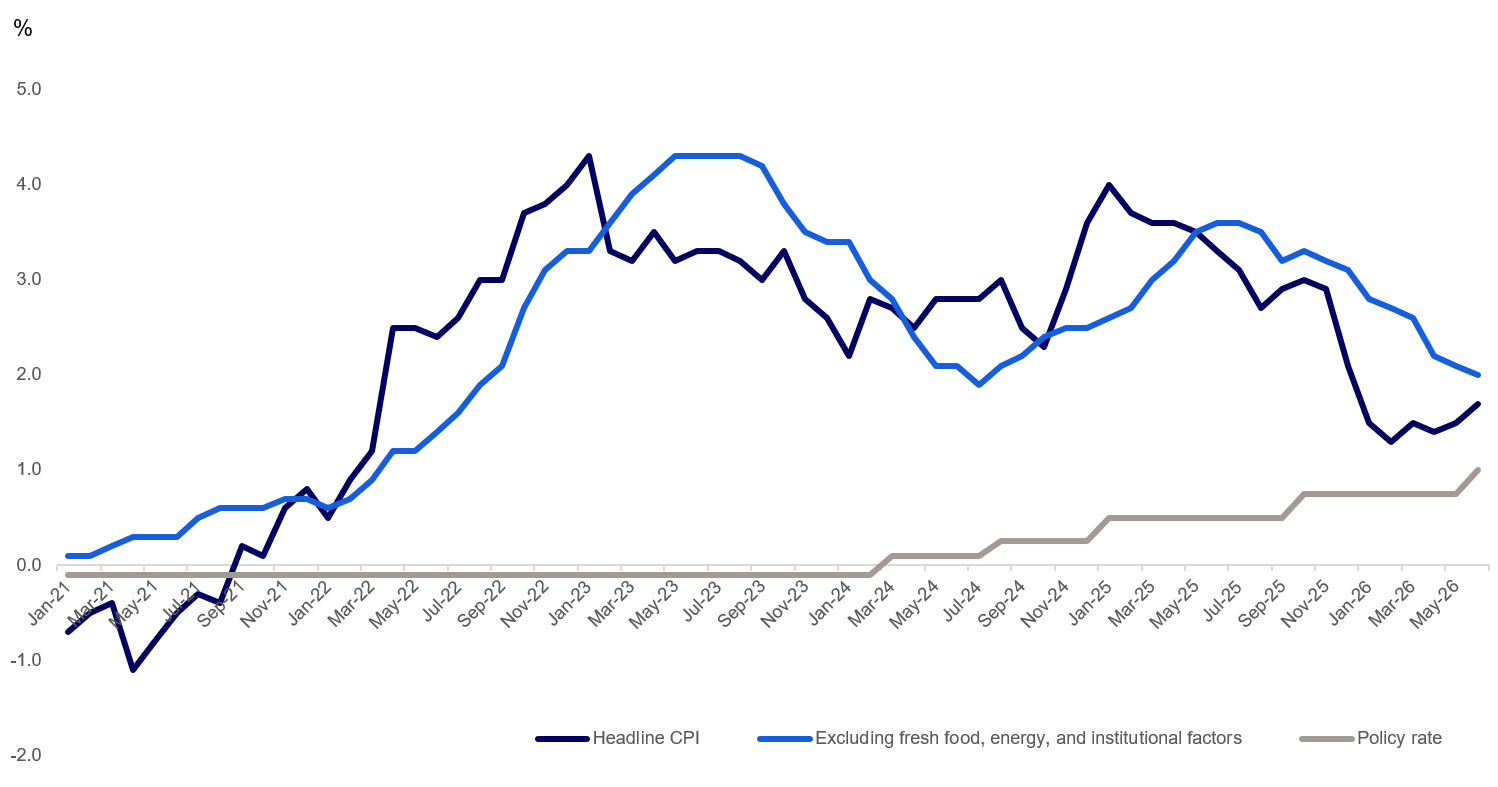
For example, the interventions in April and May 2024 failed to reverse the weakening trend in JPY. However, in July 2024, another intervention effort by Japanese policymakers coincided with the first rate hike by the BoJ, soft U.S. economic data and a forceful position unwind (“Carry Trade Unwind”). This confluence of factors pushed USDJPY from 158 to around 140 by September 2024. However, the yen strength didn’t last as the BoJ failed to live up to the market’s rate hike expectations and concerns around fiscal policy under new prime minister Takaichi emerged. For much of 2025 and 2026, the yen has weakened against the U.S. dollar, with USDJPY reaching new 40-year highs as recently as late July.
CPI and policy rate pressures
Source: MIC, BoJ
Active manager views
Constructive on the multi-year outlook, but greater selectivity is warranted as of 05/08/2026)
In our quarterly discussions with active managers—held prior to the BoJ's foreign exchange intervention—two themes emerged. Managers continued to view yen weakness and the path of BoJ policy as key drivers of Japanese markets while remaining constructive on the multi-year outlook for AI infrastructure investment, despite becoming more disciplined on valuations. At the time of those discussions, investors were heavily short on the yen, according to currency futures positioning. This backdrop was similar to July 2024, when fast-moving market participants had also built up sizeable short positions. Interventions, coupled with fundamental support for the yen, could lead to the unwinding of these positions and a rapid appreciation of the currency.
Dovishness to continue: One active equity manager noted that although recent foreign exchange intervention highlighted policymakers' concern over yen weakness, the BoJ was likely to maintain its broadly dovish stance in the near term. However, it was noted that persistent yen weakness could prompt a faster pace of monetary tightening over the coming months. Managers also pointed to early signs of improving domestic investment and expected longer-dated Japanese government bond yields to find support around current levels.
Positive outlook remains: Managers also remained constructive on the multi-year outlook for AI data center investment, which continues to drive component up-specification, resulting in a richer product mix and higher content per server across the supply chain. While maintaining a positive long-term view, many had selectively trimmed AI-related positions following strong share price performance in recent quarters. With near-term supply constraints now largely reflected in valuations, managers were increasingly focused on whether AI monetization could sustain further increases in hyperscaler capex.
Investor implications
FX intervention alone will likely not be sufficient to reverse the yen's structural weakness dating back to 2012. Sustained appreciation will require narrower interest rate differentials (higher rates in Japan and lower rates in the U.S.), along with a turnaround in investor flows.
However, periods of coordinated FX intervention can still trigger meaningful short-term currency moves, particularly when supported by improving fundamentals. Investors should therefore be prepared for greater exchange rate volatility, even if the yen's longer-term direction ultimately depends on monetary policy and capital flows.
For Japanese investors with large unhedged foreign asset holdings, a sustained period of yen strength would reduce the value of overseas assets when translated back into yen. In this environment, dynamic currency hedging may help investors remain less hedged during periods of yen weakness while increasing hedge ratios as the yen strengthens.