

In this episode of Without Boundaries, Jon Eggins, Managing Director and Co-Head of Portfolio Management at Russell Investments, speaks with Bruce Richards, CEO and founder of Marathon Asset Management and now Managing Partner and Head of CVC Marathon, about investing through one of the biggest structural shifts facing investors today — the AI boom.
One of the benefits of speaking with investors who have managed through multiple market cycles is the broad perspective they bring and how they think about risk.
As we discovered with Bruce Richards, this perspective extends well beyond credit markets to even swimming during a shark warning and whether to go for it on a second tennis serve!

I always enjoy talking with investors who clearly love what they do, and especially when they know how to spend their first day in Sydney, my hometown (catch the ferry to Manly and straight to the beach!).
Bruce and his team manage strategies accessed by Russell Investments clients in Emerging Market Debt and Multi-Asset Credit. Bruce has invested across global credit markets for nearly three decades and has witnessed firsthand the significant expansion of both public and private credit markets.
In our latest episode, we discussed the scale of the next credit cycle, dispersion in credit valuations, private credit, software and consumer lending.
From our chat, here are three points that stood out to me:
1. A historic moment for credit markets
Credit markets have evolved dramatically over the past three decades and gone through a series of cycles. Bruce was focused on what is coming next – describing it as truly transformative for the scale of global credit markets and how they are driving future economic growth.
Trillions of dollars are needed to finance AI, data centers, and the power and infrastructure needed to spur productivity gains. A broad and open architecture approach to global credit markets is critical to capitalizing on this historic moment.
2. Credit cycles are not the same as economic cycles – averages can hide a lot
At one point in the conversation, I was reminded of the old statistics joke: if your head is in a freezer and your feet are in an oven, your average temperature might look perfectly comfortable.
The same principle can apply to credit valuations. Bruce made the point that average credit spreads may suggest that a market is fairly or even fully valued. However, underneath that average, there can be significant differences between sectors, securities and borrowers where strong credit selection can unlock value for investors.
Bifurcated credit curves
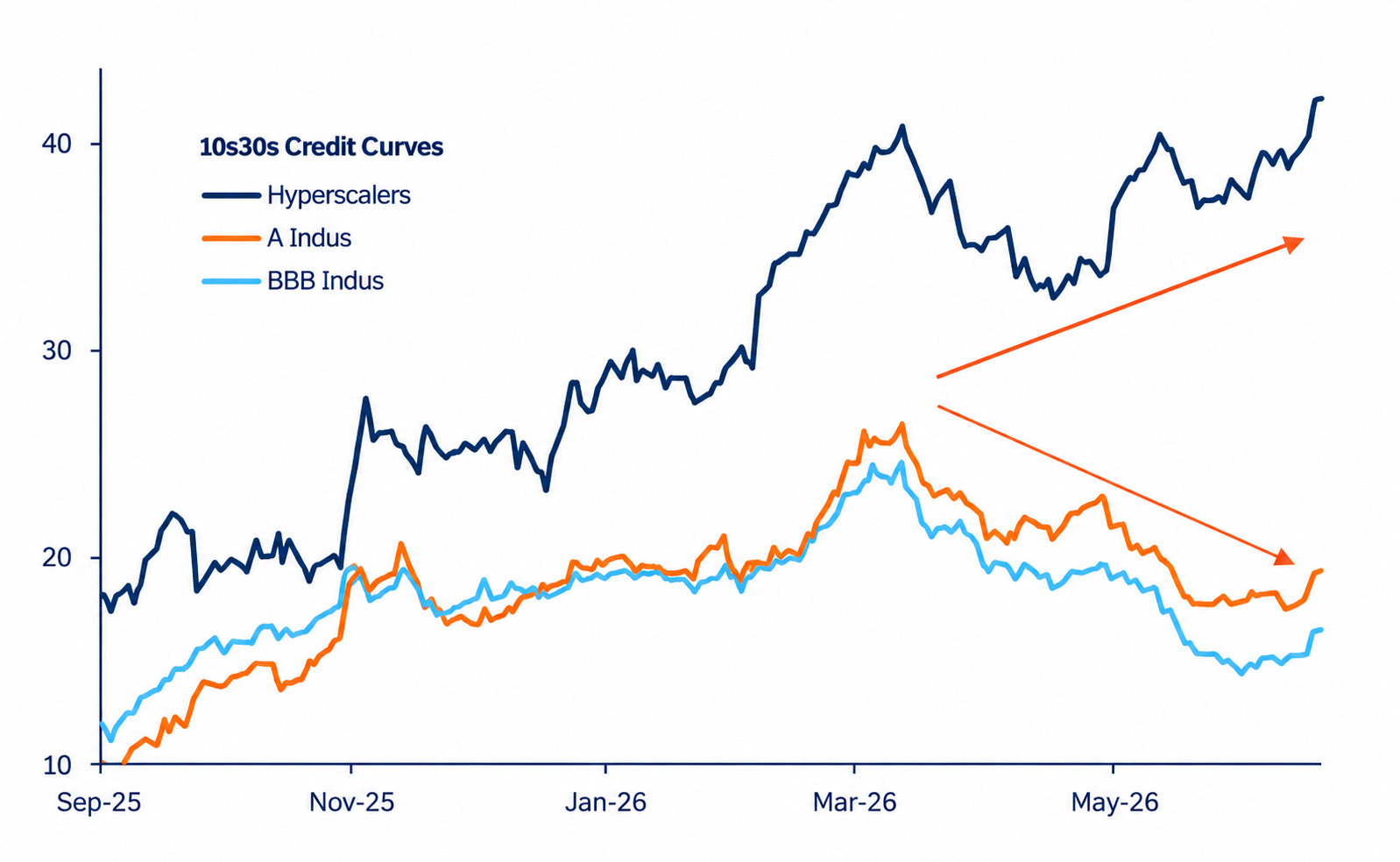
Source: Barclays research, Bloomberg MM
Credit cycles and economic cycles are often discussed together, but Bruce drew a distinction between the two. His view is that economic growth can remain supportive while a credit cycle develops underneath it, driven by differences in leverage, financing needs and balance-sheet strength. For investors, that means a benign macro backdrop does not necessarily translate into benign outcomes for every borrower.
3. The label "Private credit" tells you less than you might think – a deep dive on software
We also spent time discussing the debate around private credit. Bruce's first step was to define what we were actually talking about. Direct lending, asset-based lending and opportunistic credit can all sit under the same label. Within direct lending alone, there are major differences by market segment, structure, sponsor involvement and seniority.
The part of our discussion that may attract the most attention was software. Bruce contrasted the relatively small weight of software in high-yield markets with a much larger presence in private credit, particularly in direct lending.
His concern is not that software is disappearing. He expects successful companies to adapt and become increasingly AI-first. The issue is whether highly leveraged software companies have enough financial flexibility to make that transition.
That brought us back to risk management and diversification. Bruce questioned how a credit portfolio could justify having more than 10% to 15% invested in a single sector. Diversification is not just about the number of securities you own. It is about understanding where the underlying economic risks are concentrated.
Final thoughts
What came through repeatedly in my conversation with Bruce was the importance of selectivity and diversification. He is constructive on the opportunities across global credit markets, but also willing to avoid areas where leverage, concentration or valuations do not stack up.
Perhaps unsurprisingly for a keen chess player, and consistent with many past guests on the podcast, he is always thinking about how to remain several moves ahead.
Watch the full episode: