

Key takeaways:
- Customization is a critical component to achieving investment success
- Consider working with a provider that has robust capabilities and a proven track record of tailoring investment solutions to meet client needs.
No two institutional investment programs are alike. So it’s logical that no two solution sets should be alike.
Here’s the rub: Solutions providers tend to fall into two categories: One—the largest asset-management industry leaders, with a full set of capabilities, but a resistance to providing a level of customization that doesn’t align with their corporate revenue priorities. And two—boutique asset managers or consultants that have the willingness to customize, but lack the capability set to solve all client problems. The spirit is willing, but the skillset is weak.
It’s worth taking a cue from Goldilocks and seeking out that just-right provider—the one with the robust capability set and the willingness to customize. Customization is not just a marketing buzzword. When meaningful customization is combined with meaningful capabilities, the result can significantly enhance financial performance, manage risks more effectively, and align investments with broader organizational goals.
Below are summaries of four recent client case studies that show the transformative potential that occurs when customization intersects with capabilities.
Case study 1: Reducing costs with custom beta portfolios
The organization: A donor-funded organization with over $4 billion in assets.
The challenge: The foundation's investment team held specific investment beliefs that they wanted to implement within the portfolio, including exclusions based not only on ESG considerations, but on performance-driven theories. The limited size of their in-house team, along with limits in data, technology and other capabilities, hampered their ability to implement their beliefs.
The solution: We transitioned over $2 billion from a legacy equity portfolio into a custom beta completion portfolio, with custom exclusion. We also implemented a dynamic and highly-customized alpha-exclusion program, with security-level exclusions based on the clients own dynamic investment beliefs. In addition, we created custom sets of research and signals that allowed them to test possible outcomes and fine tune their investment approach.
The result: At the beginning of our relationship, the portfolio was mostly passive. This was not a strategic decision, but was simply based on resource constraints, such as lack of data, lack of analytics and testing abilities, and limited means to implement beliefs. The client has proven to have significant insights. By partnering their own insights with Russell Investments' platform of capabilities and data, they have now aligned their portfolio with their unique and dynamic views.
Case study 2: Putting cash to work for a large university endowment
The organization: A large university with an endowment of more than $15 billion.
The challenge: The client was looking to equitize cash held in their equity portfolio.
The solution: Our overlay team purchased index futures to capture the equity market risk premium. This service involves purchasing highly liquid and capital-efficient exchange-traded futures contracts to replicate various asset classes, while reducing the long-term performance drag of holding cash. This cash equitization service can be customized to fit a client’s preferences, falling anywhere on the spectrum from rules-based guidelines to client-directed.
The results: Since inception, the client has captured positive returns of over $15 million on their longest-running overlay.
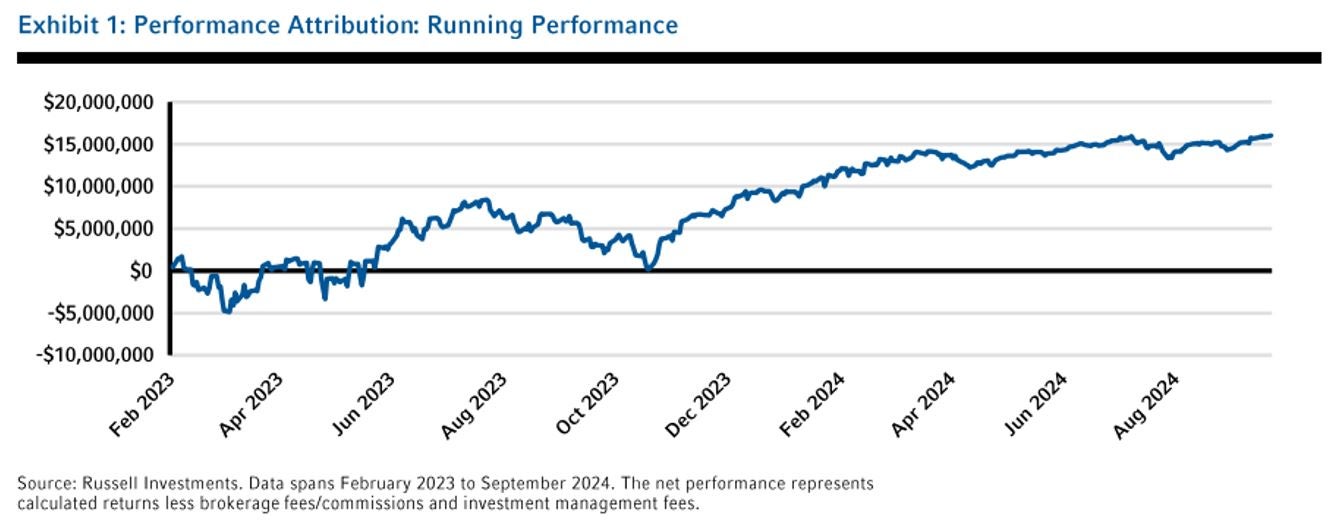
Case study 3: Supporting a university’s self-directed exposures with overlays and more
The organization: A large public university with an endowment exceeding $10 billion in total assets.
The challenge: The university’s investment team prefers to direct their own exposures. They required an implementation partner and platform they could leverage as their needs changed. They did not have the capacity or infrastructure in-house, so this necessitated partnering with an external manager. But they wanted to avoid handing over the keys—they wanted to maintain control.
The solution: We provided overlay services, execution services, FX trading and cash management. The overlay platform enabled the client to access a variety of derivative exposures, including equity futures, ETFs and equity options. The client used our trading desk to sell equity shares distributed by their private equity partnerships, using our broad broker/dealer network to access desired liquidity and maintain anonymity while liquidating large positions. The client used our FX trading desk to manage funding for capital calls, as well as place tactical currency hedges on private investments. Regarding cash management, we launched several different short-term investment accounts for the client, now totally over $850 million.
The result: By leveraging the intersection of capabilities and customization, the university’s investment team now has access to a comprehensive toolkit for addressing a wide range of challenges. The client has seen strong cost reduction and performance numbers as well.
Overlays
- Gains from option-hedging single name stocks: ~$10.6 mm
- Estimated savings from S&P 500 Futures to ETF transition: ~$1.5mm in 2024, and ~$8 mm in 20251.
Execution Services
- 335 individual events since inception
- ~$820 mm traded
- +78.2 bps vs. VWAP (Volume Weighted Average Price-client benchmark)
FX Trading
- ~$3 billion in flows traded since inception, in spots and forwards
- 0.31 bps average cost from all trading vs. upwards of 7 bps for similar transactions executed through a custody platform2.
Cash Management
- On largest cash pool, +65 bps outperformance vs. client benchmark since inception (December 1st, 2023).
Case study 4: Extending the team of a university endowment, while reducing costs
The organization: A private research university with a $15+ billion investment program. The investment program consists of multiple distinct investment pools.
The challenge: The client identified cash drag as the primary issue. Their portfolio consistently held higher-than-desired uninvested cash due to the need for operational cash reserves and receivables from manager redemptions. Additionally, they had developed a custom-beta portfolio using equity and fixed income ETFs. They wanted a more cost-efficient way to implement this approach.
The solution: To address cash drag, we implemented a cash-equitization strategy using highly liquid global equity futures. By aligning the overlay with the client’s public equity benchmark, we sought to keep the portfolio fully invested while preserving liquidity for operational needs. For the custom-beta portfolio, we conducted a comprehensive cost-benefit analysis, comparing ETFs, derivatives, and physical separate accounts.
The result: The cash overlay implementation has maintained beta exposure while ensuring liquidity for operational needs. This approach has minimized the negative impact of cash drag on the portfolio. For the custom-beta exposure, our analysis revealed that while derivatives are the cheapest to trade, current financing costs are historically high, making them less attractive for longer-term holdings, when liquidity is not an issue. In contrast, physical separate accounts, though costly upfront, proved to be the most cost-effective solution for flexible and custom broad-market exposures. For highly liquid benchmarks, ETFs remained the preferred choice, when tracking error and management fees were low.
The broader implications of customization
The power of customization in institutional investing extends beyond these specific examples. By tailoring investment solutions to meet specific goals and objectives, institutional investors can achieve greater control, flexibility, and alignment with their mission and values. Customization allows for more efficient use of resources, enhanced risk management, and the potential for higher returns, but it is only possible if the provider has the right set of capabilities.
As the investment landscape continues to evolve, the ability to customize investment solutions will remain a critical tool for institutional investors seeking to navigate complex markets and achieve their long-term goals. Whether through reducing costs, implementing self-directed strategies, optimizing cash holdings, or aligning investments with philanthropic objectives, customization offers a powerful means of enhancing overall investment performance and achieving specific financial outcomes.
1Projected savings and earnings numbers assume roll costs remain around +100bps, on average, for the next 12 months.
2Cost analysis provided via FX Transparency