

Key takeaways
- Investors are showing renewed preference for companies with tangible earnings and cash flow.
- We see markets rewarding disciplined stock selection over thematic speculation.
- Slowing global growth and sticky inflation reinforce a focus on quality and diversification.
- We believe fundamentals—not headlines—will drive the next phase of AI-related equity performance.
Show me the money
Global equities closed November mixed, as investors began favoring proven earnings power over speculative growth. The MSCI World Index ended roughly flat for the month, with value, small-cap, and dividend-paying stocks outperforming large-cap growth names. Healthcare significantly outpaced information technology by over 12%.
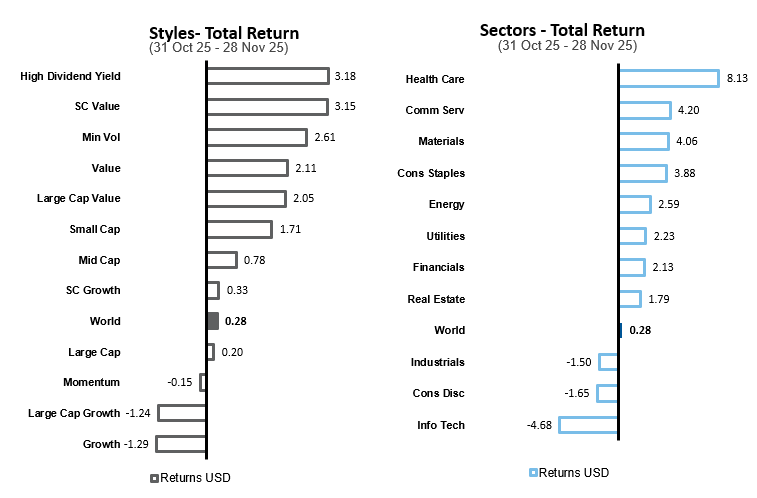
Source: MSCI, Russell Investments
Fundamentals take the lead
After months dominated by AI-driven enthusiasm, November marked a subtle shift in tone. Investors appeared more discerning, rewarding firms that delivered measurable profit growth and penalizing those reliant on narrative. Alphabet’s strong quarterly results—underpinned by revenue momentum and expanding cloud computing business—stood out as evidence that solid execution still commands a premium.
In contrast, other high-profile names tied to the AI trade faced pressure. Companies making large capital expenditure announcements without corresponding revenue traction saw muted or negative reactions. This divide suggests markets may be entering a new phase in which execution and profitability matter more than potential.
We believe this re-emphasis on fundamentals is healthy. After a long stretch of sentiment-driven performance, the pendulum appears to be swinging back toward earnings quality and balance-sheet strength—conditions that typically favor active, selective management.
AI enthusiasm meets reality
Could the AI bubble be deflating? While enthusiasm for transformative technologies remains high, investors are asking harder questions about return on investment. Market reaction to recent announcements in semiconductors, cloud infrastructure, and enterprise software indicates that capital spending alone is no longer enough to sustain momentum.
We see this as an early sign of normalization rather than a breakdown. The AI theme remains intact but is evolving from early-stage optimism to demonstrating real-world results. Over time, this shift could help distinguish established leaders from players with less-proven business models. For long-term investors, the key may be identifying businesses that can translate technological leadership into scalable earnings and sustainable cash flow.
Macro backdrop: Slowing but stable
Beyond the AI narrative, global macro conditions continue to moderate. Leading indicators point to softer labor markets, slower demand growth, and sticky inflation. Central banks appear cautious but not overly restrictive, balancing the need to manage inflation expectations with the desire to avoid triggering a downturn.
These cross-currents are shaping a more discriminating market environment. We believe higher-quality companies—with resilient business models and steady cash generation—are likely to stand out in this phase. In our view, diversification across sectors, styles, and geographies remains essential as equity leadership broadens beyond the narrow band of mega-cap technology.
Investor implications
Equity markets are shifting from story-driven rallies to results-driven scrutiny. We believe investors can benefit from portfolios that combine selective exposure to innovation with broader diversification and a quality bias. The ability to balance participation in long-term growth themes—such as AI—with protection against volatility may define success in the year ahead. In our view, fundamentals and discipline will be critical as markets enter 2026.