

Key takeaways
- The U.S. and global economy remain on solid footing
- We don’t believe recent geopolitical developments pose a systemic risk to markets at this time
- In this environment, disciplined diversification—not reactive positioning—remains the most effective response
2026 has begun with a firehose of headlines for investors.
On geopolitics, we’ve seen a U.S. intervention in Venezuela, protests in Iran, and hawkish rhetoric aimed at Greenland and other nations. On domestic policy, there’s been a subpoena of Federal Reserve Chair Jerome Powell, new tariffs, and regulatory proposals targeting real estate, consumer banking, and defense. It’s a lot. And it feels like it’s all happening at once.
For investors, however, the more important question isn’t whether the world feels unstable. It’s whether that instability is actually capable of breaking markets.
Thinking clearly in an environment like this requires two perspectives. First, an assessment of the foundation—how resilient markets and the economy are to absorbing change. Second, an assessment of how consequential that change actually is.
Why markets haven’t broken
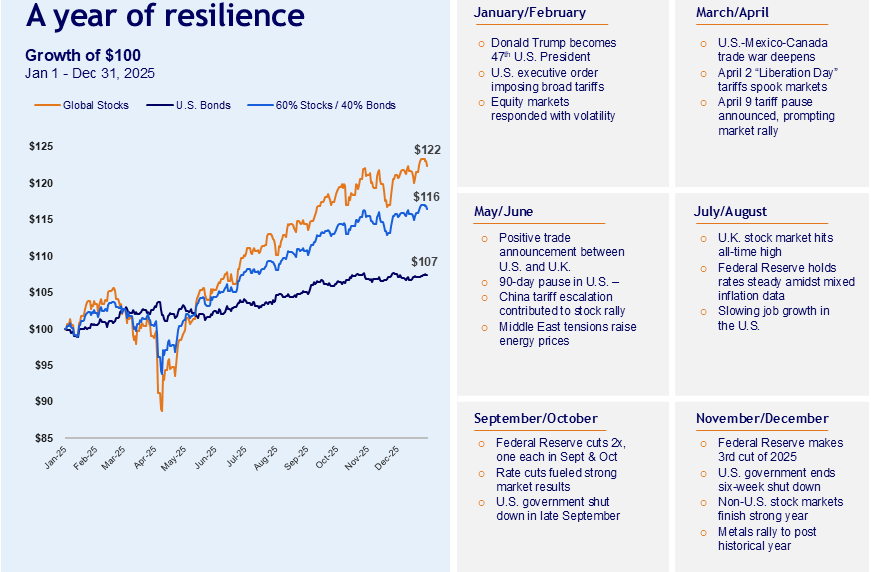
The U.S. and global economy have shown extraordinary resilience in recent years. Since 2022, the global economy has absorbed the most aggressive Federal Reserve hiking cycle in four decades, a major war in Ukraine, the largest tariff increases since the Great Depression, and the most restrictive immigration environment since the 1950s—without tipping into a global recession.
Despite all of that, private-sector balance sheets remain strong. Productivity growth has improved. Corporate earnings are healthy and increasingly broad-based.
That doesn’t mean the picture is flawless. It never is. Beneath the strong aggregates, familiar fault lines remain. Hiring has cooled. Housing affordability continues to constrain activity. And consumer spending reflects a K-shaped reality, with higher-income households far better positioned than others.
Still, these undercurrents coexist with a solid foundation. They represent friction, rather than fracture. The economy closed out 2025 in a state of resilience, not fragility, and may even be positioned for an acceleration in 2026.
History suggests markets don’t break because headlines are loud. They break when fundamentals quietly deteriorate.
What actually matters—and what doesn’t
Part of our job as investors is to separate signal from noise. In moments like this, our teams rely on three tools: experience from navigating multiple crises together; real-time measures of market psychology that help identify opportunities when prices move too far from fundamentals; and the ability to pair in-house analysis with insights from our open-architecture platform, which draws on some of the best money managers in the world.
With market psychology neither panicked nor euphoric, fundamentals—not sentiment—should guide incremental positioning decisions. The short version is this: what has transpired in recent weeks does not yet rise to the level of posing a systemic risk for markets.
Not all geopolitical shocks are equal. Historically, events in the developing world matter most for asset prices when they materially disrupt global supply chains or commodity markets.
Venezuela, for example, is largely isolated from Western markets and accounts for only about 1% of global crude oil production. Iran’s contribution to global oil supply is also in secular decline. The primary risk there is less about output than geography—most notably the Strait of Hormuz, through which roughly 25% of global oil supply transits each year. The risk warrants attention, but it must be weighed against the broader need to balance growth and resilience in portfolio positioning.
Recent actions by the U.S. administration involving Governor Lisa Cook and Chair Jerome Powell are unprecedented and have understandably raised questions about Federal Reserve independence. At this stage, however, it remains unclear whether these processes will result in any changes to Fed leadership. Reporting that the Treasury Secretary and several Senate Republicans are frustrated by the Department of Justice investigation offers some reassurance.
It’s also worth remembering how monetary policy decisions are actually made. The Federal Open Market Committee sets interest rates by majority vote. Even as the Fed Chair changes this May, many committee members may be reluctant to cut rates further should the economy strengthen in 2026, as we expect.
Markets tend to overemphasize the power of any one policymaker and underestimate the discipline imposed by data, voting rules, and economic reality itself.
The investment reality
Our outlook has not changed materially in recent weeks. We remain constructive on the path forward for the global economy and corporate earnings and are invested accordingly.
At the same time, an environment defined by frequent shocks reinforces the value of diversification—maintaining exposure to growth while ensuring portfolios are resilient to downside risks. That balance matters more than reacting to each new headline.
Much of the recent surge in news reflects noise rather than signal. For investors, the dominant risk right now isn’t complacency—it’s mistaking volatility in the news cycle for a genuine break in the economic foundation, rather than managing portfolios with a deliberate blend of growth and resilience.