

Key takeaways
- Members of the $20 billion club – our term for the group of U.S. defined-benefit plan sponsors with the largest liabilities – have seen a remarkable improvement in their funded status over the past 10 years.
- Plan sponsors have now heightened their focus on risk management, including the use of liability-hedging strategies to reduce exposure to interest-rate and equity risk, as well as broader efforts to diversify return-seeking sources.
- While most large sponsors have increased their fixed income exposure, IBM has gone the other way, shifting from fixed income to public equities and alternative assets in order to support benefit accruals in its previously frozen DB plan.
Corporate pension sponsors don’t enjoy unwelcome surprises, particularly those that create financial strain. Many experienced significant financial stress following the Global Financial Crisis and the prolonged decline in interest rates that followed. Both materially eroded funded status, driving substantial contribution requirements and balance sheet impacts. Fortunately, funded status has recovered well, as we detail in our recently posted annual paper on the $20 billion club.
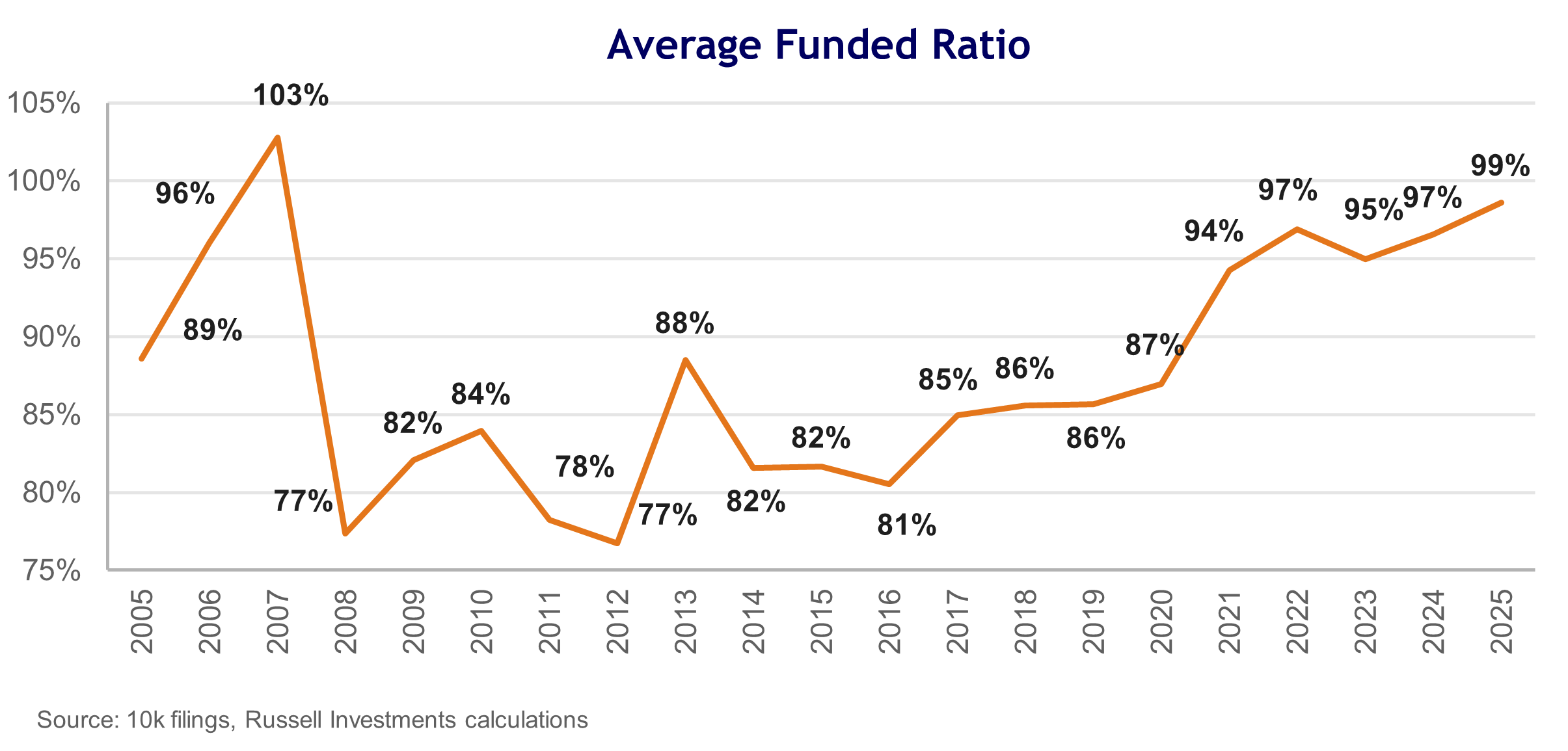
Figure 1 illustrates how average funded status has evolved since 2005 for the largest listed U.S. corporate pension sponsors. Notice the massive drop in funded status in 2008, followed by a volatile period for the next several years. During this time plan sponsors made dramatic changes to their asset allocations, and the reward has been relatively stable – and improving – funded status experience since.
Figure 1: Average global pension funded status for the 21 members of the $20 billion club
The past two decades have sharpened the focus on pension risk management, especially for plans that meaningfully influence corporate financials. Sponsors remain willing to take compensated risks but increasingly seek to mitigate unrewarded risks. The members of the $20 billion club have been at the forefront of this shift.
Efficient LDI implementation
In one of our earliest papers on this group in 2012, GM and Ford – companies where pension liabilities once exceeded company market caps – announced significant increases to their liability-hedging fixed income allocations, with Ford ultimately targeting 80% in LDI. The idea appeared a bit radical at the time, but this was a clear signal that they had no interest in holding onto excessive interest rate or equity risk. At the time, shifting from public equities to fixed income was the most direct way to reduce these risks. Over the past 15 years, however, implementation has become more sophisticated.
For example, AT&T, with approximately $30 billion in global pension liabilities and roughly 43% of assets in fixed income, implemented an LDI overlay in 2025 using about $7 billion in notional interest rate derivatives. The approach enhances liability hedging without requiring a corresponding increase in fixed income that could dilute expected returns.
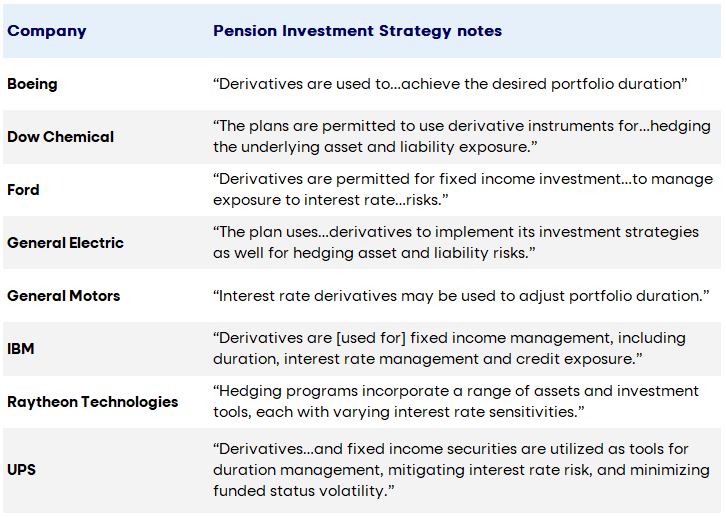
Such strategies are now commonplace among larger plan sponsors. Public filings frequently reference derivatives as tools for duration management and liability hedging. Some examples from this group are shown in Table 1.
Table 1: Liability hedging derivatives strategies. Source: 10-k filings.
LDI overlays are increasingly common among mid-sized sponsors as well. They offer a capital efficient duration extension for plans with lower fixed income allocations and allow more precise curve positioning for plans that already have high allocations to fixed income.
Portfolio diversification
Fifteen years ago, the average asset allocation among the largest plan sponsors was roughly 60% return-seeking and 40% liability-hedging fixed income and cash (60/40). As funded status has improved and risk tolerance declined, this average mix gradually shifted to roughly 40% in return-seeking and 60% in liability-hedging (40/60).
Importantly, the decline in return-seeking exposure has been concentrated in public equities. Private assets, including real estate, hedge funds, private credit and private equity have increased during that time, making up over half of return-seeking allocations. Public equities have become a small portion of overall assets, leading to lower overall portfolio volatility.
Sponsors are increasingly focused on improving risk-adjusted efficiency across the portfolio. Dow, for example, has increased their fixed income exposure from 40% to 49% since 2011. Over the same period, its allocation to “alternative investments” has increased from 15% to 26%, peaking at 30%. The result is greater diversification of return sources, new sources of yield and return, and most likely a portfolio with less (but tolerable) liquidity.
While the financial headlines highlight public equity returns, large pension sponsors operate with broader diversification mandates. This approach has contributed to lower funded status volatility.
IBM: Shifting the narrative
While most sponsors are shifting in one direction toward fixed income, IBM is moving the other way, having transitioned from 83% in fixed income in their U.S. pension plan two years ago, to only 55% now. Two things stand out to me on this massive shift in asset allocation strategy:
- IBM was the same sponsor that reopened its previously frozen and overfunded pension plan, while removing the employer match on its 401(k) plan. The shift away from fixed income shows that they are seeking to generate additional return in the portfolio to help support these new benefit accruals further into the future.
- The 45% target return-seeking assets are being allocated to a variety of asset classes, including public equity (20%) and another 25% in a variety of alternative assets such as hedge funds, infrastructure and private credit. This is consistent with the largest plan sponsors’ approach to return-seeking assets, where they invest heavily in alternative asset classes as they seek better risk-adjusted returns.
- While IBM may be an uncommon example, it highlights the importance that asset allocation isn’t a set-it-and-forget-it exercise. Asset allocation needs to evolve with the plan and should be reviewed regularly as well as in light of large changes to the plan structure or other events. In IBM’s case, the new asset allocation aligns better with a plan that is open and ongoing than the asset allocation of just a couple years ago that was tailored to a closed and frozen plan.
The bottom line
As Figure 1 shows, funded status volatility was pronounced during and shortly after the Global Financial Crisis, driven largely by interest rate movements and public equity market swings. In contrast, the past several years have shown more subdued changes.
The funded status stability appears intentional. Through disciplined liability hedging, capital-efficient overlay strategies, and diversified return-seeking portfolios, most of the largest pension sponsors have structurally reduced funded status volatility. This demonstrates that a deliberate approach to risk management can meaningfully reshape pension outcomes.