


Pension delegation refers to trustees outsourcing selected investment or governance responsibilities to specialist providers within agreed frameworks. This can range from delegating operational tasks to adopting broader fiduciary or OCIO-style models. Delegation aims to improve implementation speed, governance efficiency and access to specialist expertise while trustees retain strategic oversight and accountability.
Key takeaways
- Delegation can improve governance efficiency and support faster, more effective decision making.
- Trustees retain strategic oversight while delegating selected implementation and operational decisions.
- Increasing endgame complexity is driving demand for more flexible and responsive governance models.
Pension scheme governance is changing. Schemes are reassessing whether traditional governance models remain fit for purpose and where delegation could improve decision making, implementation and efficiency. In a recent Russell Investments webinar on delegation, featuring Sarah Leslie, Professional Trustee from ndapt, half of attendees identified improving governance and decision making as the area where delegation can deliver the greatest value for pension schemes.
However, despite the growing appetite for the benefits delegation, many industry participants remain unaware that these options are available to them. This is often due to a limited understanding and misconceptions around delegation and the different forms it can take.
What is ‘delegation'?
Delegation is not a one-size-fits-all structure. Historically, the UK market has used the term ‘fiduciary management’, while Outsourced Chief Investment Officer (OCIO) is more common internationally and increasingly associated with larger, more sophisticated delegated models.
However, labels matter less than understanding which decisions are delegated, how accountability is structured and where specialist expertise or scale can add value. Delegation is no longer limited to the largest pension schemes, with around 20% of UK defined benefit (DB) schemes now using some form of fiduciary management.
Delegation exists across a broad spectrum of approaches. Trustees may retain most strategic decisions while delegating selected implementation activities or adopt broader delegated models where day-to-day investment decisions are made within an agreed framework.
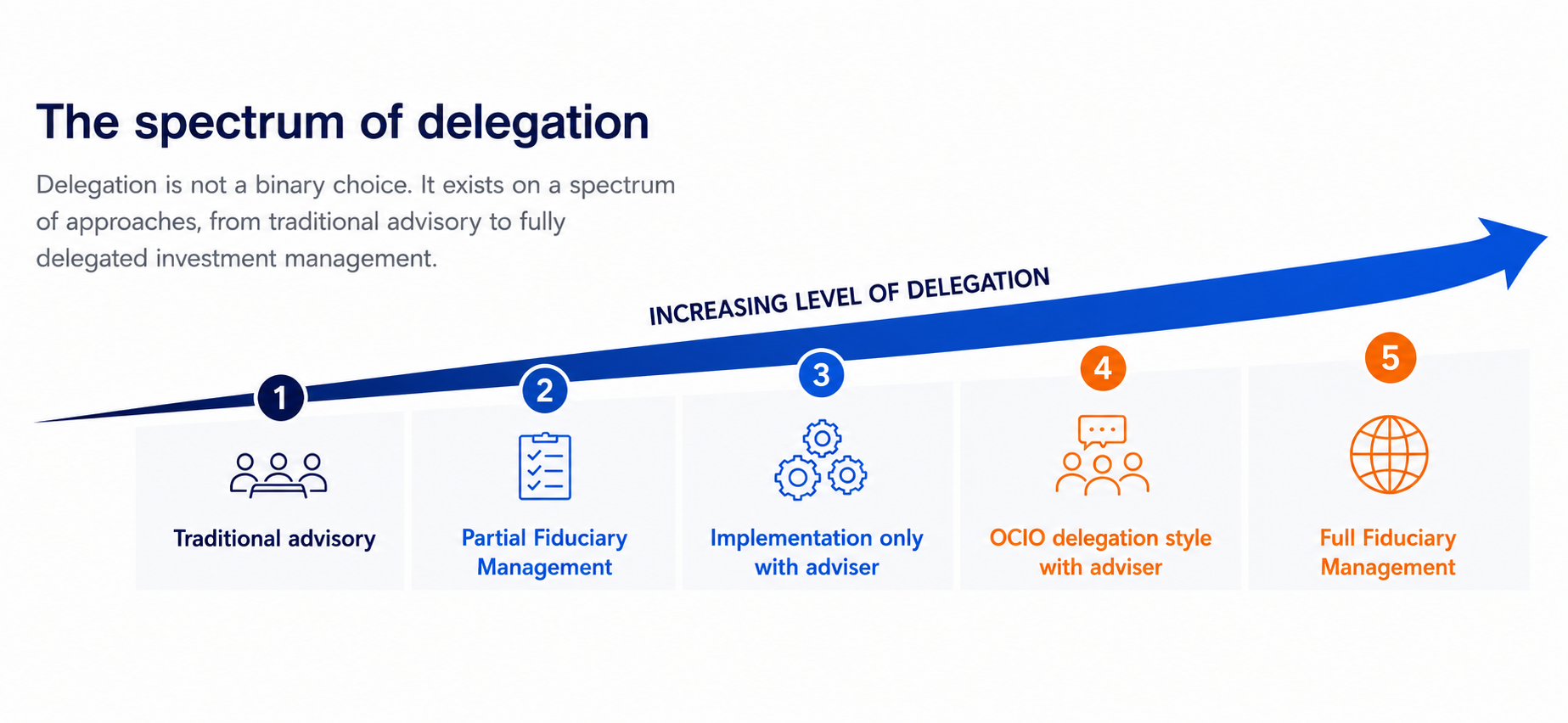
Governance and control are evolving
Another misconception is that delegation means “giving up control”. In practice, many schemes find it changes the nature of control rather than removing it. Trustees still define strategic objectives, risk tolerances and governance frameworks, while day-to-day implementation is delegated within agreed parameters.
This distinction has become increasingly important as areas such as liability hedging, collateral management and transition activity require faster execution and greater technical expertise than traditional governance structures often allow.
For many trustee boards with limited governance time, delegated approaches can free up greater focus on strategic priorities and oversight, while enabling implementation decisions to be made more efficiently.
“Delegation is massively situation specific… a lot of the time there are a lot of drivers that come together to lead to the decision to delegate.” Sarah Leslie, Professional Trustee, ndapt.
Value for money extends beyond headline fees
Discussions around delegation have also historically focused on fees, with many viewing cost as a deterrent. However, trustees are increasingly taking a broader view of value for money.
Comparisons between delegated and non-delegated approaches are often more complex than headline fees suggest. Functions such as manager selection, portfolio transitions, liability hedging and operational oversight may sit within a delegated model but otherwise require additional advisory, governance or implementation resource elsewhere.
Governance capacity also matters. Delegating selected functions can allow trustees to focus more time on strategic priorities, particularly during periods of market volatility or changing endgame conditions where timely implementation can materially influence outcomes.
Endgame may increase governance demands
Another common misconception is that delegation becomes less relevant as schemes move closer to endgame. In reality, the opposite may increasingly be true. As schemes mature, investment and operational decisions can become more complex rather than less complex.
Preparing for buyout can involve significant work around insurer readiness, portfolio alignment, collateral management and execution efficiency. At the same time, growing interest in run-on strategies may place different, but equally significant, demands on governance structures and implementation capability.
For some schemes, delegation is therefore evolving from a return-seeking framework into a broader governance and execution framework designed to support increasingly complex strategic journeys.
“Even smaller schemes are looking at more complex and bespoke solutions now.” Sarah Leslie, Professional Trustee, ndapt.
Key questions for trustees to consider
As governance demands, implementation complexity and endgame considerations continue to evolve, trustees may increasingly need to reassess whether their current governance structures remain fit for purpose.
Key questions schemes may wish to consider include:
- Which investment decisions genuinely benefit from trustee involvement, and which may be better delegated within a clearly defined framework?
- Does the current investment governance structure allow decisions to be implemented at the pace required by today’s market environment?
- How should value for money be assessed beyond headline fees alone?
- Are governance structures aligned to the scheme’s long-term objectives and endgame strategy?
- As schemes mature, will governance and operational demands become simpler — or more complex?
Delegation is not a one-size-fits-all solution. The key question for trustees is increasingly not whether to delegate, but where delegation can most effectively support governance objectives, implementation capability and member outcomes as schemes evolve.
Common client questions
Delegation does not remove trustee control; it changes how control is exercised. Trustees continue setting strategic objectives, risk tolerances and governance frameworks, while day-to-day investment implementation is delegated. Many schemes find this structure improves decision making by enabling faster execution and allowing trustee boards to focus more effectively on strategic oversight.
Pension schemes are increasingly delegating because investment environments and governance demands have become more complex. Areas such as liability hedging, collateral management and transition activity often require faster decision making and specialist expertise. Delegated approaches can improve operational efficiency while helping trustees manage limited governance time and growing endgame pressures.
As pension schemes mature, preparing for buyout or considering run-on strategies can increase governance complexity. Delegation can support insurer readiness, portfolio alignment, collateral management and efficient execution during critical transition periods. For many schemes, delegated governance is becoming an important framework for navigating increasingly sophisticated endgame planning requirements.
Any opinion expressed is that of Russell Investments, is not a statement of fact, is subject to change and does not constitute investment advice.