

Yes, by proceeds and market cap it could. Share sales from SpaceX, OpenAI, and Anthropic would push U.S. IPO fundraising beyond the record set in 2021 if the companies move forward at the scale currently being discussed.
Key Takeaways:
- Potential IPOs from SpaceX, OpenAI, and Anthropic could make 2026 a record year for U.S. IPO proceeds.
- The latest reported figures put SpaceX’s target IPO valuation at $1.75 trillion and OpenAI and Anthropic at recent valuations of $852 billion and $965 billion, respectively.
- AI mega-rounds now dominate late-stage private market funding.
- A handful of mega listings could quickly influence benchmark leadership.
A new IPO cycle emerges around AI leaders
The IPO market may be entering one of its largest cycles in years, but the next wave may be defined less by breadth than by scale. Instead of hundreds of companies listing, a smaller group of AI and strategic infrastructure leaders could reset the market on their own.
SpaceX, OpenAI, and Anthropic are the three names at the center of that discussion. The latest reported figures put SpaceX’s target IPO valuation at $1.75 trillion and OpenAI and Anthropic at recent valuations of $852 billion and $965 billion, respectively. Together, those figures point to roughly $3.5 trillion of potential public-market value if these companies list at or near current expectations.
That scale could make 2026 a record year for U.S. IPO fundraising. Share sales from all three companies would push proceeds beyond the prior U.S. IPO fundraising record set in 2021. Public investors have limited direct exposure to many of the companies driving AI adoption, compute demand, and next-generation infrastructure. If several list in a compressed window, they could influence benchmark construction, and once eligible for index inclusion, redirect passive fund demand toward a new group of AI leaders.
Here are four charts that explain the scale, concentration, and investor implications behind 2026’s potential mega IPO class.
1. Potential mega IPOs could dwarf prior VC-backed listings
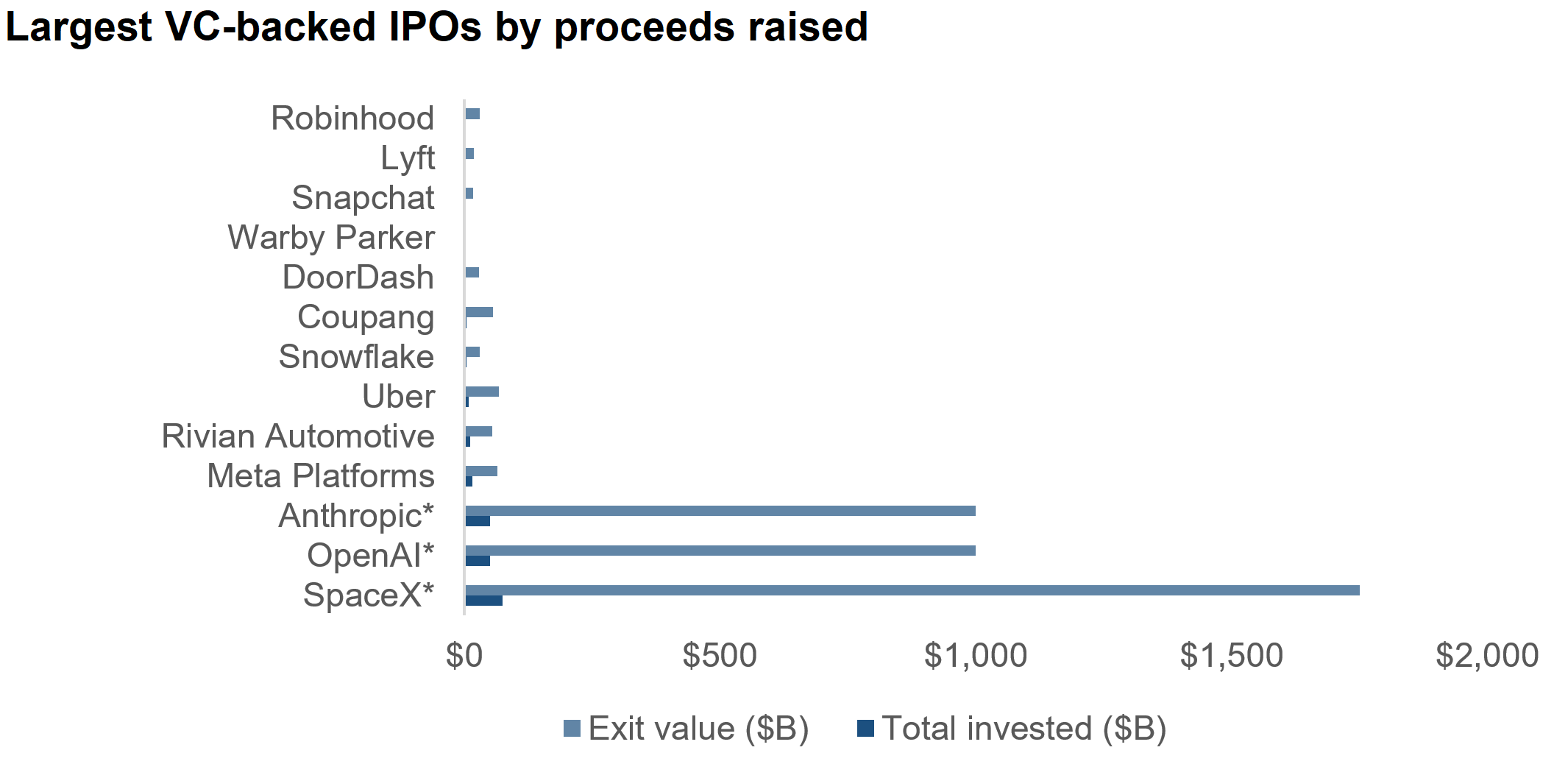
Source: PitchBook, Geography: US, *Values are estimated by Russell Investments based on press reports as of May 26, 2026.
The first chart shows how unusual this IPO cycle could be. Prior landmark VC-backed listings such as Meta, Uber, Rivian, Coupang, and Snowflake entered public markets with exit values measured in the tens of billions of dollars. The companies now being discussed are valued in the hundreds of billions or trillions. Even one successful mega listing could create more headline market value than many prior IPO cycles combined.
2. The IPO recovery may be large by value, but narrow by count
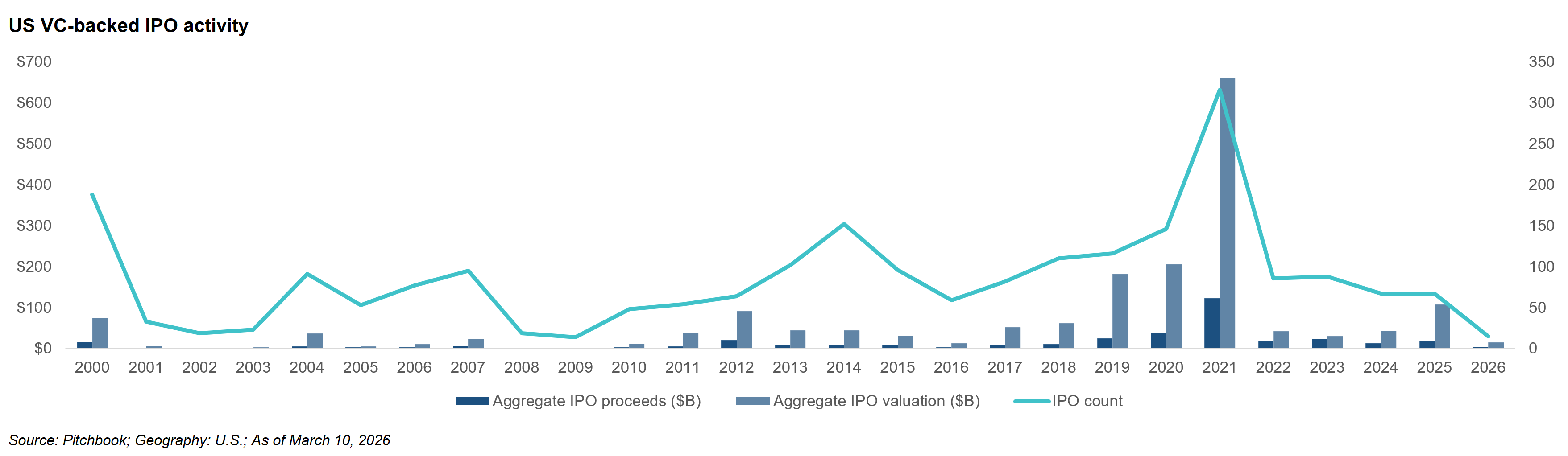
The 2021 IPO boom remains the key comparison point. That year produced over $123 billion of proceeds across over 300 VC-backed IPOs, the highest number of VC-backed listings in the period shown.
The 2026 setup looks different. It could be a record year by proceeds without feeling like a broad reopening for most private companies. Public markets may be willing to fund scarce, category-defining assets tied to AI and strategic infrastructure, while many late-stage companies still face a tougher exit environment.
The risk is that mega listings absorb capital and attention from the rest of the IPO pipeline. Strong debuts could improve sentiment and pull other companies forward. Weak trading could increase volatility and delay smaller offerings.
3. AI mega-rounds are concentrating private-market capital
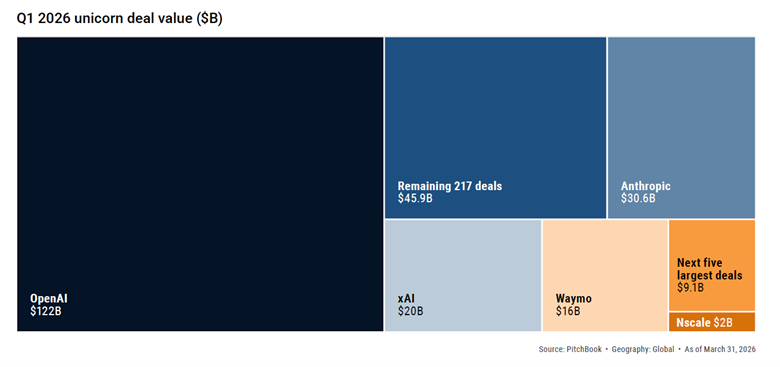
The third chart shows how concentrated private market funding has become. In Q1 2026, unicorn deal activity reached $246 billion across 227 transactions. Five companies – OpenAI, Anthropic, xAI, Waymo, and Nscale – accounted for 78% of all deal value, while the top 10 captured 81%.
That concentration changes how investors should read venture activity. Aggregate deal value now says more about the financing needs of a few frontier AI and infrastructure companies than it does about the median unicorn. Venture capital into AI is becoming more concentrated, more capital-intensive, and later-stage. Investors are not simply funding software companies. They are funding businesses that require enormous amounts of compute, infrastructure, talent, and distribution to compete.
It also helps explain the intensity around the IPO pipeline. Public investors want direct exposure to the companies driving the AI cycle, but much of that exposure remains private.
4. A handful of IPOs could influence benchmark leadership
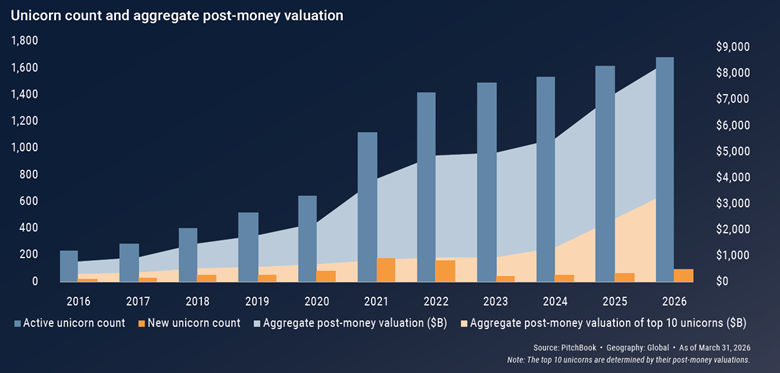
The fourth chart highlights the same concentration at the valuation level. There are now 1,680 unicorns with an aggregate valuation of $8.6 trillion, but the 10 most valuable private companies hold 41% of aggregate unicorn value. AI represents 37% of unicorns by count and 48% of unicorn value.
The latest figures for SpaceX, OpenAI, and Anthropic make the benchmark question more immediate. If companies of that scale enter public markets, they are not just new IPOs. They are potential benchmark constituents. That could influence index weights, passive fund flows, and relative leadership across large-cap growth equities.
It also raises a portfolio construction question: what gets displaced? If public benchmarks absorb several AI and strategic infrastructure companies at massive valuations, existing constituents may lose relative weight. Investors may gain more direct exposure to the AI cycle, but they may also inherit more concentration risk.
Investor implications
The next IPO cycle may be selective rather than broadly open. Investor demand is likely to favor AI infrastructure companies, hyperscale AI applications, and dominant category leaders growing at historic speed. Anthropic’s rapid ARR expansion shows how quickly enterprise AI adoption can translate into scale.
Mega IPOs could unlock much-needed venture liquidity, but the benefits may remain concentrated in a small group of winners. For public investors, trillion-dollar or near-trillion-dollar listings could reshape growth benchmarks, create more direct AI exposure, and increase concentration risk.
For other IPO candidates, the bar is higher. Legacy SaaS companies with limited AI leverage or modest differentiation may stay private longer or seek liquidity through M&A or private equity.
If 2026 becomes a mega IPO year, it may mark the moment when public markets gain direct access to a new generation of AI and strategic infrastructure leaders at unprecedented scale.
Common client questions
The latest reported figures put SpaceX’s target IPO valuation at $1.75 trillion and OpenAI and Anthropic at recent valuations of $852 billion and $965 billion, respectively.
The largest AI companies require enormous capital to fund compute, infrastructure, model development, and distribution. In Q1 2026, five companies captured 78% of global unicorn deal value, led by OpenAI and Anthropic. OpenAI’s $122 billion round alone was larger than most full-year venture markets in prior cycles. Anthropic’s just announced $65 billion financing round was also massive by historical venture standards.
Yes. If several AI and strategic infrastructure companies enter public markets at massive valuations, they could quickly become meaningful benchmark constituents. That may influence index weights, passive flows, and leadership within large-cap growth equities.
Many legacy software companies face a more difficult IPO environment because investor demand remains concentrated around AI infrastructure and high-growth platform businesses. Firms with slower growth and limited AI positioning may stay private longer or pursue M&A instead.
Any opinion expressed is that of Russell Investments, is not a statement of fact, is subject to change and does not constitute investment advice.