

Key takeaways:
- Large transition events can place significant portfolios at risk, increasing the focus on how transitions are planned, governed and executed.
- As transitions become larger and more complex, alignment, flexibility and a consultative approach become key considerations when selecting a transition manager.
- Greater market concentration strengthens the case for a more active approach to managing portfolio-level risk throughout a large transition.
Transition events are getting bigger
Transition events are getting bigger. Recent transition events have involved tens of billions in assets, with the largest potentially exceeding $100 billion. As the size of these events grow, so does the importance of how the portfolio transition is planned, managed and ultimately executed.
The challenge is that portfolios remain exposed to markets while assets are being moved and restructured. Markets fluctuate, individual securities can experience sharp price movements, and information about a large buyer or seller can affect execution. Across a large portfolio, even relatively small inefficiencies or adverse movements can translate into significant costs.
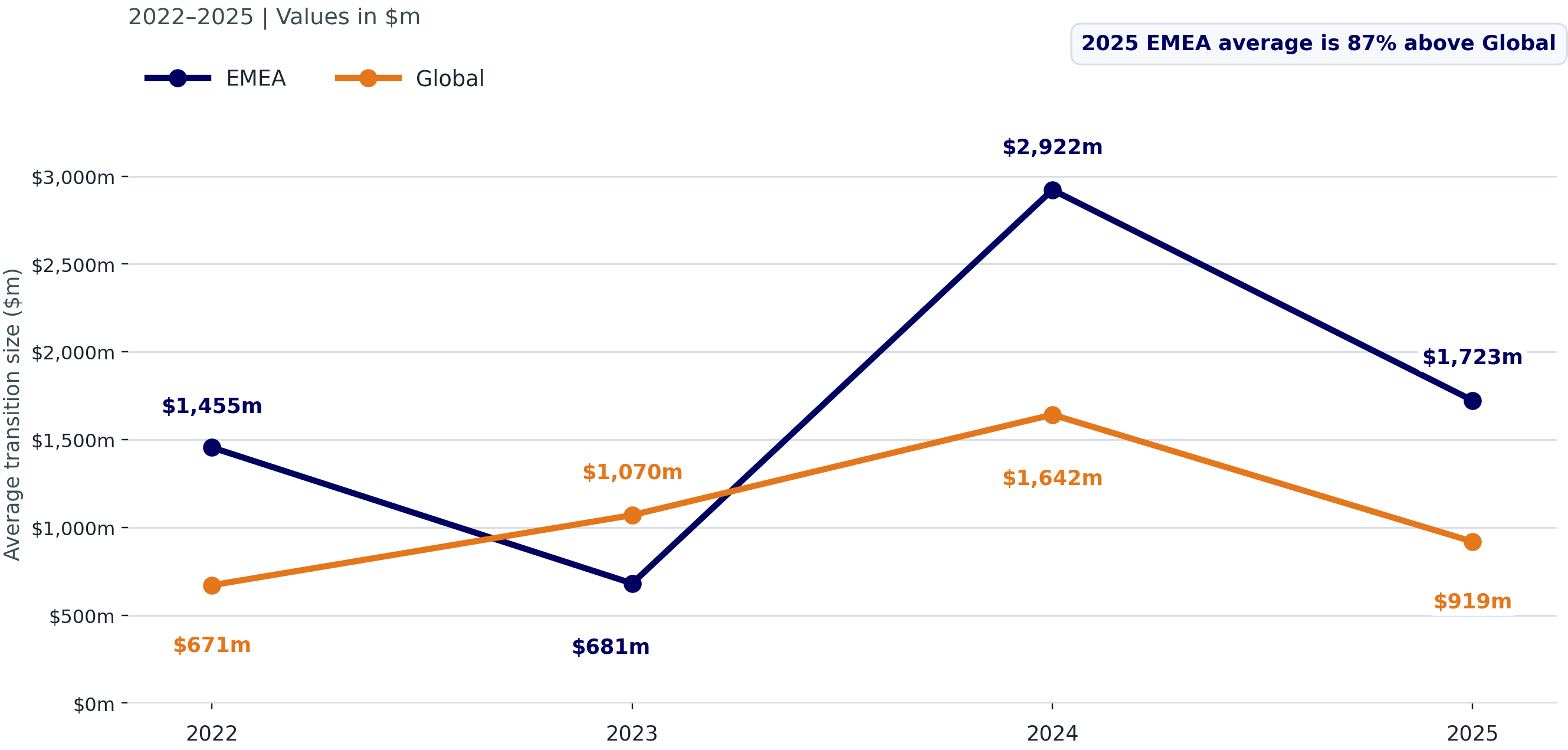
Bigger transition management events, especially in EMEA
Average Russell Investments transition event size, EMEA vs. Global
Source: Russell Investments 2026
The challenge with large transition management events
Transition management has always involved balancing multiple objectives and large transitions are no different. Investors typically want to minimise transaction costs while controlling tracking error, maintaining appropriate market exposure and completing the transition within the required timeframe. However, the larger the portfolio, the greater the potential consequences of getting that balance wrong.
Scale can introduce complexity. A transition may span multiple asset classes, markets, currencies and trading venues. Certain securities may be difficult or expensive to transfer. Tax considerations can influence whether assets should be transferred, crossed in the market or sold and replaced. Settlement requirements can create additional demands on cash and operational resources, particularly in emerging market transitions, which have become more common given the strong positive returns in the asset class.
Therefore, for particularly large events, to balance different objectives and variables institutions may implement scenario planning well before the first trade takes place. In some cases, discussions with a transition manager can start many months and sometimes a year in advance as different approaches are analysed and the operational implications considered. Varying the participation cap (%), number of tranches, period of execution or even including a derivative-based (using futures) or market on close (MOC) benchmark hedge can all influence the estimated cost of a transition and the exposure to key risk factors.
Why does a larger transition require a more consultative approach?
There is rarely one way to execute a complex transition. Consider a portfolio worth tens of billions. An institution might move the portfolio in a single event, divide it into a series of smaller transitions or adopt different approaches for different parts of the portfolio.
Each option creates different trade-offs. A transition manager can model those alternatives before implementation, examining expected costs, risks and operational requirements. A consultative process allows the institution and transition manager to analyse the portfolio, develop potential scenarios and determine which approach best reflects the investor's objectives.
A consultative approach can be particularly valuable in markets where transferring assets is difficult or costly. For example, one emerging-markets transition Russell Investments undertook required different implementation approaches across the portfolio. For some holdings, transferring assets and paying the associated taxes made sense. For others, selling securities in the existing portfolio, transferring cash and repurchasing the required exposure produced a more tax-efficient outcome.
Reaching the preferred solution required scenario analysis and close coordination with the investor to determine whether its operating model could support the necessary cash movements and settlement requirements.
Large transitions can make this type of customisation more worthwhile. When potential savings are significant, institutions may be prepared to dedicate additional internal resources, involve treasury and operational teams or provide capital to support a more efficient implementation approach.
How important is a transition manager’s business model?
Large transitions inevitably involve sensitive information. Knowing that an institution intends to buy or sell a significant position can itself be valuable. As the size of a transition increases, controlling how information is handled and limiting unnecessary information leakage becomes essential.
The sensitivity of trading information also makes the transition manager’s business model an important consideration. Some providers operate within organisations that offer brokerage, custody, asset management or other trading activities, creating potential competing economic interests around a transition. Investors therefore need to understand how a provider is incentivised and whether those interests could influence how, when or where trades are executed.
An unconflicted model can help simplify that question. Using multiple counterparties and independent execution venues creates competition for trades while allowing execution decisions to be made according to the requirements of the transition. The objective is to create an execution framework in which the transition manager's incentives are closely aligned with those of the investor.
Market concentration demands a broader transition manager toolkit
Size is not the only factor shaping transition risk. Equity markets have also become more concentrated in a relatively small number of large companies. For a portfolio in transition, exposure to an individual volatile security can become a meaningful source of tracking error.
This creates an important distinction between the individual trades taking place and the risk across the portfolio as a whole. A regional trader may naturally focus on liquidity, execution and completing the positions in front of them. A portfolio manager can see how those individual trades interact and which securities are contributing disproportionately to overall transition risk.
Having a portfolio-level view can inform execution. Risk analysis can identify the securities contributing most to tracking error alongside those expected to be particularly costly to trade. Traders can then be given priority names and parameters based on that analysis, with the assessment refreshed as the transition progresses, which can materially reduce the exposure to risk during the transition (the “opportunity cost flightpath”). This is particularly relevant for highly volatile or concentrated positions. A large exposure left outstanding may dominate portfolio risk even if most of the transition has already been completed.
Stock specific risk has become more pertinent than ever in transition management. With the evolution of AI we have seen vast growth in these stocks, and their weighting in indices and overall transitions, as well as their underlying volatility. This trend is not unique to developed markets, as even within the MSCI Emerging Markets index the top 3 stocks are Information Technology stocks that supply AI technology (via memory and semiconductors) and comprise a total weighting of ~28% (MSCI Factsheet July 2026).
What should investors look for in a transition manager?
Large transitions magnify the potential costs and risks involved in moving and restructuring assets, which places greater importance on the transition manager’s business model, approach and ability to manage risk throughout the event.
For the largest and most complex transitions, careful planning can be as important as execution. Understanding the investor’s objectives, evaluating different implementation scenarios and identifying the key sources of portfolio risk can help determine how and when assets should be moved.
As transitions grow in size and portfolios become more concentrated, investors may need to look beyond execution capabilities alone. Alignment, a consultative approach and the ability to connect portfolio-level risk with trading decisions can all help support a more effective transition.