



No. Multi-manager investing is not necessarily closet indexing. Although combining active managers can lower a portfolio’s Active Share and Tracking Error, it may also improve risk-adjusted returns by reducing manager-specific risk while preserving multiple sources of potential excess return.
Key takeaways:
- Lower Active Share doesn’t mean less active management. Multi-manager portfolios can reduce risk while preserving excess-return potential.
- Diversification can improve consistency. Combining differentiated managers can increase the probability of positive long-term excess returns.
- Focus on efficient use of active risk. Advisors should look beyond Active Share and Tracking Error to risk-adjusted outcomes and compounding.
For decades Russell Investments has advocated a multi-manager, multi-style approach to active management.
The premise is straightforward. Skilled managers tend to operate in different market habitats such as growth, value and smaller cap, etc. By combining managers and their differentiated investing styles, excess return potential can be preserved while improving the consistency of outcomes over time.
However, while proven, the multi-manager framework is often misunderstood. Multi-manager portfolios usually exhibit lower Active Share and Tracking Error and, as a result, are sometimes dismissed as closet indexers. Yet, this conclusion confuses portfolio difference with portfolio value.
Addressing the myth of low Active Share and Tracking Error
Multi-manager portfolios are sometimes dismissed as “closet indexers” because combining several active managers typically lowers both Active Share and Tracking Error. The assumption is that if a portfolio looks less differentiated from its benchmark, it must also have less potential to outperform.
However, multi-manager differentiation lies deeper, in portfolio construction. Active Share tells you how different a portfolio looks from its benchmark. Tracking Error tells you the variability of its benchmark-relative returns. Neither metric tells you how efficiently the portfolio’s active risks have been assembled.
When managers are combined thoughtfully, manager-specific risk can be reduced without eliminating the underlying sources of excess return. The result can be lower Active Share and Tracking Error, but that doesn’t mean active management has disappeared.
In fact, the measures that really matter, such as risk adjusted returns, ending wealth, and probability of positive excess returns can improve.
Testing the closet indexing myth
Russell Investments tested the closet indexing hypothesis, analyzing 128 U.S. small-cap managers over the 10 years ended March 31, 2026, with 5,000 simulation paths and, importantly, no assumed ability to identify future winners.
The single-manager simulation produced a median outcome close to the market return. In contrast, despite no assumed manager selection skill, both multi-manager portfolios generated positive median excess returns with meaningfully lower Tracking Error. The proportion of simulations producing positive 10-year excess returns increased from 48% for one manager to 72% for three managers and 81% for six, even as Active Share declined.

Under a traditional interpretation, lower Tracking Error and Active Share might suggest the portfolios were becoming less active. Yet the opposite occurred: the active return profile became more efficient, with higher median excess returns, lower Tracking Error, stronger Information Ratios and a higher likelihood of producing positive cumulative excess returns over the 10-year period.
Thoughtful portfolio construction seeks to combine differentiated sources of active return so that manager-specific risks offset one another without eliminating the portfolio’s opportunity to outperform. In this simulation, that resulted in a smoother and more efficient active return profile.
Diversify risk, not return potential
Underneath the results lies one of the most fundamental ideas in investing: diversification.
No active manager wins all the time. Investment styles rotate, market environments change and even skilled managers experience periods when their approach is out of favor. Combining differentiated managers can reduce dependence on any single manager, style, or return pattern.
No active manager wins all the time
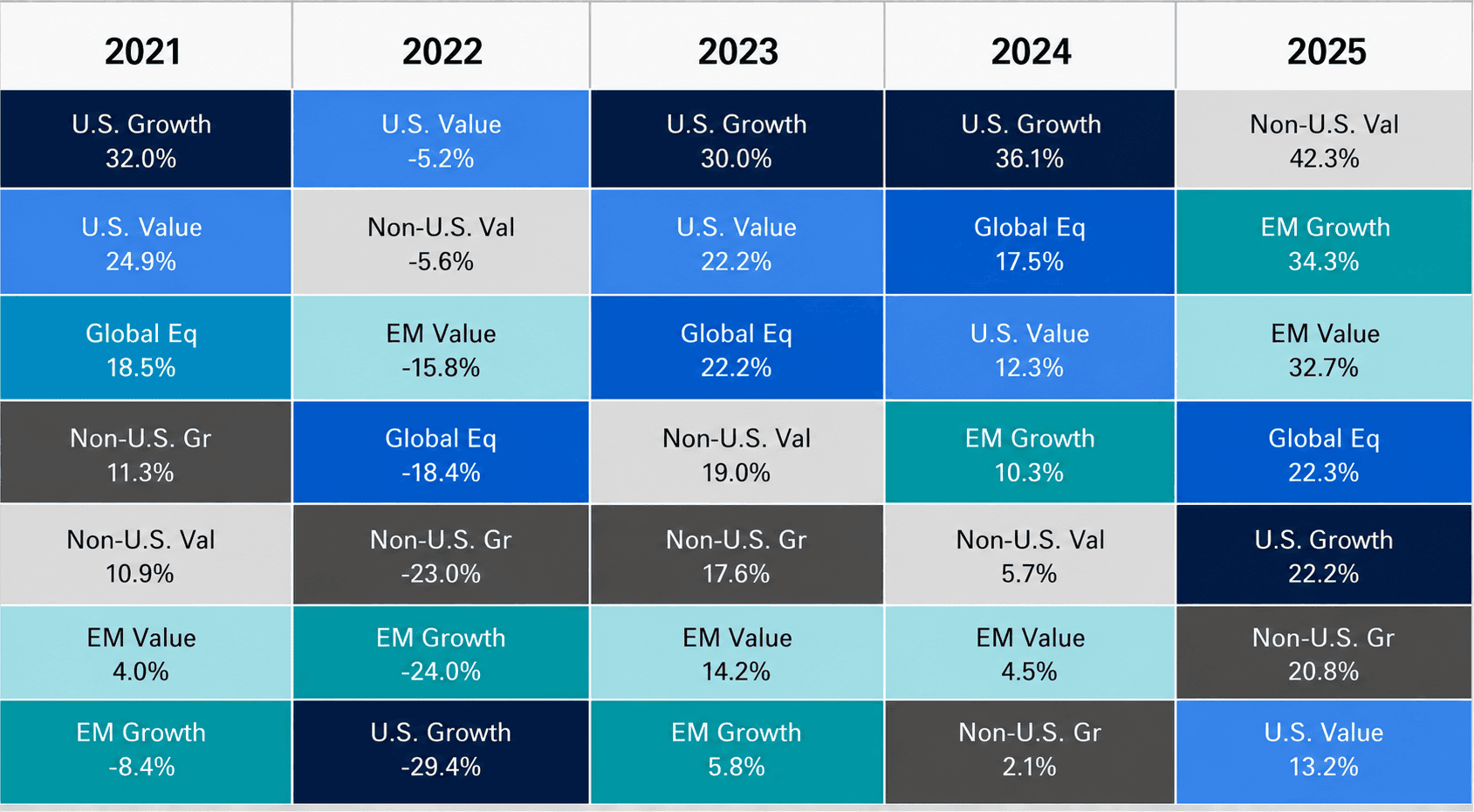
Sources: U.S. Growth and Value: S&P 500 Growth Index, S&P 500 Value Index, Non-US Growth and Value: MSCI World x-US Growth Index and MSCI World x-US Value Index, Emerging Markets Growth and Value: MSCI Emerging Markets Growth Index and MSCI Emerging Markets Value Index, Global Equity: MSCI All Country World Index; MSCI Country returns and value stock classifications.
Volatility affects more than the smoothness of the investor’s journey. Investors experience compounded returns, and greater volatility creates a drag on the rate at which returns translate into accumulated wealth.
A simple hypothetical example illustrates the effect. Holding arithmetic return expectations roughly constant, combining two uncorrelated return streams reduces volatility from 30.3% to 21.4%. Annualized compounded return increases from 5.6% to 8.0%, while terminal wealth rises from 2.96× to 4.68× — nearly 60% more.
Diversification is not merely about reducing risk. By reducing unnecessary volatility while preserving return potential, it can improve the efficiency of returns that compound into long-term wealth.
What advisors should evaluate
The focus for advisors shouldn’t be on whether adding managers makes a portfolio look more or less like its benchmark. What matters is whether those managers are genuinely differentiated, whether their excess returns are imperfectly correlated, and whether the portfolio construction process preserves excess-return potential while reducing uncompensated risk.
In that context, risk-adjusted returns, the consistency and probability of excess returns, drawdowns and compounding can be more informative than any single holdings-based metric.
Investor implications
The objective of active management should not be to maximize Active Share or Tracking Error. It should be to use active risk efficiently. Thoughtfully constructed multi-manager portfolios seek to achieve this by combining differentiated sources of return while diversifying the manager-specific risks investors do not need to take.
Volatility matters to compounding and reducing unnecessary active risk can improve the efficiency with returns that eventually translate into an investor’s long-term wealth.
Common client questions
A multi-manager portfolio combines differentiated investment managers, styles and sources of active return. This diversification can reduce reliance on any single manager, improve consistency across market environments, lower unnecessary volatility and increase the probability of achieving positive long-term excess returns.
Not necessarily. Active Share measures how differently a portfolio’s holdings compare with its benchmark, while Tracking Error measures benchmark-relative volatility. Neither metric shows how efficiently active risks are combined. A portfolio can have lower readings while still delivering a more efficient active return profile.
Diversification can improve long-term compounding by reducing unnecessary volatility without eliminating return potential. When differentiated return streams are combined, the portfolio may experience smoother outcomes, higher compounded returns and greater terminal wealth than a concentrated portfolio with similar arithmetic return expectations.
Advisors should assess manager differentiation, correlations among active returns, risk-adjusted performance, drawdowns, compounding and the probability of positive excess returns. Evaluating these portfolio-level outcomes provides a more complete view of active-management efficiency than relying solely on Active Share or Tracking Error.