

No. Institutions can retain strategic responsibilities and use an OCIO selectively for portfolio management, implementation or specialist functions. The right structure depends on the organization’s existing capabilities and investment needs.
For Peter Corippo, Managing Director, Fiduciary Solutions - Retirement at Russell Investments, doing more with limited investment resources is a challenge he has experienced firsthand.
Key Takeaways:
- An OCIO can help investment teams do more with existing resources by providing access to additional scale, specialized expertise and implementation capabilities.
- The value extends beyond investment performance, with return, risk, cost and operational efficiency all impacting the organization behind the portfolio.
- Outsourcing does not have to be all-or-nothing. Institutions can retain the areas where their internal teams add the most value and use external support to strengthen capabilities elsewhere.
Investment teams are being asked to do more
Running an institutional investment program can be a lonely job. When I was chief investment officer (CIO) at a large utility, we were a team of three supporting the investment program inside an organization of roughly 20,000 people. We thought about investments all day, while almost no one else in the company did.
Our immediate team was small, but the investment program was not. We relied on asset managers, consultants, actuaries, custodians and other specialists. On paper, there was a team of three. In practice, there was a much larger network behind us.
That experience is familiar to many institutional investors. Most organizations are not in the business of managing money, yet their investment teams can be responsible for complex portfolios requiring oversight of performance, risk, implementation, liquidity and governance. This can create significant resourcing challenges. The result can be a constant need to reprioritize tasks that at times mean making difficult choices, deciding between what you want to do and what you can do.
Impacting the bottom line – investment outcomes affect organizational outcomes
When I think about how an investment program affects an organization’s bottom line, I come back to three areas: return, risk, and cost.
They are closely connected. For a defined benefit (DB) pension plan, stronger investment returns can improve funded status and reduce the cost of sponsoring the plan. Managing volatility between assets and liabilities can make those financial outcomes more predictable. Lower investment and implementation costs leave more of that precious return in the portfolio.
A full OCIO can be a compelling answer… but it’s not the only one
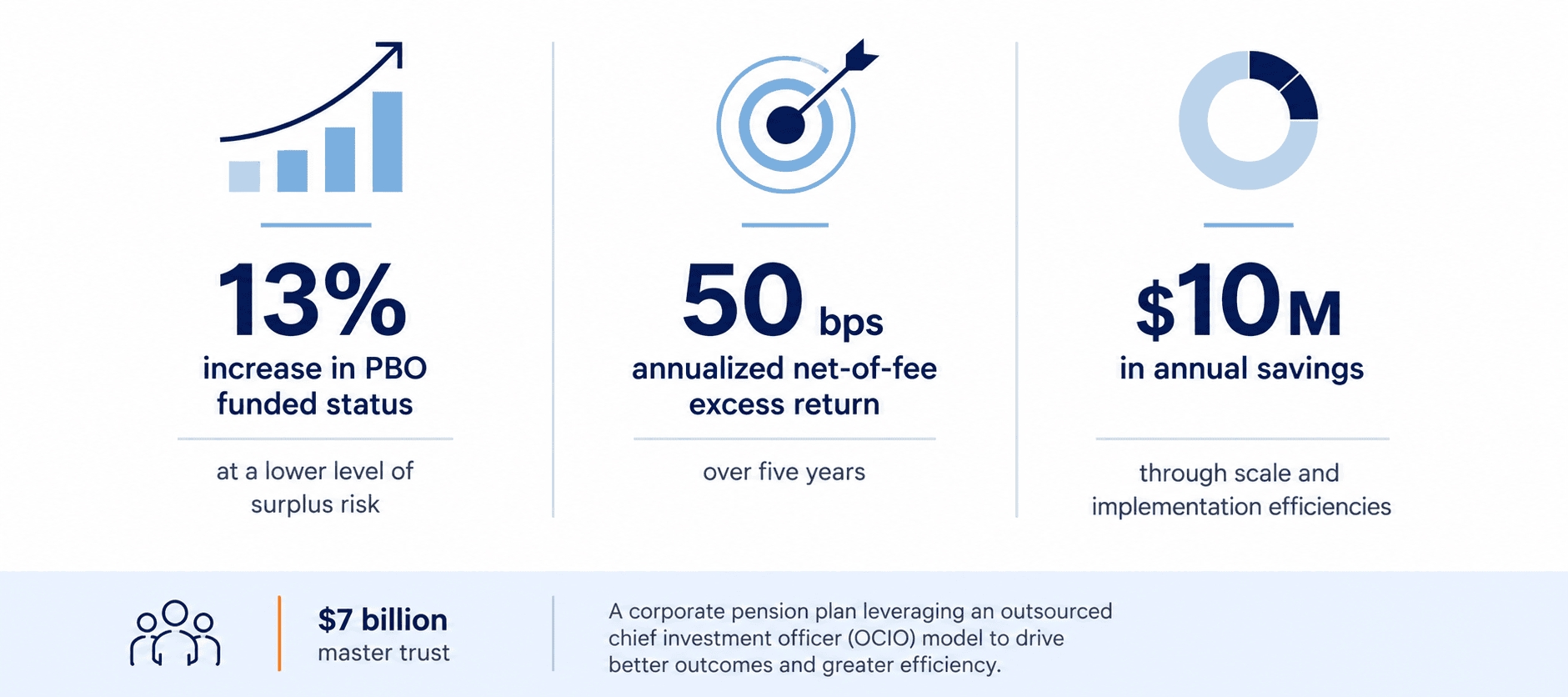
A recent Russell Investments study of a $7 billion corporate pension master trust shows how an outsourced chief investment officer (OCIO) model can translate into financial outcomes. The OCIO relationship improved projected benefit obligation (PBO) funded status by 13% with lower surplus risk and delivered 50 basis points of annualized net-of-fee excess return over five years. Scale and implementation efficiencies also reduced fees by 47%, generating $10 million in annual savings. These results were achieved by first partnering with the investment committee to ensure the overall asset/liability management solution was right for their enterprise and stakeholders. Russell Investments then implemented everything from manager selection and retention to ongoing risk management and monitoring.
For the sponsor, those outcomes extend beyond the portfolio. Improved funded status can affect future contribution requirements, while lower surplus risk can reduce the volatility the pension plan introduces to the company’s financial position.
Figure 1. OCIO partnership delivered stronger outcomes
Source: Russell Investments. For illustrative purposes only.
Delegation is not all or nothing
Building a larger internal team is one response institutions have made to addressing resourcing constraints, but it is not always the most practical solution. Often it is more productive to determine where an organization’s own resources add the most value and strategically access external scale, expertise or implementation capabilities where it can help the team achieve more.
That helps explain the growth of OCIO relationships. The U.S. OCIO industry has more than tripled in less than a decade, growing from just over $1 trillion in assets in 2015 to more than $3.3 trillion at year-end 2024, according to Cerulli Associates. Cerulli expects OCIO assets to reach $5.6 trillion by 2029.
The ways institutions use an OCIO model have also evolved with that growth. Full delegation remains one model, but the right answer for many institutions might be retaining responsibilities where their internal teams have skill and impact, while bringing in external capabilities to accomplish more. This partial assignment of responsibilities allows asset owners to be selective in harnessing the right level of an OCIO’s capabilities for them.
Implementation is part of the outcome
All investment actions must be implemented. Managers need to be hired or terminated. Due diligence extends beyond investment considerations into operations and can be equally resource-intensive. Contracts and guidelines need to be negotiated. Portfolios need to be rebalanced, cash managed, exposures adjusted and trades executed. For a small internal team, those responsibilities can consume significant time and require specialized capabilities that may be difficult to maintain internally.
I saw that clearly from the client side. If my team could confidently delegate execution to an external specialist to improve my bottom line, that would be a win. This could involve delegating a ‘had-to-do’ task to an external resource that could do it better, at a lower cost or, ideally, both. One example of this might be leveraging the scale of an OCIO firm in the nuts-and-bolts of negotiating contract terms and potentially reducing fees – even better if it comes along with robust guideline negotiations and monitoring. These examples of delegated implementation free up internal staff resources with improved bottom line results.
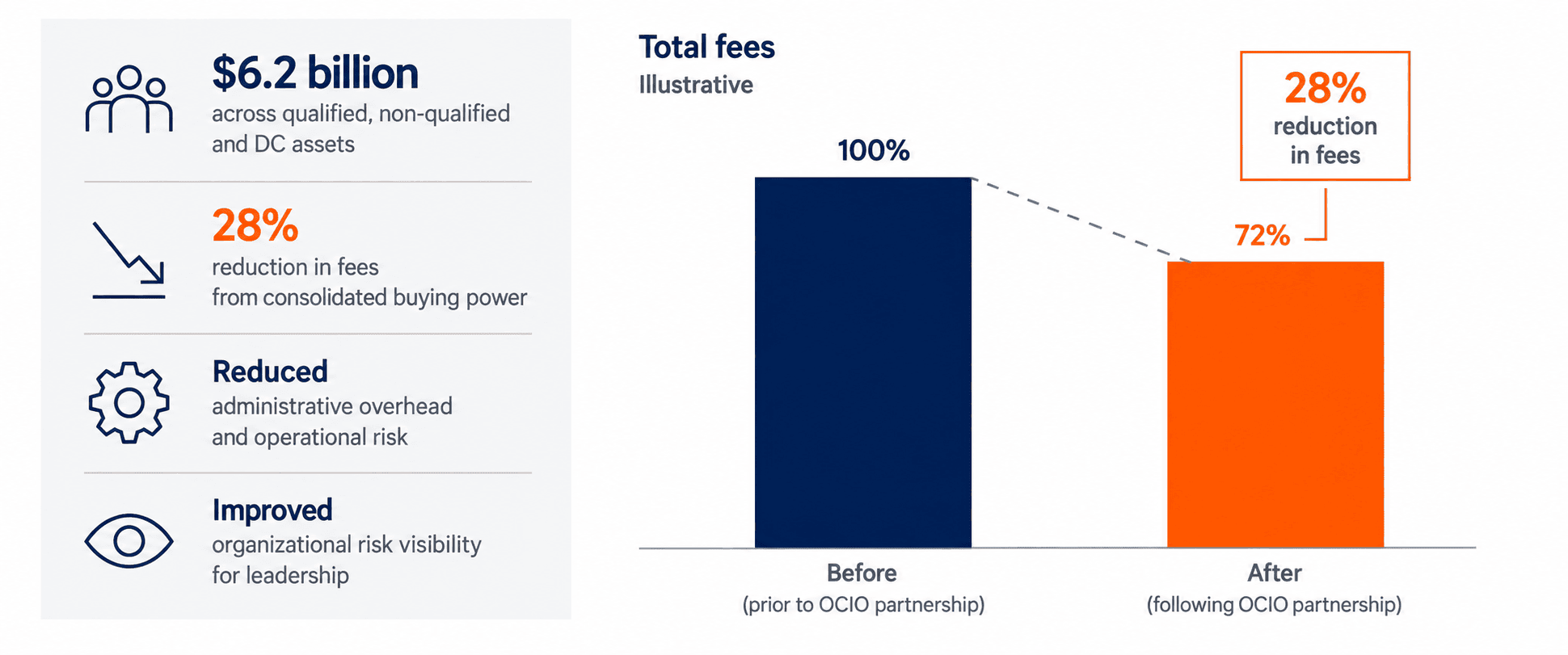
A recent Russell Investments study of an academic health system provides a specific example. Following a series of acquisitions, the health system was overseeing approximately $4 billion in qualified and non-qualified assets, alongside $2.2 billion in defined contribution (DC) assets.
A hybrid governance model that included features of both an OCIO and consulting model helped bring those assets together, increasing buying power and contributing to a 28% reduction in fees while reducing administrative demands and operational risk.
The aim is to build the operating model around the needs of the institution rather than fitting the institution around a predetermined outsourcing model.
Figure 2. Scale in action: 28% reduction in fees
Source: Russell Investments. For illustrative purposes only.
Harnessing specialists
When I was a CIO, our investment team sometimes felt like an island. Moving to Russell Investments gave me a different perspective. Instead of being one of only a handful of people focused on investments, I was surrounded by specialists working on many of the same challenges.
That depth can be difficult for an individual institution to recreate. An OCIO relationship can provide access to manager research, portfolio construction, risk management, trading, transition management and operational support without requiring an organization to build every capability internally.
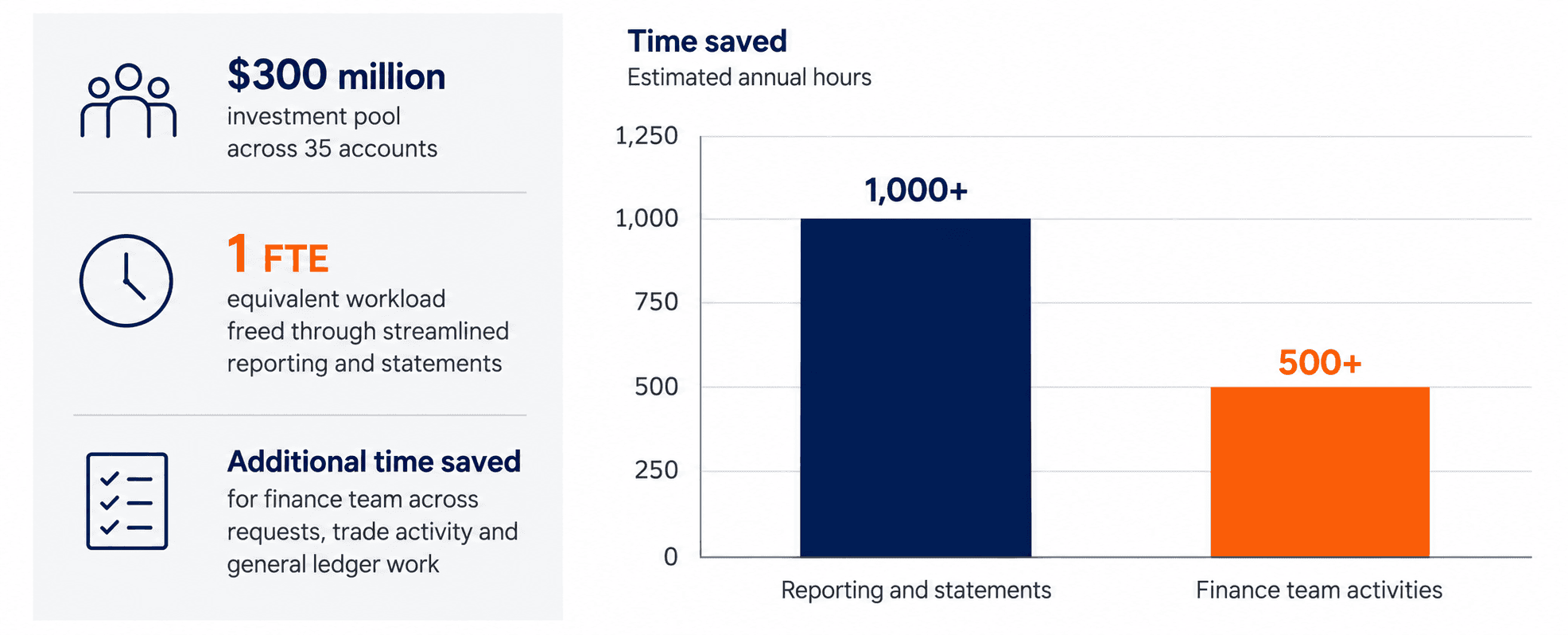
A recent case study of a non-profit managing $300 million across 35 investment accounts shows the operational value this can create. External administrative support freed up the equivalent of one full-time role. More efficient reporting and account statements also reduced the finance team’s time spent processing requests, maintaining the general ledger and coordinating trades.
Figure 3. Administrative efficiency: Time saved for higher priorities
Source: Russell Investments. For illustrative purposes only.
The point is not to reduce headcount. It is to consider what those resources could be doing instead. Investment committees can spend more time on strategy and governance. Internal investment professionals can focus on areas where their knowledge of the institution gives them an advantage. Finance teams can spend less time managing investment administration.
Broader organizational depth can also help with continuity. Small teams often concentrate significant knowledge among relatively few people. When responsibilities change or someone leaves, knowledge about managers, portfolio decisions and governance can be difficult to replace quickly.
This may become particularly relevant as DB plans continue to freeze or shrink and specialized internal teams become harder to sustain.
Different institutions will use an OCIO differently
The economics vary depending on the institution. For a corporate DB sponsor, the company bears the investment risk. Portfolio performance and volatility can affect funded status, contribution requirements and the company’s broader financial position.
Within a DC plan, participants bear the investment risk and often the investment costs, while the sponsor remains responsible for governance, oversight and building an investment structure designed to support retirement outcomes.
One Russell Investments DC client wanted to improve retirement outcomes while giving its investment committee more time to focus on strategy and oversight. After moving to an OCIO partnership and restructuring the investment menu, investment management expenses fell 27%, saving approximately $600,000 annually. The plan also simplified its core menu and gave the sponsor greater visibility into employees’ retirement readiness.
Institutional implications
Every institutional portfolio ultimately has a job to do. A pension plan needs to fund benefits. A DC plan needs to help employees prepare for retirement. A foundation needs to support its mission. A university or healthcare system needs its assets to meet spending requirements alongside other demands of the organization.
For institutions, that means the economics of an investment program should not be judged on performance alone. Return, risk and cost remain central, but the resources required to manage the portfolio and implement decisions also matter.
The appropriate OCIO model will differ from one institution to another. Some may benefit from broad delegation, while others may choose to retain substantial internal capabilities and use external expertise selectively. The focus should be on where the internal team has an advantage and where additional scale, resources or specialized expertise can improve outcomes.
Ultimately, the goal is to build an investment program that can do more with the resources available to it, allowing improvements within the portfolio to carry through to the organization behind it.
Any opinion expressed is that of Russell Investments, is not a statement of fact, is subject to change and does not constitute investment advice.
Common client questions
Look beyond headline fees. The assessment should include net investment outcomes, risk, implementation costs, operational demands and the internal resources required to manage the program.
Established teams can use external resources in areas including manager research, portfolio construction, risk management, transition management and specialist implementation. Selective outsourcing can expand capabilities without requiring every function to be built internally.
Small teams can concentrate significant investment knowledge among relatively few professionals. Broader organizational depth can reduce reliance on individual team members and provide greater continuity when responsibilities change.