

The operational lead time can be easy to underestimate because public trading does not automatically make an investor’s existing position liquid or hedgeable. Lockups, custody arrangements, approvals, and derivatives documentation can constrain available choices. With derivatives onboarding estimated to take a month or more depending on instrument type, advance preparation can preserve execution flexibility without requiring an investor to hedge.
Key takeaways
- SpaceX’s IPO brought the complexity of the private to public portfolio transition into sharper focus.
- Hedge design should reflect investor objectives, distribution timing, market conditions, and the desired portfolio outcome.
- Early operational preparation can give investors greater flexibility when market conditions and distribution timing become clearer.
What did SpaceX reveal about the private to public transition?
Before the SpaceX IPO, we examined how a mega listing could turn private market exposure into a complex public portfolio challenge. SpaceX provided a real-world test.
The scale extended well beyond the equity offering. SpaceX raised $75 billion at a valuation above $1.7 trillion and attracted more than $70 billion in global retail orders. Its subsequent $25 billion investment-grade bond offering drew approximately $78 billion in demand, while international participation contributed to elevated U.S. dollar conversion activity ahead of the listing.
For institutional investors that held SpaceX directly or through private market funds, the more revealing developments came after trading began. A public price did not make those existing holdings immediately liquid. Restrictions and distribution schedules determined when shares could be sold, while the cost and availability of hedging changed as the options market developed. These investors also had to plan portfolio reporting, share sales, hedge reductions and the reinvestment of proceeds.
Our observations following the SpaceX IPO offer a practical framework for institutions with private market exposure to companies that may form the next wave of mega IPOs.
How can investors prepare? Decide first what the portfolio should own after the transition.
Before shares become available, investors should decide how much of the newly public company they ultimately want to own. Full liquidation may not be the objective. That decision can guide whether to hedge, how much to sell, the pace of trading and where the proceeds should go.
Lockups and distribution schedules can prevent investors from selling shares even after public trading begins. Once the shares are unrestricted, distributed and available to trade, the trading plan moves into execution. Historical trading patterns can help inform the pace. Our global trading desk found that 28.3% of technology distributions were at or above their distribution price on day one, rising to 40.25% by day 30.
Return to distribution price varied by sector
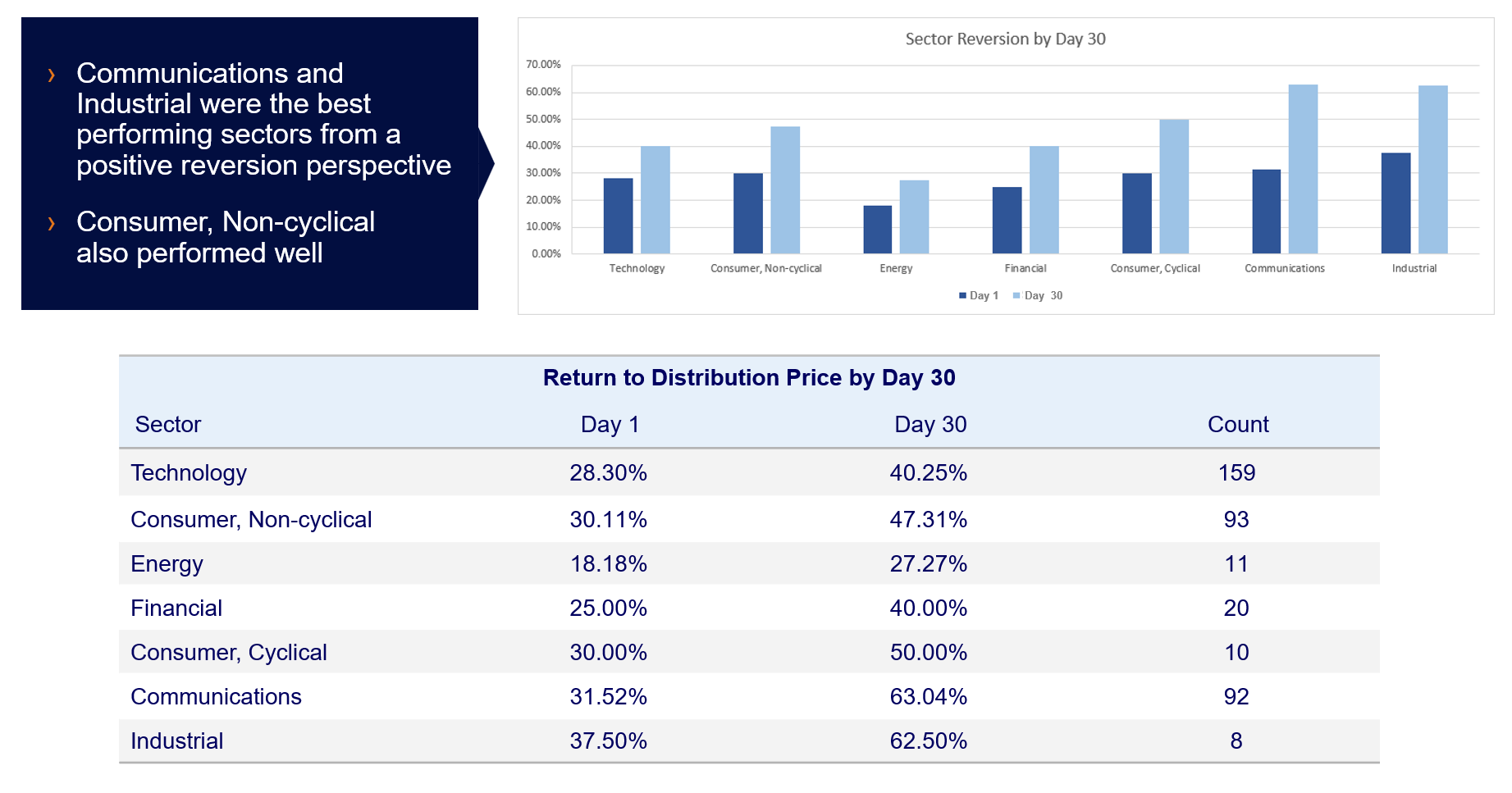
Source: Russell Investments. Trade data based on 1,093 distributions for the period of 1/7/2022 through 5/15/2026. Indicated results are not a guarantee of future performance results. For illustrative purposes only.
With many potential mega IPOs in the technology sector, investors can use these patterns to help inform the pace of sales and conditions for pausing. Proceeds can then be reinvested according to the portfolio’s intended allocation.
How a hedge can protect the portfolio during the transition.
Even after an IPO, lockups and distribution schedules can leave investors exposed to price movements before their shares can be sold. A hedge can help manage that risk during the period between the listing and the eventual sale.
Before selecting an approach, investors need to confirm what can actually be hedged. Ownership structure, custody arrangements and trade approvals can all affect what is possible.
That preparation can take several weeks. Listed derivatives onboarding can take about a month once the investment management agreement is in place, while OTC derivatives setup can take even longer. Investment guidelines may also need to permit derivatives, and trading documentation may need to be established with counterparties. Starting early does not commit the investor to a hedge. It broadens the toolkit available as the listing and distribution dates become clearer.
The appropriate hedge depends on several factors, such as the protection the investor needs, the exposure they want to maintain and when the shares may become available. For example, one SpaceX investor expected to receive shares but did not know the exact distribution date. A 12-month collar provided protection below 80% of the reference price and allowed participation up to 145%, with zero initial premium.
Another important consideration is the investor’s available liquidity. A costless collar has unlimited upside exposure, which could result in high margin needs. Paying some upfront premium to lock in reduced margin levels can benefit investors with less access to liquidity. This consideration is particularly important when an IPO represents a significant proportion of the portfolio.
Hedging strategies vary by protection, cost, and participation
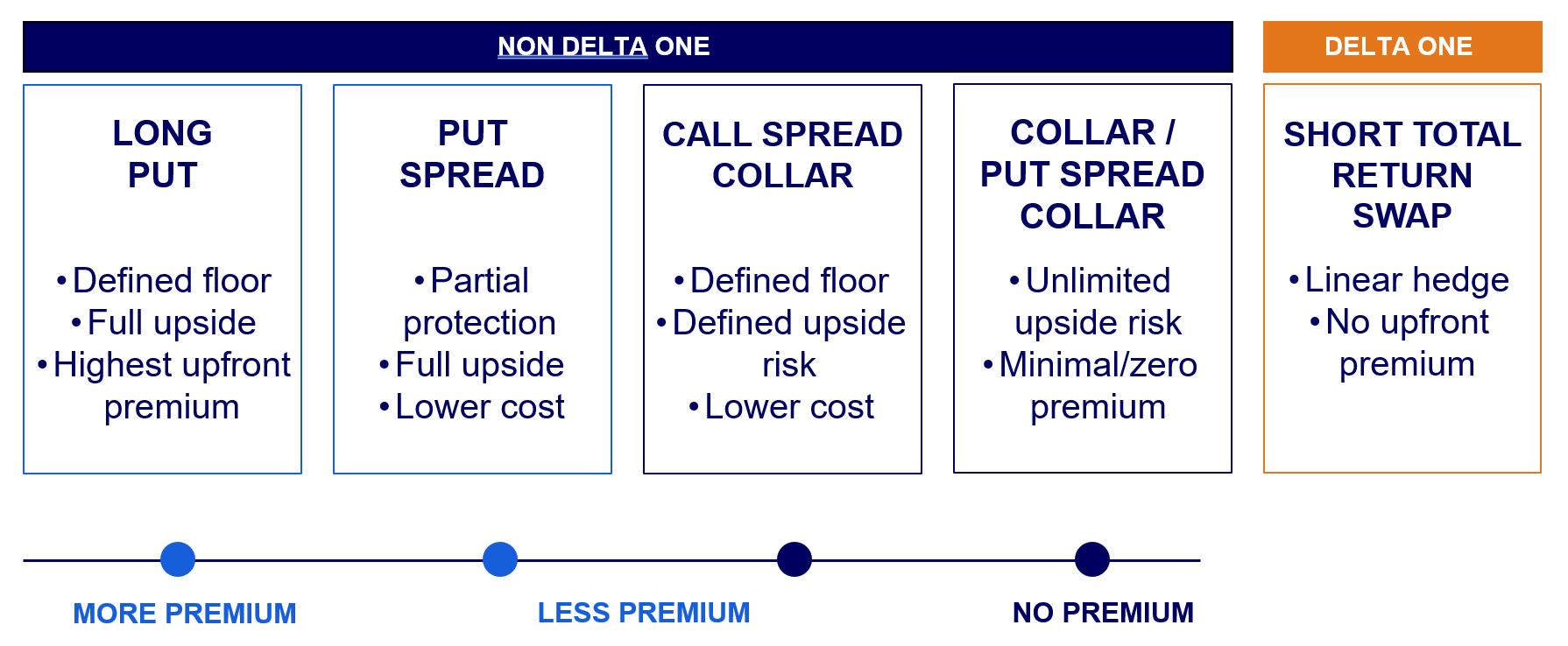
Source: Russell Investments
How did market conditions change the cost of hedging SpaceX?
The cost of protection changed quickly after the IPO. In the first week, 12-month put options that protected against losses below 80% of the share price traded at premiums of 17% to 23%. The volatility data also moved considerably. Between June and August, one-month implied volatility ranged from approximately 62 to 113, while realized volatility ranged from approximately 50 to 170.1
Those conditions made outright put protection expensive, but they also created opportunities to offset that cost. One approach was a collar, which combines the purchase of a put option with the sale of a call option. The put sets a floor on potential losses. The premium received from selling the call helps pay for that protection, while limiting gains above the call’s strike price.
Early demand for SpaceX call options made those calls particularly valuable. For example, a few days after the IPO, an investor could have bought a 12-month put with an 80% floor and offset the full cost by selling a call with a strike near 160% of the share price.2 This example shows why hedge selection depends on both the investor’s objectives and option prices at the time of execution.
As shares are distributed, the hedge can be reduced to maintain alignment with the remaining equity exposure. That process can include monitoring market conditions and trading windows, competing option unwinds across counterparties, coordinating the unwind of the hedge with the requisite shares, and managing the trading strategy for any residual shares.
Hedge performance also needs context. A hedge may sit in one account while the exposure it protects originated elsewhere in the portfolio. Investors should determine in advance where hedge gains and losses belong in performance reporting and whether the hedge and underlying exposure should be evaluated separately or as a combined economic position. Connecting the reporting treatment to the hedge’s economic purpose can provide a clearer view of how the position and its protection contribute to total portfolio results.
Investor implications
The next wave of mega IPOs will also have a large portfolio impact. Anthropic and OpenAI were valued at approximately $965 billion and $852 billion (as of their latest private funding round).
The impact will extend beyond the initial listings. As lockups expire and more shares become publicly available, these companies could increase in weight through successive index rebalances. Under illustrative assumptions, SpaceX, Anthropic and OpenAI could collectively represent approximately 3.0% of the Russell 1000 and 5.6% of the Russell 1000 Growth Index by early 2028.
Institutions could hold the same company through private market funds, distributed shares, and public market mandates. That makes it important to understand total exposure across the portfolio and how it may grow over time.
SpaceX provides a useful starting point. Before the next mega IPO, investors can define the exposure they want to retain, prepare for the period when shares remain locked up and establish how hedging, share sales and reinvestment will work once the transition begins.
1Bloomberg
2 Bloomberg
Common client questions
Yes. Selling distributed shares may reduce direct exposure, but the same company can reappear through public market mandates and eventually through benchmark exposure. Under the article’s illustrative assumptions, SpaceX, Anthropic, and OpenAI could collectively reach approximately 3.0% of the Russell 1000 and 5.6% of the Russell 1000 Growth Index by early 2028. Investors may need to assess exposure across the total portfolio rather than mandate by mandate.
It is ultimately an allocation decision because receiving tradable shares does not determine how much exposure the portfolio should retain. Investors still need to decide whether the position fits their intended allocation, how quickly to sell, and where proceeds should be reinvested. Defining that end state before the distribution can help coordinate execution, hedge reductions, and portfolio positioning.
Hedging becomes less attractive when protection costs outweigh the risk reduction an investor needs or when the structure limits more upside than the investor wants to surrender. SpaceX showed how quickly those economics can change: 12-month puts with an 80% floor initially cost 17% to 23%, while strong call demand made some collars more economical. Hedge design should reflect both portfolio objectives and prevailing option prices.