

Managers remain constructive on AI's long-term growth potential, but are more selective about how they participate. Attention has turned toward monetization, capital efficiency, and earnings durability as the investment cycle matures. For portfolios, this favors a differentiated approach across AI infrastructure, software, and adoption beneficiaries rather than relying primarily on exposure to the largest technology companies.
Key takeaways
- AI remains the dominant structural growth theme, but managers are scrutinizing AI CapEx levels and focusing more on monetization, capital efficiency, and earnings durability as the investment cycle matures.
- AI remains the dominant structural growth theme, but managers are focusing more on monetization, capital efficiency, and earnings durability as the investment cycle matures.
- Higher bond yields, energy costs, and geopolitical uncertainty are shaping sector positioning, while discerning managers favor companies with resilient earnings, pricing power, and strong balance sheets.
- Global opportunities are broadening, supported by improving European earnings, corporate reform in the UK and Japan, and selective opportunities across emerging markets.
AI enters a more demanding phase as managers focus on returns
AI remains the dominant structural investment theme across global equity markets, but managers are taking a closer look at the economics of adoption. After a period defined by substantial infrastructure investment, attention has turned toward whether companies can generate sustainable returns on AI spending. Capital intensity, token economics, power availability, and monetization are additional considerations in assessing long-term earnings potential.
The opportunity set extends beyond hyperscalers, semiconductors, and memory producers into networking, storage, electrical equipment, cybersecurity, automation, and enterprise workflows. However, the benefits of adoption may not be evenly distributed. Falling inference costs may encourage wider adoption while broadly weakening the pricing power for model providers and less-differentiated software businesses. Managers favor companies with visible cash flows, proprietary data, durable customer relationships, and strong balance sheets.
Regional positioning reflects these distinctions. Taiwan and Korea remain central to AI infrastructure through semiconductor manufacturing and memory production, while Japanese managers continue to identify opportunities among infrastructure beneficiaries following a recent correction. Within long-short equity portfolios, some managers have moved away from crowded hardware positions toward hyperscalers and selected software companies, where earnings visibility and returns on capital are central to stock selection. The next phase of AI investment will depend on which businesses convert investment into sustainable earnings.
Concentration and changing market leadership sharpen active selection
Persistent market concentration continues to complicate active equity positioning, with mega-cap technology companies accounting for an outsized share of benchmark weights and earnings. This market condition has been building for several quarters and cannot be ignored. Information Technology now represents approximately half of the Russell 1000 Growth Index, compared with 20% a decade ago. For managers, maintaining exposure to these market leaders must be balanced against crowding risks and opportunities elsewhere.
Recent market volatility has reinforced the need for disciplined portfolio construction. The July unwind in long-short equity exposed vulnerabilities among common factor exposures and concentrated holdings, prompting some managers to reduce gross exposure and short cover, tighten their position limits, and increase hedging. Momentum exposure subsequently declined to a 2026 low, although it remains elevated relative to longer-term history.
At the same time, managers are identifying opportunities in less-crowded areas of the market. Software, healthcare, consumer businesses, industrials, and smaller companies are among potential beneficiares if earnings leadership broadens beyond the largest AI hyperscalers. U.S. small-cap managers have maintained exposure to industrial and technology suppliers supporting AI infrastructure, while large-cap managers generally remain underweight those sectors.
Concentrated benchmarks introduce portfolio construction challenges, reinforcing the value of understanding how individual positions interact and how complementary active strategies can diversify sources of return. For investors, the priority is balancing exposure to established market leaders with differentiated opportunities while managing benchmark-relative risk.
Higher rates and energy costs reshape sector opportunities
Higher long-term bond yields and elevated energy prices are creating a more differentiated backdrop across sectors and regions. Growth companies whose valuations depend heavily on distant earnings remain sensitive to changes in discount rates, while higher energy costs are pressuring businesses and consumers with limited pricing flexibility. The more constructive managers are therefore placing greater emphasis on earnings resilience, balance-sheet strength, and companies capable of maintaining margins in a more challenging environment.
Consumer positioning reflects these pressures. Elevated fuel prices and persistent inflation have weakened purchasing power among lower-income U.S. households, contributing to cautious positioning across consumer discretionary businesses. Managers still see selective opportunities among premium brands, travel companies, and businesses undergoing operational turnarounds, where pricing power or differentiated customer experiences may support earnings. Higher oil prices and geopolitical disruption remain important considerations, particularly for travel-related businesses.
In financials, European banks have attracted investor interest, given the evidence of balance-sheet repair and rate-driven improvements in net interest margins. Meanwhile, gradual rate normalization could support selected financial companies in Japan and elsewhere in Asia. However, managers are also considering the implications of a potential slowdown in AI capital spending giving rising borrowing costs, which could reduce funding demand and realign the yield curve outlook.
Managers separately have identified structural investment opportunities in aerospace, defense, automation, and electrical equipment. These industries benefit from drivers extending beyond AI, including defense spending, energy security, and the broader industrial cycle. European utilities also provide exposure to renewable integration, storage, and energy infrastructure, while U.S. electricity investment remains more closely tied to data center demand, as an alternative AI play.
U.S. policy developments add further complexity. While managers generally do not expect the midterm elections themselves to drive significant portfolio repositioning, potential changes to data center permits and energy infrastructure policy could influence the pace, cost and return horizon for AI investments.
The global opportunity set is broadening
Source: Russell Investments
Earnings recovery and corporate reform broaden out global opportunities
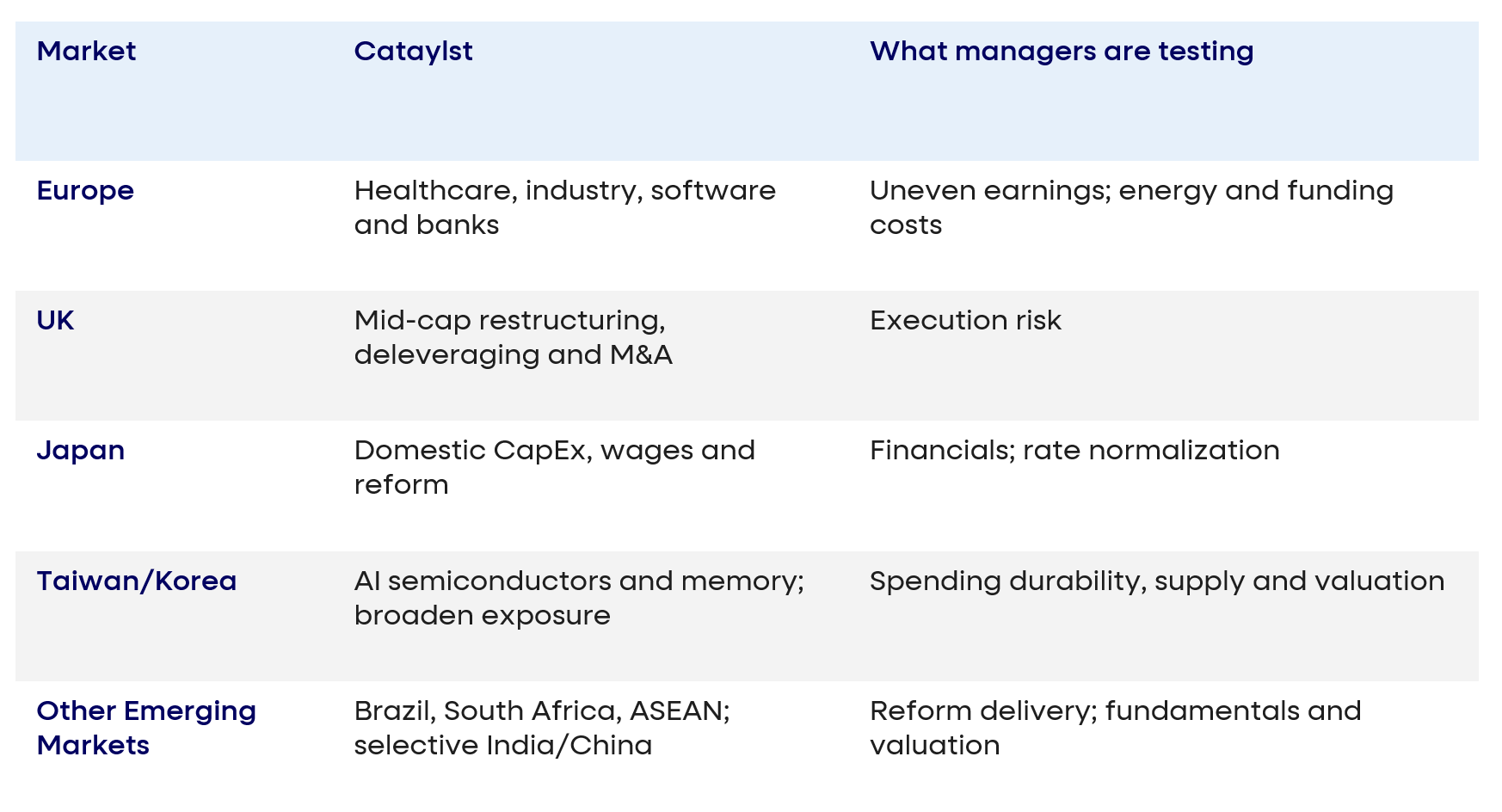
Managers are finding a more differentiated opportunity set outside the U.S. and its big tech behemoths. While the U.S. remains a core allocation due to its economic resilience and market cap, positioning adjustments have generally been incremental towards non-US exposure. Managers are focusing on markets where improving earnings, corporate restructuring, and domestic investment provides identifiable catalysts for returns in conjunction with lower valuations.
A firmer earnings backdrop has emerged in Europe across healthcare, industrials, software, and financials, with positive revisions supporting selected companies. European banks have benefited from improving fundamentals, while industrial businesses offer exposure to automation, defense, and infrastructure investment. However, earnings outcomes remain uneven, and managers favor companies with durable earnings growth and resilience to higher energy and financing costs.
In the UK, opportunities are tied more closely to company-specific actions than expectations of a broad market rerating. Managers see potential among undervalued mid-cap businesses where restructuring, deleveraging, asset disposals, and improved capital allocation could unlock shareholder value. Rising takeover interest from strategic and private equity buyers provides another potential catalyst, suggesting public market valuations may understate underlying business value.
Japan also offers a wider range of investment drivers beyond AI infrastructure. Domestic capital spending, wage growth, and ongoing corporate restructuring are creating opportunities across financials, industrials, and businesses exposed to domestic demand. Gradual interest rate normalization could further support selected financial companies, while improvements in corporate capital allocation continue to attract active managers.
Across these markets, earnings recovery, corporate reform, and domestic investment offer differentiated sources of return beyond dominant global technology companies. For active managers, these developments support broader portfolio diversification while rewarding company-specific research and valuation discipline.
Emerging markets highlight the importance of selective positioning
Emerging markets present a broad but uneven opportunity set. Taiwan and Korea remain critical to the global AI supply chain, particularly in semiconductor manufacturing and memory production, but concentrated positioning has heightened sensitivity to changes in capital spending expectations and valuations. Recent volatility exposed substantial differences between managers, prompting some to rebuild exposure more selectively while balancing country and factor risks.
Within North Asia, managers are looking beyond the most crowded AI beneficiaries toward financials, industrials, shareholder-return opportunities, and less-crowded technology companies. The sustainability of hyperscaler spending, potential additions to Chinese memory capacity, and semiconductor pricing power remain important considerations.
Elsewhere, managers are exploring opportunities in Brazil, South Africa, ASEAN, and selected frontier markets, where valuations and potential policy or corporate reforms offer different investment drivers. These markets have participated less fully in the AI-led rally, potentially creating opportunities beyond the dominant technology trade. The appeal depends on whether reforms translate into sustainable earnings growth.
China and India illustrate the importance of distinguishing long-term growth potential from current fundamentals. China's property weakness, uneven consumer demand, trade friction, and industrial overcapacity continue to constrain the broader outlook, although selected technology, manufacturing, and policy-supported businesses offer opportunities. India retains attractive structural drivers, including credit penetration, digital adoption, and rising higher-income consumption, but premium valuations face a more demanding test as managers assess earnings growth and domestic capital formation.
For investors, emerging market allocation requires an understanding of both country-specific fundamentals and the concentration of underlying equity exposures. Broad market returns can conceal substantial differences between companies, sectors, and managers. Disciplined stock selection and position sizing can help manage these risks while preserving exposure to structural growth.
Investor implications
Active managers remain constructive on AI, but are more discerning about which companies can generate sustainable returns from their CapEx spending. Persistent market concentration, higher yields, and geopolitical uncertainty reinforce the need for disciplined position sizing, benchmark awareness, and portfolio risk management. Improving earnings, corporate reform, and domestic investment offer opportunities to diversify return drivers across different sectors and regions outside US big tech. For investors, combining differentiated active strategies can support more balanced participation across potential market outcomes.
Common client questions
Higher yields and energy costs are encouraging managers to emphasize pricing power, resilient earnings, and strong balance sheets. Financials, industrials, energy infrastructure, and selected defensive businesses offer different ways to navigate these pressures, while consumer exposure requires greater scrutiny. The portfolio challenge is to balance businesses benefiting from structural investment with those more vulnerable to financing costs or weaker household demand.
Managers are identifying opportunities through improving European earnings, UK corporate restructuring, and Japanese domestic investment and corporate reform. Selected emerging markets also offer exposure to valuation recovery and policy catalysts outside the dominant AI trade. These opportunities can diversify earnings drivers, although their potential depends on company fundamentals, valuation discipline, and the execution of reforms.
Concentrated AI exposure, valuation premiums, and uneven economic fundamentals remain important risks across emerging markets. Taiwan and Korea are sensitive to semiconductor and memory expectations, while China faces structural challenges and India's valuations require earnings support. Managers are responding through selective country exposure, differentiated stock selection, and greater attention to factor concentration and portfolio liquidity.