



Investment-grade private credit involves privately negotiated loans and debt issued by higher-quality borrowers that meet investment-grade credit standards. Unlike traditional direct lending, which is often associated with below-investment-grade companies, investment-grade private credit typically offers a lower-risk profile while providing investors with additional yield in exchange for reduced liquidity.
Key takeaways:
- Investment-grade private credit can provide access to additional spread and differentiated exposures without moving down the credit-quality spectrum.
- Growing demand from investment-grade companies for customized financing, alongside managers’ expanding origination capabilities, is broadening the private credit opportunity set.
- The growing range of specialist managers makes access, manager selection and a multi-manager approach important considerations for investors building an investment-grade private credit allocation.
Grace Uniacke, Director, Alternative Solutions; David Jurca, Director, Private Credit; and Justin Owens, Senior Director, Co-Head, Total Solutions, examine how investment-grade private credit can complement public bonds by offering potential spread and diversification benefits.
The potential for additional spread
For institutional investors, public investment-grade credit has long provided income and diversification. Yet, investment-grade private credit is increasingly being considered as a complementary allocation.
A research survey of insurers earlier this year found that 40% planned to increase allocations to investment-grade direct lending, while 38% intended to raise their exposure to investment-grade structured credit.1
What is prompting this interest? One core factor is the potential for additional spread.
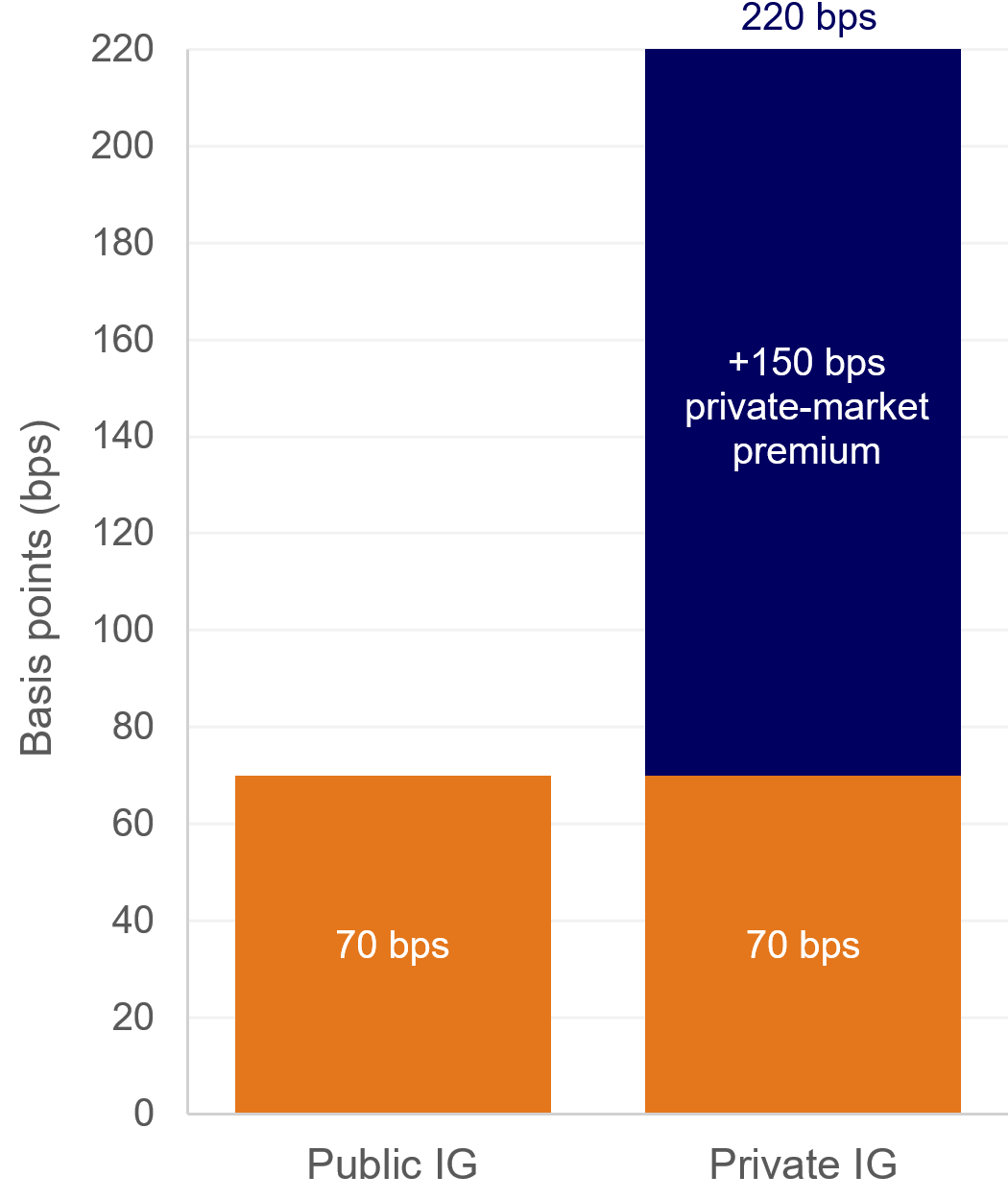
Selected managers in investment-grade private credit have delivered a spread pickup of roughly 150 to 200 basis points over public credit, net-of-fees, according to Russell Investments analysis.2 Historical losses among these managers have been comparable with those in the public investment-grade credit market.
The market has also broadened as alternative investment managers have expanded their origination capabilities to meet growing demand for customized financing. This has led to more bilateral financing directly with investment-grade borrowers, creating additional sources of spread.
Illustrative net-of-fee spread over Treasuries
Source: Russell Investments. For illustrative purposes only.
The potential for broader diversification
Diversification is another key reason investors are considering investment-grade private credit. Public investment-grade portfolios can be concentrated in the largest corporate issuers, while tight spreads may limit the compensation investors receive for taking that exposure. For portfolios with substantial public credit allocations, private credit can provide another source of issuer and credit-market diversification.
At roughly $38 trillion, the private investment-grade market provides access to a substantial pool of borrowers and transactions outside traditional public markets.3 That broader universe can help diversify exposure beyond public corporate credit.
Blending public and private credit
Investment-grade private credit is not intended to replace public fixed income. Public markets provide valuable liquidity, transparency, breadth and price discovery. For investors able to accept some illiquidity, reallocating part of a traditional public allocation to private credit may improve portfolio economics while maintaining investment-grade credit quality.
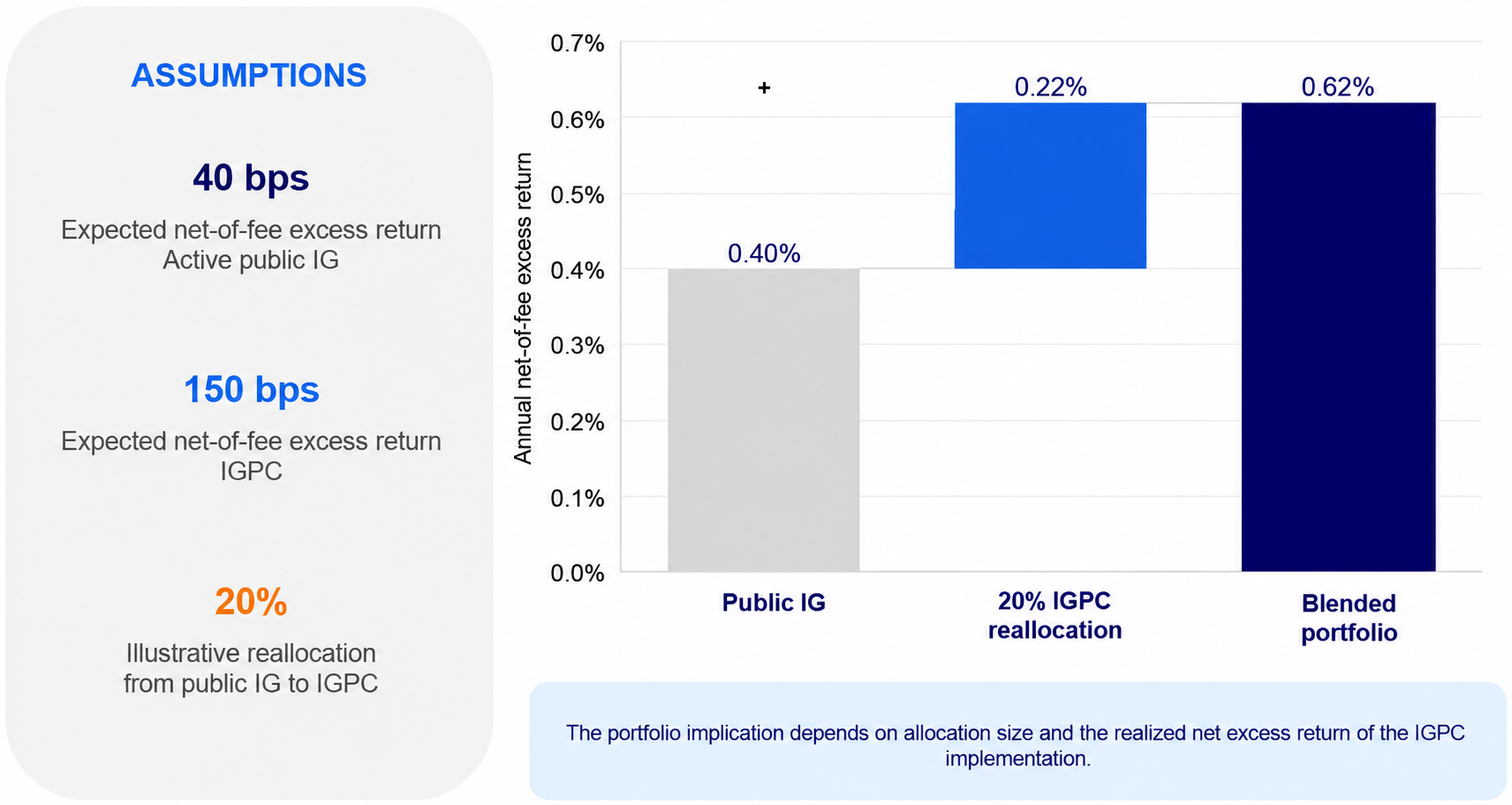
The chart below illustrates the potential impact. Assuming a 40 basis point net-of-fee excess return for active public investment-grade credit and 150 basis points for investment-grade private credit, reallocating 20% of the allocation increases the expected excess return from 40 to 62 basis points.
Illustrative impact of expected excess return
Expected net-of-fee excess return assumptions: 40 bps for active public IG and 150 bps for investment grade private credit (IGPC).
Source: Russell Investments. Assumes 40 bps expected net-of-fee excess return for public IG and 150 bps IGPC. For illustrative purposes only.
The return enhancement comes with trade-offs. Investors must be able to tolerate less liquidity, transparency and flexibility, and the appropriate allocation will depend on each investor’s portfolio objectives and liquidity needs. Moreover, the realized benefit will depend on the size of the allocation and the net excess return achieved by the private credit implementation.
Where public and private credit converge
The boundary between public and private credit is becoming less distinct as companies draw on both sources to meet different financing needs. Large investment-grade companies can access public bond markets while also using private capital for more customized financing.
Intel provides a useful example. The company could have issued conventional bonds to help finance a major semiconductor plant but instead pursued a customized private transaction. The financing could be structured around the specific needs of the project, with investors compensated for providing that flexibility.
For investors, this reinforces the value of assessing public and private markets together as part of a broader investment-grade credit opportunity set, with the potential to access a wider range of borrowers, differentiated exposures, and sources of spread.
Rethinking what private credit means
Private credit is often associated with direct lending to below-investment-grade companies, where investors accept greater credit risk in pursuit of higher returns. These loans also tend to be floating rate, with limited or no duration.
However, investment-grade private credit has a different profile. It targets investment-grade credit exposure through privately negotiated corporate and asset-based financing. Investors may earn additional yield in exchange for characteristics such as lower liquidity, customization, and greater structuring complexity, while maintaining an investment-grade credit profile. Unlike traditional direct lending, investment-grade private credit can also provide duration, making it potentially complementary to traditional public fixed income.
In broad terms, traditional direct lending sits closer to high-yield bonds and syndicated bank loans, while investment-grade private credit sits closer to public investment-grade bonds.
Demand from insurers and pension plans
Insurance companies have played an important role in establishing investment-grade private credit as an institutional asset class and pension plans are increasingly evaluating its role in their portfolios. Most U.S. life insurers use private credit as a complement to public bonds, and over 90% of that exposure is investment-grade.4 Although investment-grade private credit is newer to U.S. pension plans, a small but increasing number are using it as a complement to their liability-hedging fixed-income allocations.
Those differences can have a meaningful impact on portfolio construction. A single manager may provide strong access to certain sectors, transaction types, or origination channels, while leaving greater concentration in others. Combining managers with complementary capabilities can provide exposure across different parts of the market and reduce reliance on any one approach.
As established managers expand their capabilities and new entrants emerge, access and manager selection will remain crucial. An open-architecture approach can help investors evaluate those differences and construct an allocation based on the relative merits of the available opportunities.
Investor implications
For investors, the growth of investment-grade private credit expands the opportunity set available within high-quality fixed income.
Rather than viewing it as a replacement for public investment-grade credit, we see it as a complementary allocation that can provide access to different borrowers, structures and sources of yield. As the market grows, the ability to invest across both public and private markets will become increasingly valuable.
As the market continues maturing, manager selection and portfolio construction become increasingly important. Deal access, origination capabilities, underwriting standards and areas of specialization vary considerably across managers. An open-architecture approach can help investors evaluate those differences and build an allocation that balances return potential, diversification and the trade-offs associated with reduced liquidity.
Footnotes:
[1] Fund Fire, Here’s How Insurance Companies Want to Boost Allocations, March, 2026.
[2] Russell Investments, 2026.
[3] Private Credit: Fact vs. Fiction Apollo Global Management December, 2025.
[4] American Council of Life Insurers Fact Book, 2025.
Common client questions
Traditional private credit is commonly associated with direct lending to below-investment-grade borrowers, where investors accept greater credit risk in pursuit of higher returns. Investment-grade private credit focuses on higher-quality borrowers and can be viewed as closer to public investment-grade bonds, with additional yield typically compensating investors for lower liquidity and more complex structures.
Investors are becoming more comfortable with private markets while looking for additional diversification and yield within higher-quality fixed income. Investment-grade private credit can provide access to borrowers, transactions and structures that may not be available in public markets, helping broaden the opportunity set without necessarily moving significantly down the credit-quality spectrum.
Investment-grade private credit can offer potentially higher yields than comparable public investment-grade bonds and portfolio diversification, with access to differentiated borrowers. Privately negotiated transactions may also provide lenders with stronger protections or tailored structures. These benefits come with trade-offs, particularly lower liquidity, making careful underwriting and portfolio construction important.
Manager selection can be particularly important because deal access, underwriting standards, sector expertise and portfolio construction vary across the market. Investors should consider whether a manager has access to a broad opportunity set and the ability to assess relative value across public and private credit, while being appropriately compensated for additional illiquidity and complexity.