


A Chief Financial Officer (CFO) should consider whether the program still reflects the company’s objectives, whether it is delivering the required outcomes at an appropriate cost and whether investment-related risks could affect the broader organization. That includes governance, internal resources, implementation and the role each investment pool plays.
Key takeaways
- Investment program costs extend beyond headline fees. Chief Financial Officers (CFOs) should consider investment-management fees, internal resources, external providers, technology, reporting and implementation costs in relation to the outcomes the program delivers.
- Performance is broader than investment returns. It also reflects whether the program is aligned with defined objectives, uses resources effectively and has the research, manager access and implementation capabilities needed to execute decisions.
- Investment-related risks can affect the broader organization. Cash needs, liquidity, contribution requirements, pension expenses, funded status, balance sheet volatility, earnings and financial flexibility.
- The support model should reflect the program’s objectives, complexity and internal capabilities. Options range from advice and targeted specialist support to broader delegation, with the investment team remaining central to strategy and oversight.
What CFOs need to know about the investment program
CFOs may not manage an investment program day to day, but they remain accountable for many of the outcomes it can influence. The cost of the program, the performance it delivers and the risks it carries can all have implications for the broader organization.
As CFO and Global Head of Institutional, we bring different perspectives to these questions. One of us looks at cost, risk, resources and accountability through the lens of the broader enterprise. The other works closely with institutional clients and investment teams to understand the role their investment programs play across the organization and the needs of different stakeholders.
What we’ve learned through our careers is that a well-constructed investment portfolio is only one part of building a strong investment program. Costs, objectives, risk and resources all play a role. So does implementation, where investment strategy meets market conditions. That includes monitoring, trading, rebalancing and making timely adjustments as conditions change.
Assessing whether the program still fits requires an understanding of the objectives of each investment pool, the liabilities or participant needs it serves and the organization’s broader financial and governance priorities. Strong outcomes depend on how the program is governed, resourced and implemented as well as on the investments it holds.
With that in mind, here are three questions we think every CFO should ask about their investment program.
1. Is our investment program delivering the outcomes we need at an appropriate cost?
In this higher-inflation environment, expense management dominates the CFO agenda. But for an investment program, a low investment fee does not necessarily mean a low-cost program.
The full cost depends on the investment pools, the work required to oversee them and what it takes to put investment decisions into practice.

That gives CFOs and investment teams several places to look for better economics. The question is whether the fees, internal resources and implementation capabilities supporting each pool are justified by the outcomes they deliver.
Implementation is one place to look. Better operational support across transitions, trading, rebalancing and liquidity management can reduce the cost of implementing investment decisions. For example, in one $7 billion corporate pension program we worked with, improvements in scale and implementation efficiencies helped reduce fees by 47%, or $10 million a year. The program also improved PBO funded status by 13%, lowered surplus risk and delivered 50 basis points of annualized net-of-fee excess return over five years.*
For the sponsor, that meant stronger funded status, lower risk and less pressure on future contributions and the company’s financial position.
Taxable assets can create another cost that is easy to miss. Embedded gains can make portfolio changes expensive, even when the investment decision itself makes sense. Bringing tax management into the investment process can help account for that cost alongside risk, return and implementation.
The internal investment team does not need to own every capability. CFOs can work with the team to decide where internal ownership is most important and where specialist support can add scale, capacity or more efficient execution.
2. Has the investment program’s performance kept pace with what the enterprise now needs?
CFOs should judge the investment program’s performance more broadly than investment returns alone. It can also mean progress toward plan objectives, stronger funded status, better participant outcomes or preserving liquidity and financial flexibility.
Governance is critical to keeping those outcomes on track. As the objectives and needs of the program change, the investment strategy, decision rights and oversight may need to change with them. A governance model built for one set of circumstances may no longer fit the next.
Our 2026 $20 Billion Club found that the average funded ratio across 21 of the largest U.S. corporate plans rose from 96.4% to 98.6% in 2025, while the combined deficit fell from $29 billion to $16 billion. Ten of the 21 plans were more than 100% funded.
That improvement changes both the investment decisions and the financial trade-offs for the company. An underfunded plan is largely focused on closing the funding gap while managing contribution risk. But a strong funded status does not mean yesterday’s governance model still fits. As plans move into surplus, sponsors face new decisions about how much risk to take, how to protect what has been built and what role surplus assets should play.
Pension surplus can create strategic value beyond full funding, supporting future retirement benefits and broader organizational objectives. A surplus glidepath can help protect promised benefits while giving sponsors more flexibility in how surplus assets are managed.
That flexibility may extend beyond the defined benefit (DB) plan. Possible legislation could potentially allow surplus to support DC benefits, while changes in the workforce may call for the defined contribution (DC) plan itself to evolve.
For some sponsors, stronger funding may also make plan termination more realistic. That brings a different set of priorities around protecting funded status, maintaining liquidity and preparing the portfolio for the transfer of liabilities.
As those choices change, governance should change with them. The CFO and investment team need clear decision rights, the right level of oversight and an investment approach that reflects the company’s current financial and retirement priorities.
3. What investment risks could have consequences for the broader organization?
Investment risk can reach the enterprise through cash needs, contribution requirements, pension expense, funded status, balance sheet volatility, earnings and financial flexibility. CFOs need to consider both whether the portfolio remains within policy and how its risks could affect the company as markets move.
A DB plan makes that connection especially visible. When a plan is underfunded, changes in asset values, interest rates or liabilities can increase contribution requirements and PBGC premiums. When a plan is well funded, those same forces can erode funded status or reduce a surplus the organization expected to preserve.
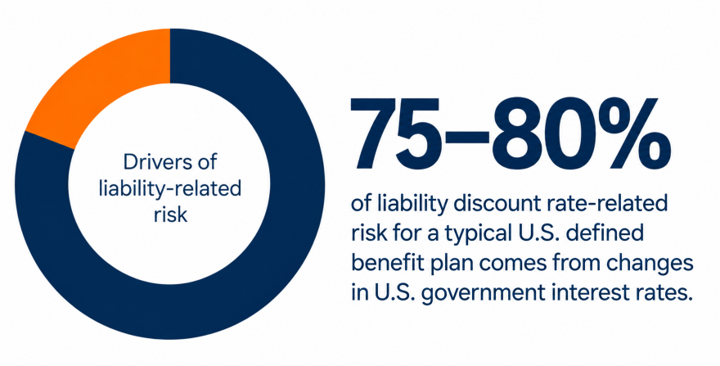
That is increasingly important in a more volatile rate environment. For DB plans, changes in U.S. government interest rates can account for roughly 75% to 80% of liability discount rate-related risk. Unhedged interest rate risk can cause unanticipated volatility of the pension plan on the company’s balance sheet, as well as in earnings and contribution needs.
Figure 3. Interest rate changes drive most liability discount rate-related risk
Source: Russell Investments
Stress testing can then translate portfolio risk into terms the CFO can use. Rather than stopping at volatility or expected return, the analysis can show what a change in rates, markets or liquidity could mean for funded status, contributions and cash needs.
That gives the CFO and investment team a more useful view of risk: not simply what could happen to the portfolio, but what could happen to the company if it does.
The risk sits differently in a DC plan. The company does not bear investment risk in the same way, but plan design can still affect participant outcomes and fiduciary oversight.
What this means for CFOs
The investment program can look like an investment issue from the outside. But the decisions made inside it can affect the company and all of its stakeholders, from current employees and retirees to equity owners. They also connect directly to the priorities CFOs manage, including cash flow, contribution needs, pension expense and financial flexibility.
Cost, performance and risk offer a useful way to see the program more clearly. Together, they show not only how the investments are performing, but whether the program is still delivering what the organization needs and whether the way it is governed, resourced and implemented still fits.
That view becomes even more important as funded status, liabilities, participant needs, cash flows and business priorities change.
*Past performance does not guarantee future results.
Common client questions
A DB plan can affect cash contributions, funded status, pension expense, the balance sheet, earnings and financial flexibility. Changes in markets, interest rates and liabilities can therefore have consequences well beyond investment returns.
An underfunded plan is generally focused on closing the funding gap while managing contribution risk. As a plan becomes fully funded or moves into surplus, governance may need to place greater emphasis on protecting funded status, managing surplus and determining the plan’s longer-term direction.
In a DB plan, investment risk can directly affect funded status, contributions, the company’s balance sheet and earnings. In a DC plan, participants bear the investment risk, while the company remains responsible for fiduciary oversight and for maintaining a plan design that supports participant outcomes.
Support can range from specific capabilities such as transition management, overlays, liquidity management, trading and execution to broader delegation. The right approach depends on the organization’s objectives, internal resources and which decisions the investment team wants to retain.