

A Total Portfolio Approach (TPA) is an investment framework that evaluates decisions through the lens of the overall portfolio through time rather than within individual asset-class silos or within the constraints of a strategic asset allocation. TPA typically emphasizes portfolio-level outcomes, integrated views of risk and liquidity, and greater flexibility in implementation. While approaches vary across institutions, the common objective is to improve coordination across investment decisions and align portfolios more closely with long-term objectives.
Key Takeaways:
- Total portfolio thinking reflects a broader shift toward outcome-oriented investing and greater integration of portfolio decisions across asset classes.
- The total portfolio approach (TPA) has had the strongest adoption among large asset owners, where portfolio complexity, private market allocations, and organizational scale create both the need for and challenges of portfolio integration.
- Advances in risk analytics are making it easier for investors to evaluate exposures, liquidity, and risk across public and private markets within a unified framework.
- Successful implementation depends less on adopting a specific framework and more on establishing governance, accountability, and decision-making processes that support total portfolio integration.
What total-portfolio thinking signals about institutional priorities
Total-portfolio thinking is gaining momentum across institutional investing, with investors looking to adopt portfolio-wide approaches that integrate risk, liquidity, and capital allocation decisions. As institutions manage broader opportunity sets and place greater emphasis on portfolio integration, total-portfolio thinking is increasingly influencing how they set objectives, allocate capital, implement strategies, and govern portfolios. Much of the attention has focused on the Total Portfolio Approach (TPA) due to its adoption by some of the largest asset owners, including CalPERS and AustralianSuper.
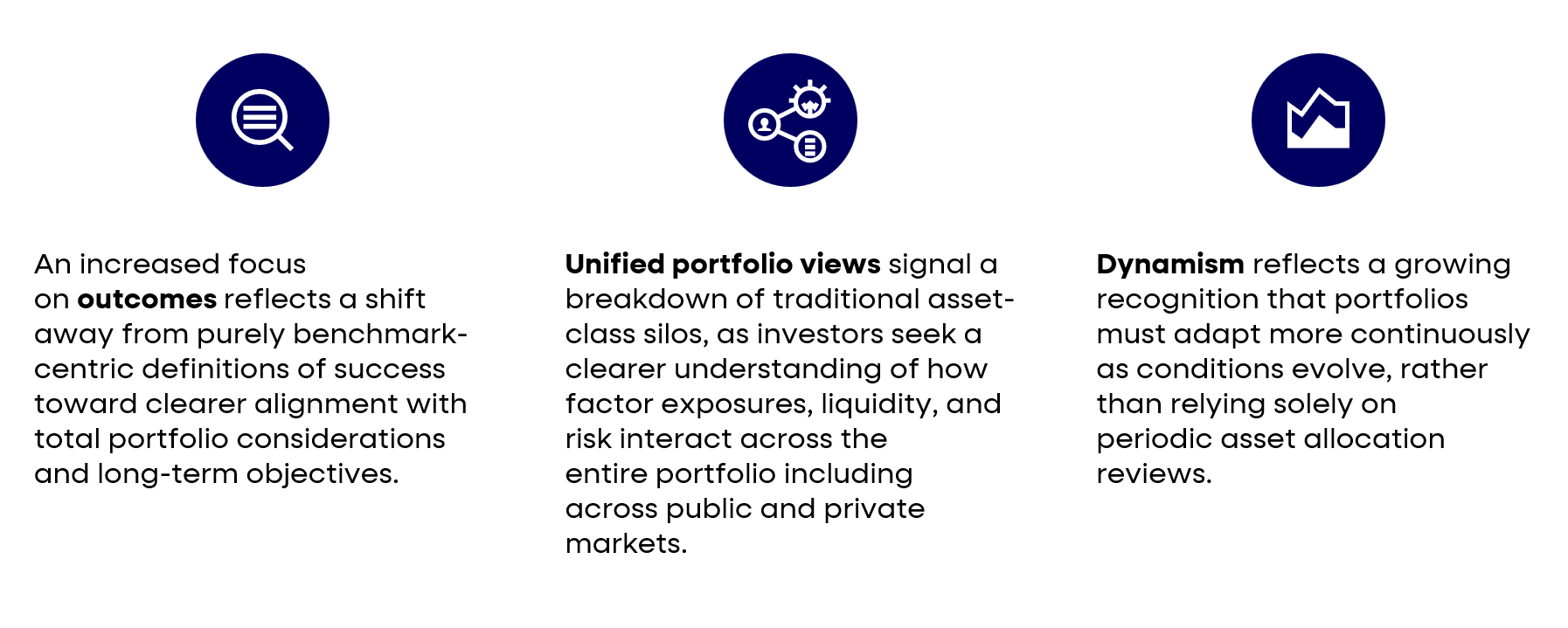
The discussion around total-portfolio thinking highlights three attributes that increasingly shape institutional decision-making: outcome orientation, unified portfolio views, and dynamism. These attributes are not features of a single framework, but signals of how institutional expectations are changing.
Three attributes shaping institutional decision-making
Why and where interest in TPA is rising
Investors today are managing broader opportunity sets, higher allocations to private assets, tighter liquidity constraints, and greater uncertainty across economic regimes. At the same time, portfolio decisions increasingly span private and public markets, asset classes with incremental diversification, implementation timing, risk management, and cash-flow coordination. These realities have pushed institutions to think less about individual asset-class decisions and more about how all exposures interact at the total-portfolio level.
TPA adoption has gained traction from mega-funds, where complex portfolios, sophisticated tools, and organizational silos create the greatest opportunity to transform operating and implementation models. Smaller investors may not require or be able to manage this complexity. CalPERS, which manages pensions for public employees in California, will be the first pension fund in the U.S. to replace their current strategic asset allocation (SAA) model with TPA, starting in July. Through SAA, the CalPERS board set allocation targets every four years with mid-cycle check-ins to identify any necessary changes. With TPA, and without specific asset targets, CalPERS will be able to adjust investment decisions and strategies through time without needing to justify them relative to a pre-existing SAA.1
These large investors often have advanced analytics, deeply resourced internal teams, and governance models that support the implementation of TPA. However, that scale that allows deep resourcing can also create impediments to total portfolio integration.
Larger organizations are more likely to have siloed and specialized teams focusing on the best implementation of their specific asset class without much consideration on the impact to the total portfolio. As they pursue total portfolio integration, they must break down asset class silos to a much greater extent than a five-person investment team typically would. [ML6] This doesn’t mean asset class specialists become less important but rather emphasizes the value of communication and coordination across the various specialists.
The shift to TPA is driving broader changes in how portfolios are operated and implemented. The revised operating and implementation models should drive tighter integration between policy setting and implementation and a greater emphasis on tools and processes that support coordinated decision-making. In many cases, these priorities are supported through portfolio implementation platforms that allow institutions to monitor risk, implement tilts, and maintain exposures efficiently. The combination of complex portfolios, robust tools and large siloed organizations has pushed adoption of TPA across mega-funds that have the most to benefit from the paradigm shift that this can bring to their operating and implementation models. Smaller investors may not require or be able to manage this complexity.
How advancements in risk analytics are enabling this trend
Whether or not an investor follows an SAA or TPA framework, there is a need for risk tools that move beyond standard volatility measures and stress testing that can examine common factor exposures and sensitivities across all portfolio investments. Ongoing investment from Russell Investments, and across the industry, reflects a growing focus on building tools and processes to support this evolution in portfolio implementation. McKinsey reports that technology investment among asset managers has grown nearly 9% annually over the past five years as firms invest in better data, analytics, and decision-making capabilities.2
The improvement in analytical capabilities in recent years has been tremendous and has given investors a better lens into total portfolio risk and exposures. Analyzing and understanding changing portfolio exposures is crucial in all parts of the process, from strategy design to implementation. Improvement in capabilities empowers decision makers to understand their portfolios in new ways that foster more robust discussions on the impact of portfolio changes through time. This allows investors to more holistically integrate total portfolio decisions and be more confident in transitioning to TPA.
Challenges faced in the adoption of TPA and total portfolio integration
TPA requires delegation and the ability to continuously monitor risk, factor exposures, and capital allocation. Boards and investment committees need transparency, clear accountability, and defined risk parameters. While organizations approach these challenges differently, most TPA adopters maintain a reference portfolio to guide high-level decisions and monitor outcomes, even without a formal strategic asset allocation.
Total portfolio integration creates both management and compensation incentivization challenges. In a siloed framework, success is clearly defined by beating the asset class benchmark. With TPA, there needs to be accountability for both performance relative to asset class benchmarks and for how the implementation contributes to the total portfolio. Many organizations have worked towards including weighting schemes to multiple objectives within compensation formulas, but no perfect answer has been found.
Investor implications
The rising interest in TPA reflects how institutional portfolio goals and operating models continue to evolve. Rather than centering on framework labels, we believe the more relevant consideration is: do you have a total portfolio, outcome-oriented approach that allows for dynamic management of your portfolio through time?
These attributes can be expressed through a range of portfolio frameworks. In some cases, they are implemented through TPA. In others, they are embedded within a robust SAA framework that provides clear policy anchors and oversight while incorporating a total portfolio framework that allows for flexibility in implementation. Most important is that investors align their portfolio frameworks with their objectives and ensure that total-portfolio thinking is implemented in a manner that is effective, durable, and well suited to their institutional context.
1https://www.calpers.ca.gov/newsroom/calpers-news/2025/calpers-board-adopts-streamlined-investment-approach-to-seize-market-opportunities
2https://www.mckinsey.com/industries/financial-services/our-insights/how-ai-could-reshape-the-economics-of-the-asset-management-industry
Common client questions
Large institutions often manage broader opportunity sets, larger private market allocations, and investment decisions that span multiple teams and asset classes. These characteristics can increase the benefits of portfolio-wide decision-making. At the same time, organizational scale can create implementation challenges, increasing the need for stronger coordination, governance, and portfolio integration.
Risk analytics provide investors with a clearer understanding of factor exposures, liquidity risks, and portfolio sensitivities across public and private assets. These capabilities help decision-makers evaluate trade-offs more consistently, assess the portfolio impact of investment decisions, and support more informed portfolio-level decision-making.
Not necessarily. The most effective framework depends on an organization's objectives, governance structure, resources, and investment capabilities. Many investors can incorporate the principles of outcome orientation, portfolio integration, and dynamic decision-making without formally adopting a TPA framework, while others may find a more explicit TPA structure better suited to their needs.