Tax-managed mutual funds are available for Canadian investors. To learn more, consult your financial advisor to determine if tax-managed mutual funds are suitable for your personal investment objectives and goals.
Tax-managed investing
New to the active tax management concept? Explore this page for the highlights.
What is active tax managed investing?
Active tax-managed investing is an investment approach aimed at minimizing tax drag and maximizing after-tax wealth. Tax drag is the impact that investment taxes have on a portfolio. This dynamic approach uses real-time, year-round techniques such as tax loss harvesting, minimizing wash sales, and tax-smart yield management to systematically target sources that may erode investment returns, thereby helping investors keep more of what they earn.
How does tax management help me?

Removes complexity from investing

Saves advisors and investors time, effort & money

Goes beyond tax efficient strategies for investing

Aims to minimize capital gains & associated taxes
In a world where investors are fixated on a pre-tax investment perspective, after-tax investment value tends to be an afterthought.
Yet, compounding tax drag nevertheless continues to weigh down portfolios and reduce returns. Fortunately, this perpetual problem has a systematic solution in the form of active tax management. Designed to target actual problems faced by investors, this dynamic approach carries out real-time, year-round measures aimed squarely at minimizing avoidable losses and maximizing after-tax wealth.
How can tax drag negatively impact my ending wealth?
Even a 2% tax drag can have a massive effect on your portfolio.
Consider the hypothetical growth of a $100k portfolio over 10 years with an average 7.5% return. If the annual tax drag on that portfolio was 2%, it would have an ending value after 10 years of $171K. With no tax drag, that portfolio would have an ending value above $200K.
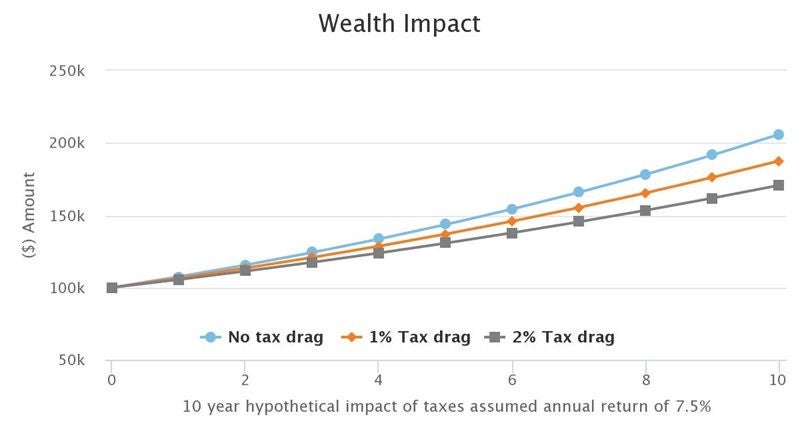
NOTE: This is a hypothetical illustration and not meant to represent an actual investment strategy. Tax drag is the reduction of potential investment returns due to taxes. Taxes may be due at some point in the future and tax rates may be different when they are. Investing involves risk and you may incur a profit or loss regardless of strategy selected.
Our active tax-management approach

Because it's not what you make, it's what you get to keep.
Explore our tax-managed solutions designed to maximize after-tax returns.
When you invest what you earn, you should never settle for good enough. We're not only leaders in active tax management, we are also pioneers, having spent more than three decades in the U.S. sharpening an approach tailored to remove complexity, solve problems and save time.
FAQs
In Canada, different types of distributions have different federal and provincial taxation levels. For example, capital gains are taxed at a lower level than interest income.
Tax-managed mutual funds aim to minimize or eliminate capital gain or dividend distributions, both of which are taxed. Using professionally-managed tax-managed mutual funds can help to minimize tax drag and help investors maximize their after-tax returns.
Our approach to tax-managed mutual fund includes the following strategies and techniques: active money management, centralized trading & implementation, tax-loss harvesting, minimizing superficial losses and gains realization, as well as tax-smart portfolio turnover, and managing a fund’s yield.
Our tax-managed solutions for Canadian investors draw on our 35+ years of experience with tax-managed solutions in the U.S. and more than a decade in Australia. Our approach includes techniques and strategies outlined in the next question in order to minimize taxable distributions.
Tax drag is the impact that investment taxes have on a portfolio.
Also known as tax-loss selling, tax-loss harvesting is the process of selling investments that are losing money to create a tax-loss, which can be used to offset capital gains made elsewhere in the fund’s portfolio, that otherwise would be paid as a distribution.
Tax-managed funds, particularly for non-registered assets (e.g. not in an RRSP or TFSA) in Canada are worth considering as they use sophisticated tax-management strategies and techniques which aim to minimize taxable distributions, such as capital gains. As with any investment, please consult your financial advisor to discuss suitability.
Non-registered accounts or assets are ideal for considering investing in tax-managed mutual funds. These unique mutual funds are designed to minimize the embedded year-end capital gain distributions that trigger capital gains taxes. This is important because these taxes can impact the value of a taxable portfolio.