

Scale can give wealth managers access to a wider opportunity set, including specialist strategies and segregated mandates that may not be available through local platforms. It can also support deeper relationships with asset managers and potentially lower costs. Better outcomes depend on having the research, technology and implementation capabilities to use that access effectively.
Chris Frost, Director of Customised Portfolio Solutions, explores how UK wealth managers can use greater scale to enhance their manager selection process.
Key takeaways:
- Greater scale can open access to a broader range of managers and segregated mandates. This can result in lower costs through deeper manager relationships.
Consolidating assets into “building blocks” opens the door to a broader array of implementation tools, such as derivative overlays to smooth performance whilst preserving manager alpha.
Working with an implementation partner can enhance these benefits by leveraging the scale of a larger organisation and unshackling manager selection from fee economics to increase profitability.
The UK wealth management industry is growing and becoming more complex. As firms expand and consolidate, they bring together different investment propositions, third-party manager line-ups and operating models.
However, scale alone does not guarantee better outcomes. To realise the benefits of growth, firms need the capabilities to manage that added complexity and capture efficiencies.
Russell Investments manages $400 billion in assets and has exeprienced many of the same challenges UK wealth firms now face. We know what it takes to get MPS and multi-asset portfolios ready for their next stage of growth.
In this series, we explore how wealth managers can build the capabilities to invest like a $400 billion firm, starting with manager research.
Researching managers like a $400 billion firm
The priority for growing wealth managers is developing the capabilities needed to use their scale effectively. Manager selection is a central part of this.
For organisations looking to strengthen their investment approach, three questions should guide the process:
1. How broad is our manager opportunity set?
The first question concerns access. Manager selection can become constrained when firms rely mainly on strategies already available through existing platforms or pooled fund structures.
Pooled funds can be efficient and straightforward to invest in, but they do not represent the entire investment universe. Some managers’ pooled funds may also not be available or registered for sale on local platforms. Many managers offer their most flexible or differentiated strategies through segregated mandates, institutional accounts or customised arrangements.
Access to a broader opportunity set does not mean adding more managers for its own sake. It means assessing a wider range of potential sources of return and risk before deciding what belongs in a portfolio.
Importantly, the right choice will depend on the portfolio’s objectives, liquidity needs, risk tolerance, client requirements, and cost pressures.
Skilled manager research can help portfolios outperform
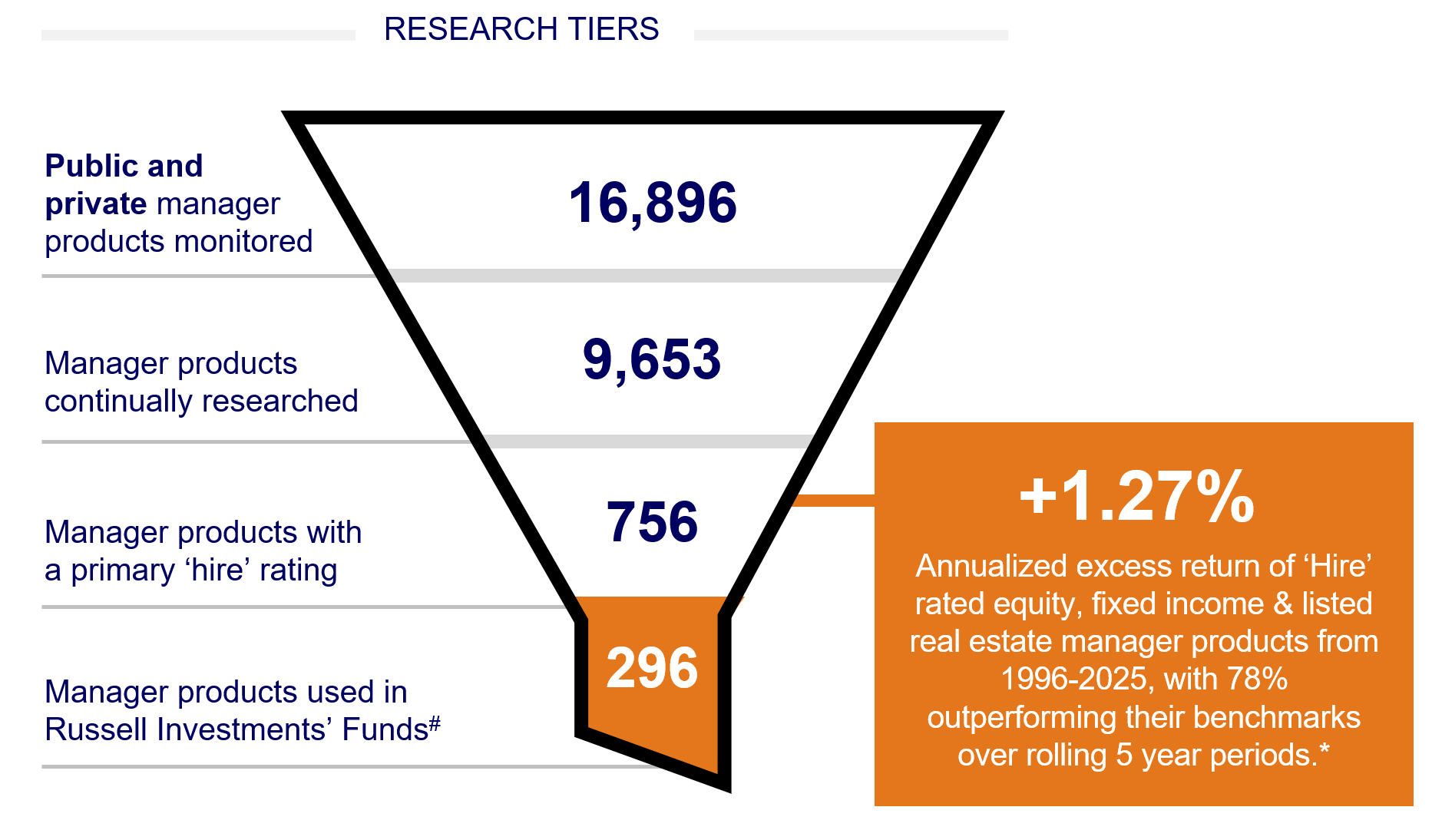
Past performance does not predict future returns.
Source: Russell Investments. As of 30 June 2026, unless otherwise stated. #Does not include alternatives. *Source: Russell Investments. As of 31 December 2025. Please see METHODOLOGY on the Leading managers endnotes slide. Individual calendar year performance: 2025 = -0.31%, 2024 = -0.16%, 2023 = 0.61%, 2022 = 0.1%, 2021 = 2.1%. Single year periods are naturally more volatile. Hire-rated managers’ performance does not reflect the actual performance of any Russell Investments product or client account. The hire-rated manager universe is not an investable portfolio or index and cannot be invested in directly. The +1.27% excess return result is primarily gross of manager/advisory fees and may be lower if all applicable fees, expenses, transaction costs and implementation costs were deducted. Includes equity, fixed income and listed real estate managers.
2. Do we have the capabilities and infrastructure to assess managers properly?
A broader opportunity set creates more information, data and potential overlap. Whether an organisation has the tools, expertise and in-house resource to assess that universe effectively is essential.
Manager research needs to look beyond headline performance and examine how returns were generated, the risks taken to achieve them, the consistency of how the investment process is applied, team stability, skill in different parts of the process and the role a manager could play alongside existing holdings.
Alpha can remain while aggregate active share declines
Excess return and active share by manager
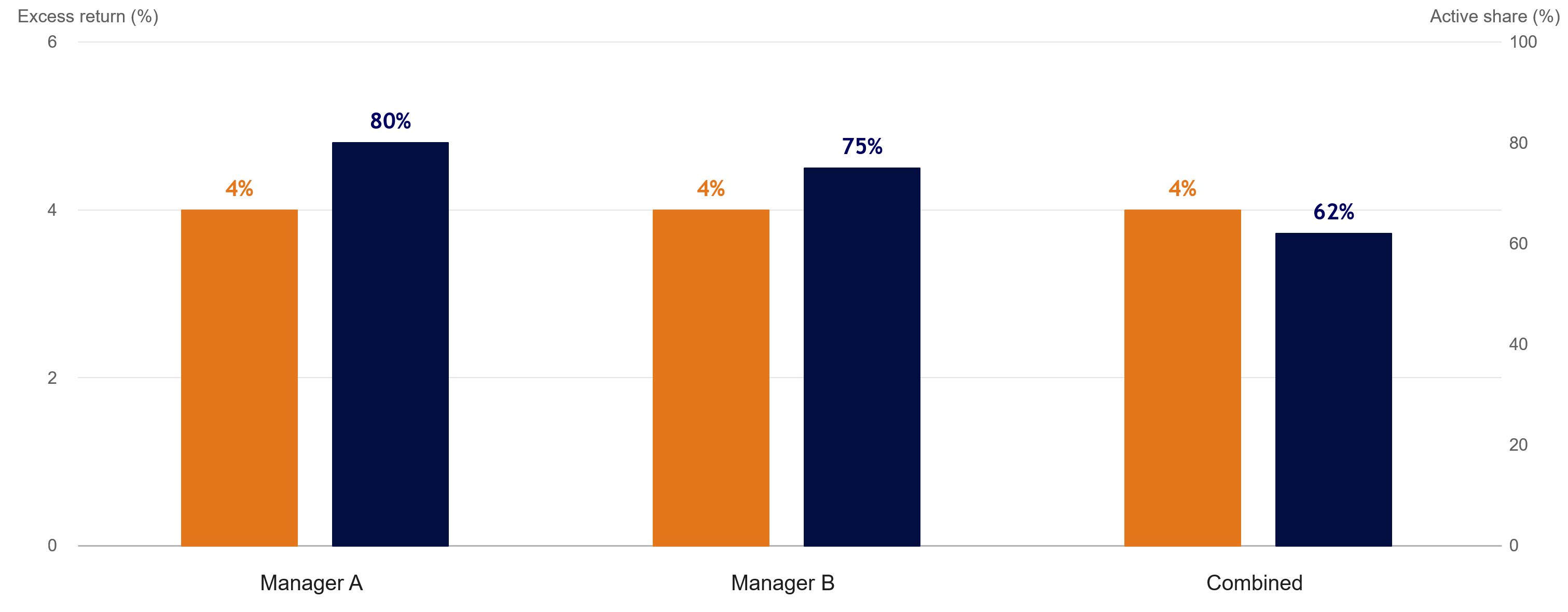
Source: Russell Investments 2026. Illustrative only. Active-share figures are hypothetical and should be replaced with a live portfolio example if available.
This requires both scale in terms of the number of people dedicated to manager research and the technology that can bring together performance data, holdings, risk metrics, fees and liquidity information, alongside manager reports, investment papers and research notes.
Technology including AI can make research faster and more consistent, but human judgement remains key. Firms do not need to build every system internally, but they do need access to the tools that help them understand what they own, why they own it and how each holding fits within the wider portfolio.
Separating skill from beta
| Diagnostic lens | Questions to answer | Why it matters |
|---|---|---|
| Source of return | Is excess return coming from security/issue selection or from broad factor, sector, region, currency, duration, or credit exposure? | Investors should pay active fees for skill, not for beta. |
| Manager diversity | Are managers making money in different ways, or are they crowding into the same trade? | Multiple managers do not guarantee diversified skill. |
| Total-portfolio risk | Which risks are diversifying away and which are compounding? | Unintended exposures often appear only at the aggregate level. |
| Cost alignment | Are fees aligned with the expected source of excess return? | Cheap exposures should be owned cheaply. |
| Governance discipline | Does the process support rebalancing and manager decisions through cycles? | Skill can be squandered by buying winners late and firing underperformers early. |
Source: Russell Investments article, ‘Paying for active management. Are you getting it?’, June 2026.
3. Can we combine and implement our decisions effectively?
The third question begins once managers have been researched and selected. Strong managers still need to work together within a portfolio at competitive fees.
Several managers may appear different by name but have similar exposures to the same factors, sectors, countries or currencies. Portfolio construction should therefore consider each manager’s contribution to the total portfolio, not only their standalone track record.
Implementation matters. Moving from pooled funds to segregated mandates, combining portfolios after an acquisition, managing currency exposure or transitioning between managers can all create costs and risks.
Implementation partners can provide access to institutional-quality capabilities

Investor implications
Investing like a $400 billion manager does not mean replicating the full infrastructure of the largest institutional investors. It means identifying where additional scale, expertise and technology can improve outcomes.
Partnerships can help extend access to manager research, portfolio analytics, risk management and implementation capabilities, while firms retain control of their investment philosophy, client relationships and governance.
Common client questions
Pooled funds combine money from multiple investors and can be efficient and straightforward to access. Segregated mandates are managed for an individual client or institution and may allow for greater flexibility or customisation. Some managers offer differentiated strategies through segregated arrangements that are not available on local platforms.
Wealth managers should look beyond headline performance to understand how returns were generated, what risks were taken and how consistently the investment process was applied. They should also consider team stability, where the manager has demonstrated skill and how the strategy would fit alongside existing portfolio holdings.
An implementation partner can provide access to capabilities such as manager research, portfolio analytics, risk management and portfolio transitions. This can help wealth managers handle growing complexity, including combining portfolios after an acquisition or moving between managers, while retaining control of their investment philosophy, client relationships and governance.
When assets are consolidated into portfolio building blocks, derivative overlays can provide another way to manage exposures. They may help smooth portfolio performance while preserving the contribution of selected active managers. Their suitability depends on the portfolio’s objectives, risks, liquidity needs and costs.

Partner with us
Get in touch with us through this form, and we'll reach out to you.