

Apple

New Bill Poised to Unlock Pension Surpluses for Retirement Savers

2025-10-02

Justin Owens, CFA, FSA, EA

Justin Owens, CFA, FSA, EA

Co-Head of Strategic Asset Allocation


Find other posts with these tags:
Defined benefit
Plan management
Retirement

Key Takeaways

  • Congress is considering a bill allowing DB plans to use surplus assets to fund DC plans
  • This law may incentivize plan sponsors to maintain well-funded DB plans instead of terminating them
  • While meaningful safeguards exist in the proposal, we believe three additional measures—funding thresholds, reliable discount rates and long-term investment strategies—should also be implemented

Overfunded pension plans don't have to die—they can live on in a 401(k) plan.

A new bill under consideration by Congress aims to unlock pension surpluses, giving more flexibility to sponsors of DB (defined benefit) plans.  

Pension surpluses arise when pension assets, which are intended to secure participants’ earned benefits, grow faster than the liabilities they are meant to cover. Once benefits are fully funded and protected through a liability-driven investing strategy, a surplus can build up.

While pension surplus can be used in a variety of ways to help participants and/or plan sponsors, some sponsors are not convinced it has meaningful value beyond what’s needed to terminate the plan.

With average corporate pension funded status at its highest level since before the Global Financial Crisis, and many sponsors debating what to do next with their overfunded plans, now is an opportune time to explore more possible uses for pension surplus. One of the most promising proposals—under consideration from lawmakers—is to allow pension surplus to fund defined contribution (DC) benefits, such as 401(k) plans.  

Surplus in Motion

The concept of using pension surplus for DC plans is not new, but the current momentum is unprecedented. A bill has been introduced in the U.S. Senate—the Strengthening Benefit Plans Act of 2025—that would allow surplus transfers from DB to DC plans if the following conditions are met1:
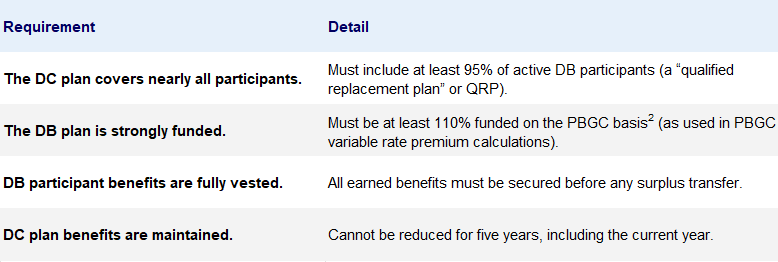
Requirements

Under the proposal, transferred assets would not be treated as employer income, would not be taxable and would not be tax deductible. These provisions would take effect in 2026.

This framework is similar to the rules that govern pension asset reversions during plan terminations. The difference is that surplus transfers would be allowed for existing—rather than terminating—plans. This removes a possible incentive to terminate a DB plan to directly access the surplus.3

The Road Ahead

If enacted, we expect several outcomes:
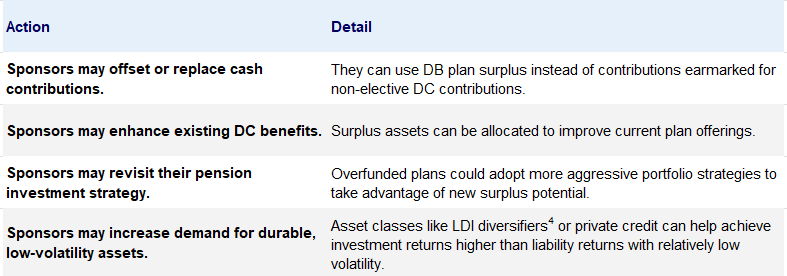
Outcomes

As we have discussed, pension surplus uses can benefit either sponsors or participants— sometimes both—and sponsors must continue to navigate the distinction between fiduciary and settlor functions. 

Public Safety

While we view this proposal as a step in the right direction and an important development for pension sponsors, we also recognize the potential for misuse if safeguards prove insufficient. Pension surplus should never be used in a way that jeopardizes participants’ benefit security.

The conditions outlined above provide meaningful safeguards for DB participants, including the elevated funding threshold. We recommend three added measures, which could be incorporated into the regulations or adopted by sponsors as best practices:

  1. Use the PBGC’s standard method (rather than alternative) for the discount rate basis when determining the 110% funding threshold. The standard method is closer to marked-to-market, while the alternative basis can use a 24-month average of discount rates, which may not fully reflect current market conditions.

  2. Adopt an investment strategy designed to maintain full funding over the long term with a high probability of success. This can be checked by using stochastic asset/liability analysis to discourage overly aggressive asset allocations.

  3. Measure liabilities using the present value of future benefits (PVFB) method, which accounts for future expected benefit accruals for non-frozen plans. This ensures anticipated benefits are adequately funded before the surplus is used.

If enacted, this legislation could reshape a path forward for overfunded DB plans. Allowing surplus assets to enhance DC benefits or reduce employer funding obligations may give sponsors compelling reasons to maintain, rather than terminate, well-funded plans. This is a development worth monitoring closely.

The Bottom Line

Allowing surplus assets to enhance DC benefits or reduce employer funding obligations may give sponsors compelling reasons to maintain, rather than terminate, well-funded plans.

If enacted, expect this bill to breathe new life into overfunded DB plans.


1 The bill also includes significant adjustments to the use of excess retiree health assets, which are not covered in detail here.

2 PBGC stands for Pension Benefit Guaranty Corporation

3 This closely follows a proposal from the American Benefits Council in 2023, which was suggested primarily as a means to stem the perceived tide of plan terminations if pension surplus was not unlocked for existing plan sponsors.

4 Beyond Traditional LDI: The Role of LDI Diversifiers in DB Plan Portfolios


Important information pertaining to the hypothetical example: Past performance does not predict future returns. Return level is proportionately scaled in line with cash level to be overlaid. Source: Russell Investments. Assumptions: Average cash level 1.0%, 10-year history from 12/31/2023, gross of fees. Opportunity cost from not securitizing cash varies by asset allocation and time period, and is represented by horizontal bars as marked within the chart legend. Target asset allocation used: 0% cash, 74% MSCI World, 26% Global Aggregate (GBP Hedged). For illustrative purposes only. Does not represent any actual investment. Indexes are unmanaged and cannot be invested in directly. Performance benefit (net) of overlaying cash by last 5 individual calendar year is as follows:  2023:20 bps, 2022:-17bps, 2021:16bps, 2020:14bps, 2019:23bps.

These views are subject to change at any time based upon market or other conditions and are current as of the date at the top of the page. The information, analysis, and opinions expressed herein are for general information only and are not intended to provide specific advice or recommendations for any individual or entity.

This material is not an offer, solicitation or recommendation to purchase any security.

Forecasting represents predictions of market prices and/or volume patterns utilizing varying analytical data. It is not representative of a projection of the stock market, or of any specific investment.

Nothing contained in this material is intended to constitute legal, tax, securities or investment advice, nor an opinion regarding the appropriateness of any investment. The general information contained in this publication should not be acted upon without obtaining specific legal, tax and investment advice from a licensed professional.

Diversification and strategic asset allocation do not assure a profit or guarantee against loss in declining markets.

Please remember that all investments carry some level of risk, including the potential loss of principal invested. They do not typically grow at an even rate of return and may experience negative growth. As with any type of portfolio structuring, attempting to reduce risk and increase return could, at certain times, unintentionally reduce returns.

The Russell Investments logo is a trademark and service mark of Russell Investments

The information, analyses and opinions set forth herein are intended to serve as general information only and should not be relied upon by any individual or entity as advice or recommendations specific to that individual entity. Anyone using this material should consult with their own attorney, accountant, financial or tax adviser or consultants on whom they rely for investment advice specific to their own circumstances.

Products and services described on this website are intended for United States residents only. Nothing contained in this material is intended to constitute legal, tax, securities, or investment advice, nor an opinion regarding the appropriateness of any investment, nor a solicitation of any type. The general information contained on this website should not be acted upon without obtaining specific legal, tax, and investment advice from a licensed professional. Persons outside the United States may find more information about products and services available within their jurisdictions by going to Russell Investments' Worldwide site.

Russell Investments is committed to ensuring digital accessibility for people with disabilities. We are continually improving the user experience for everyone, and applying the relevant accessibility standards.

Russell Investments' ownership is composed of a majority stake held by funds managed by TA Associates Management, L.P., with a significant minority stake held by funds managed by Reverence Capital Partners, L.P. Certain of Russell Investments' employees and Hamilton Lane Advisors, LLC also hold minority, non-controlling, ownership stakes.

Frank Russell Company is the owner of the Russell trademarks contained in this material and all trademark rights related to the Russell trademarks, which the members of the Russell Investments group of companies are permitted to use under license from Frank Russell Company. The members of the Russell Investments group of companies are not affiliated in any manner with Frank Russell Company or any entity operating under the "FTSE RUSSELL" brand.

© Russell Investments Group, LLC. 1995-2025. All rights reserved. This material is proprietary and may not be reproduced, transferred, or distributed in any form without prior written permission from Russell Investments. It is delivered on an "as is" basis without warranty.