

Key takeaways
- We see global equities entering 2026 with supportive momentum, but a higher bar for results.
- Investor scrutiny is rising, particularly around capital intensity and returns on investment within the AI trade.
- Regional and style dispersion is widening as trends toward global decoupling increase.
- We believe broader leadership will continue, and skilled stock selection will matter more, as markets move from enthusiasm to execution.
Global equities closed 2025 with solid gains, supported by strong headline returns from the world’s largest firms, along with a surprising combination of smaller companies, many of which handily outperformed the top ten in the MSCI World Index. While a significant share of market performance was driven by companies most closely associated with artificial intelligence, European banks, defense contractors, Asian tech firms, and metals and mining companies drove non-U.S. countries to meaningfully outperform the U.S. Importantly, as the year progressed, markets became more discerning, showing less willingness to reward AI narratives without clear evidence of economic and financial progress.
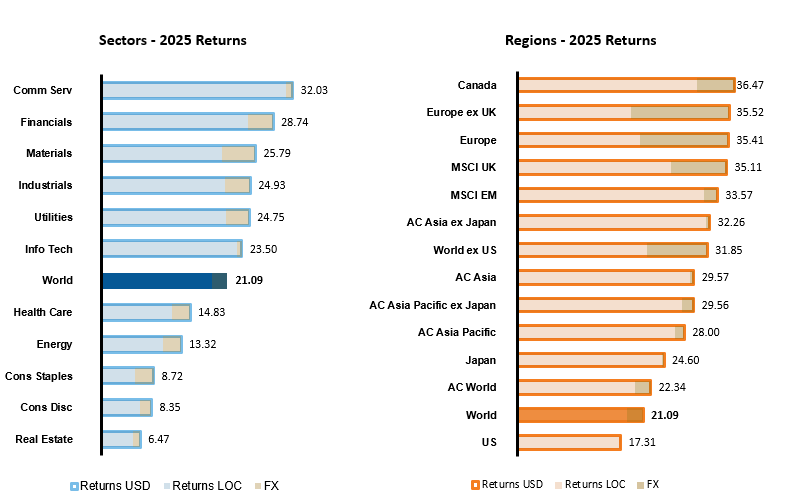
Source: MSCI, Russell Investments
This evolution marks an important transition for the AI trade. While AI remains a powerful structural theme, we are seeing manager focus shift from potential to execution—specifically, whether AI-related investments can translate into sustainable earnings growth, cash flow generation, and balance-sheet resilience. As expectations have risen, so too has the bar for results, setting the stage for a more selective investment environment as 2026 begins.
At the same time, the uncertainty that characterized early 2025 has eased. Markets are now pricing in a relatively favorable outlook, particularly in areas that have already delivered strong performance. With less margin for disappointment, discipline around valuation and fundamentals is becoming more important across global equities.
Beyond AI
Beyond the most crowded growth segments, 2025 brought about a meaningful shift away from the primary market drivers of the past two decades. Specifically, we believe the year marked what could be a prolonged shift toward protectionism and regionalization, along with increased defense and infrastructure spending. If this prevails, we expect to see continued opportunities in long-ignored areas outside of U.S. mega-cap technology stocks.
Valuations and regions back in focus
With such structural changes evolving, regional valuation differences have become increasingly difficult to ignore. U.S. equities—particularly those most closely tied to AI leadership—appear expensive relative to their own history and to other markets, reflecting both strong performance and elevated growth expectations. With optimism already embedded in prices, we believe the U.S. market offers less room for error should earnings or execution fall short. Managers with selective exposure to firms with durable and demonstrated earnings growth, beyond mere hype, will be key.
By contrast, we see Europe and Emerging Markets as presenting more attractive valuation profiles. Expectations remain more moderate, and improving cyclical conditions provide scope for earnings normalization. While these markets have lagged during pre-2025 periods of U.S.-led growth concentration, we believe they can continue to benefit from the continued deglobalization shifts that began last year.
Elsewhere, valuation dispersion across styles also remains wide. Smaller-cap equities globally appear more compelling relative to larger peers as cyclical support builds, while quality characteristics outside the most crowded segments look increasingly attractive when viewed against long-term averages.
Investor implications
Global equities enter 2026 with momentum, but also with higher expectations and reduced tolerance for disappointment. The shift from broad enthusiasm toward execution is likely to favor managers that are more active and selective in their approach and can exploit the shifting opportunity set across regions and styles, paying careful attention to valuation and focusing on companies capable of converting investment into durable financial performance. We expect we will see more rotations among global equity managers as we enter our quarterly review.
As markets move further into this phase, we believe discipline and selectivity will play a larger role in navigating an environment where leadership is broadening, dispersion is rising, and outcomes are likely to diverge more meaningfully across global equity markets.