
Geopolitical disruptions are increasing the focus on energy security, driving investment into power generation, grids, and storage. Higher electricity prices and supply uncertainty are reinforcing infrastructure’s role in delivering reliable and diversified energy systems.
Key takeaways
Geopolitics is redirecting capital toward stable and nationally strategic infrastructure sectors such as energy, supply chains and digital assets.
Rising power demand and energy security needs are accelerating investment in generation, grids, and storage.
Allocations to assets with contractual or regulated inflation linkage may help protect real returns during volatility.
Essential-service infrastructure with high-quality counterparties may provide consistent cash flows across economic cycles.
Geopolitical volatility is not only increasing investor demand for infrastructure assets; it is urgently reshaping where and how capital is deployed. As energy security, supply chain resilience, and digital sovereignty rise up policy agendas, infrastructure investments that expand capacity and relieve bottlenecks are becoming critical.
We believe infrastructure investments allow investors to prioritize three key objectives to support portfolios:
1. Harvest higher inflation
Geopolitical events create inflation through disruption to energy markets and supply chains. Infrastructure assets, which benefit from price rises and higher barriers to entry, can add positive inflation sensitivity into portfolios to protect real returns when inflation volatility episodes occur.
Many infrastructure revenues have the benefit of being linked, directly or indirectly, to inflation. These assets typically have high gross margin cost structures and can more efficiently harvest rising prices without the cost pressures faced by other industries. Regulatory regimes also often allow cost pass-through as well as concession agreements including inflation escalators and, in many cases, contracted assets have direct CPI adjustments to revenue.
However, there are differences in the inflation sensitivity of different infrastructure strategies, which make portfolio construction and manager selection important. For instance, operating assets have in-place physical networks and facilities which allow them to generate revenue without reliance on raw materials. For these assets, rising prices of construction inputs limits new capacity and the competitive positioning of the assets can strengthen. In contrast, the returns of greenfield development strategies can be highly sensitive to input costs rising during the development process and are more vulnerable to rising costs in supply chains.
2. Withstand growth shock
A defining feature of infrastructure is that it provides essential services to governments, communities and corporates. With the correct portfolio construction and investment selection, infrastructure assets can bring durable demand that’s resilient to market shifts. For example, investing in data centers focused on the needs of large, creditworthy corporates around data storage, cloud computing capacity and other use cases, are less likely to be impacted by cyclical economic or market gyrations.
Infrastructure assets such as utilities, social infrastructure and core digital networks can provide essential services that remain in demand across all economic environments. While broader economic activity may fluctuate, these services are rarely discretionary. In contrast, infrastructure sectors with more economic sensitivity face risks in this type of environment, such as airports and toll roads in the transportation sector.
3. Benefit from rising electricity prices
Demand for energy, especially electricity, has begun rising in the U.S. in recent years after two decades of stability. In other global markets, the rise in electricity demand has not begun; however, prices are now rising alongside the spike in natural gas prices from disruptions to Middle East supply. These trends and disruptions have had a direct impact on the strategic importance of energy security, which investment in energy efficiency, efficient power generation and renewable energy uniquely helps support.
Higher electricity prices can directly increase the return potential of renewable energy generation and efficient gas-fired power in the short-term. And over the longer-term, governments are prioritizing the energy security that comes from reliable supply, with a diversified generation mix and stronger grid stability. This policy priority underpins the already attractive economics of renewables, storage, transmission, and flexible generation assets in many markets. Where these investments were once environmental goals, today they are increasingly urgent nationally strategic priorities.
Many of these assets operate under long-term power purchase contracts or regulated return models, providing revenue visibility even during periods of price volatility. As demand for reliable and diversified power grows, infrastructure owners may benefit from structural capital deployment into the energy system. At the same time, investment selection is critical as political winds can blow unpredictably, from shrinking legislative support in the U.S. to windfall taxes in the UK and Europe.
U.S. demand for electricity rises
Total Electricity Consumption (indexed Jan 2011 = 100, trailing 12 months)
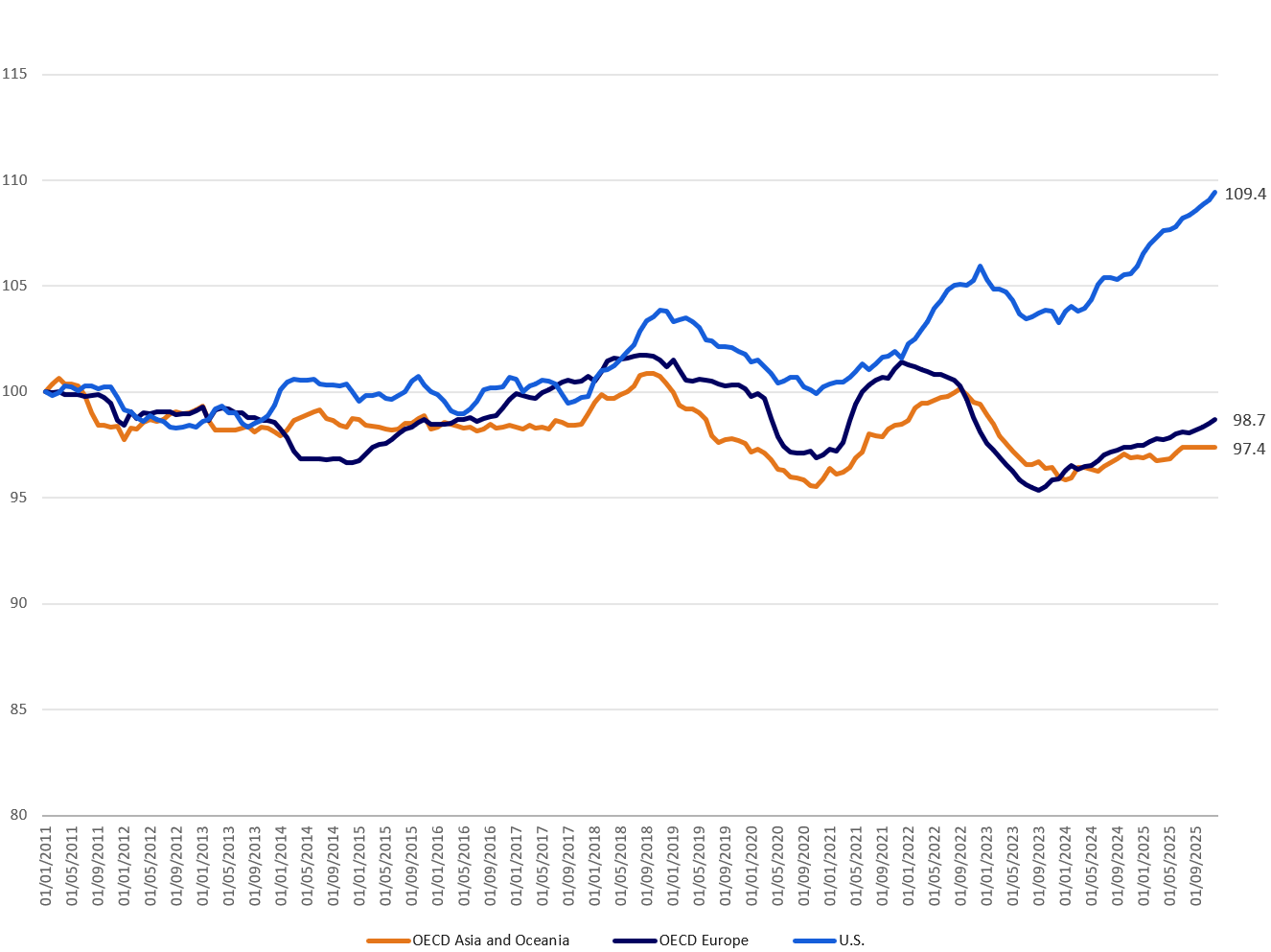
Source: International Energy Agency (raw data) and Russell Investments (rebasing)
Investor implications
As geopolitical uncertainty spreads across global markets, private infrastructure may play an increasingly important role in investor portfolios. The asset class offers a differentiated set of return drivers anchored in essential services, long-term contractual frameworks, and structural demand that persists across economic cycles.
These characteristics help underpin infrastructure’s resilience. Unlike many traditional asset classes that are more closely tied to market sentiment or short-term economic fluctuations, infrastructure assets often derive value from stable, asset-level cash flows and services that remain critical to the functioning of economies.
Common client questions
Opportunities are concentrated in renewable generation, grid modernization, and flexible power assets, supported by policy priorities and rising demand for electricity. These areas are increasingly viewed as nationally strategic.
Many infrastructure assets have revenues linked to inflation through regulation or contracts, which can help support real returns. This is typically stronger in operating assets, while development projects are more exposed to rising input costs.
Assets with regulated frameworks or long-term contracts that include CPI linkage tend to capture inflation more effectively. Operating assets with limited reliance on input costs are generally better positioned than greenfield developments.
Essential-service assets such as utilities, digital networks, and contracted data centers tend to show consistent demand across economic cycles. Transport and other usage-based sectors are more sensitive to changes in growth.
Investors are prioritizing assets with inflation-linked cash flows, durable demand, and strong policy support, while carefully assessing regulatory structures, counterparty quality, and exposure to cost pressures.
Any opinion expressed is that of Russell Investments, is not a statement of fact, is subject to change and does not constitute investment advice.