


No. These signals do not point to a single management model. An institution may strengthen internal resources, improve analytics or governance, add specialist support for particular responsibilities or consider a delegated or OCIO relationship. The appropriate approach depends on the decisions the institution wants to retain internally and where additional capabilities could strengthen oversight or implementation.
Key takeaways
- Persistent policy drift can change the risk an institution carries, even when its long-term objectives have not changed.
- Liquidity can be miscalibrated in either direction. Holding too little can constrain decisions, while holding too much can leave capital underinvested.
- Portfolio risk needs to connect to the institution’s liabilities, spending needs, operating priorities, and other demands on capital.
- The appropriate response can range from adding internal resources to using specialist or delegated support for specific responsibilities.
Investment programs are being asked to do more
Institutional portfolios have changed considerably, and so have the demands placed on them. Organizations are asking their investment programs to support a broader set of priorities, from funding liabilities and spending needs to maintaining liquidity and financial flexibility.
Over the past two decades, the investment toolkit has expanded across public and private markets, giving institutions more ways to pursue their objectives. Corporate defined benefit (DB) plans show just how much portfolio construction has changed. In 2000, 80% of the median corporate DB portfolio was in U.S. stocks and bonds. Today, 44% is allocated across other asset classes.
Figure 1. Corporate DB portfolios look markedly different than they did two decades ago
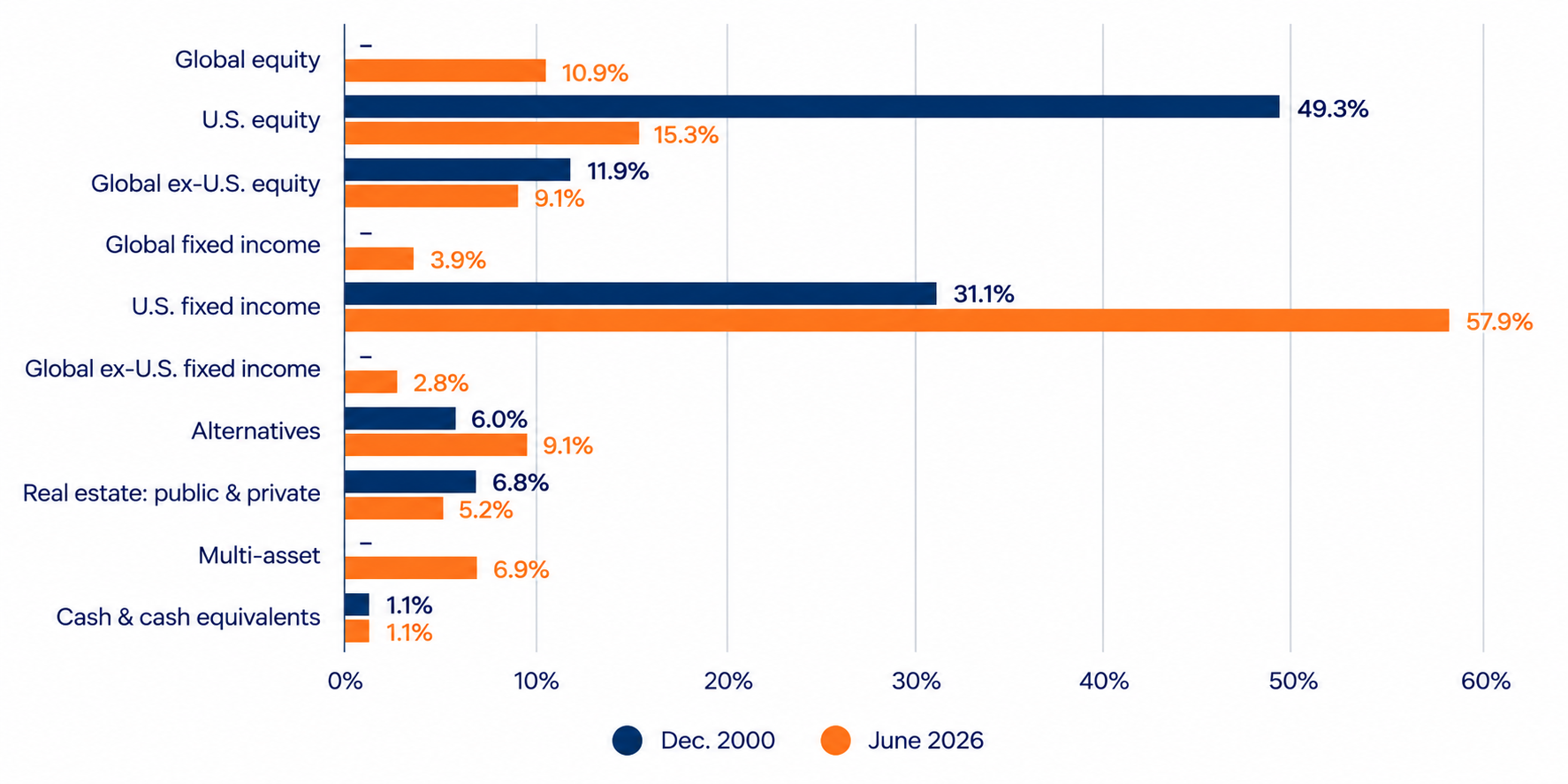
Source: Investment Metrics. Selected median asset-class allocations for U.S. corporate defined benefit plans with $250 million–$1 billion in assets, December 2000 and June 2026.
We have seen that evolution take different forms. Some corporate DB plans have simplified their return-seeking portfolios as funded status improved and placed greater emphasis on liability hedging. Other institutions continue to expand across public and private strategies to pursue return, diversification or other objectives.
Regardless of the direction, portfolio needs can change faster than the processes and resources around them. Changes in liabilities, liquidity, allocations or organizational priorities can require different capabilities or faster decisions than they once did. The warning signs show up in different ways, from exposures straying off target to liquidity in the wrong place or risks that are harder to act on.
In our experience, those three signals can be useful prompts to reassess whether the way an investment program is managed still fits what the institution needs from it today.
Sign 1: Persistent policy drift is the first signal
After decades of reviewing institutional portfolios against investment policy guidelines, one of the first signals we tend to see is a gap between the exposures an institution intends to hold and the ones it actually holds.
Some movement is expected. Markets reprice, private assets revalue, liabilities change and cash flows rarely arrive on schedule. What we pay attention to is when those changes leave the portfolio carrying risks that were not an intentional decision.
We saw this clearly during the 2022 market selloff. Public markets repriced quickly while private-market valuations moved more slowly, leaving alternatives at a larger than intended share of many portfolios. In our experience, the denominator effect can leave portfolios with significant alternatives exposure 5 to 10 percentage points overweight to policy during volatile periods.
Figure 2. Market moves can push allocations and hedging exposures away from policy
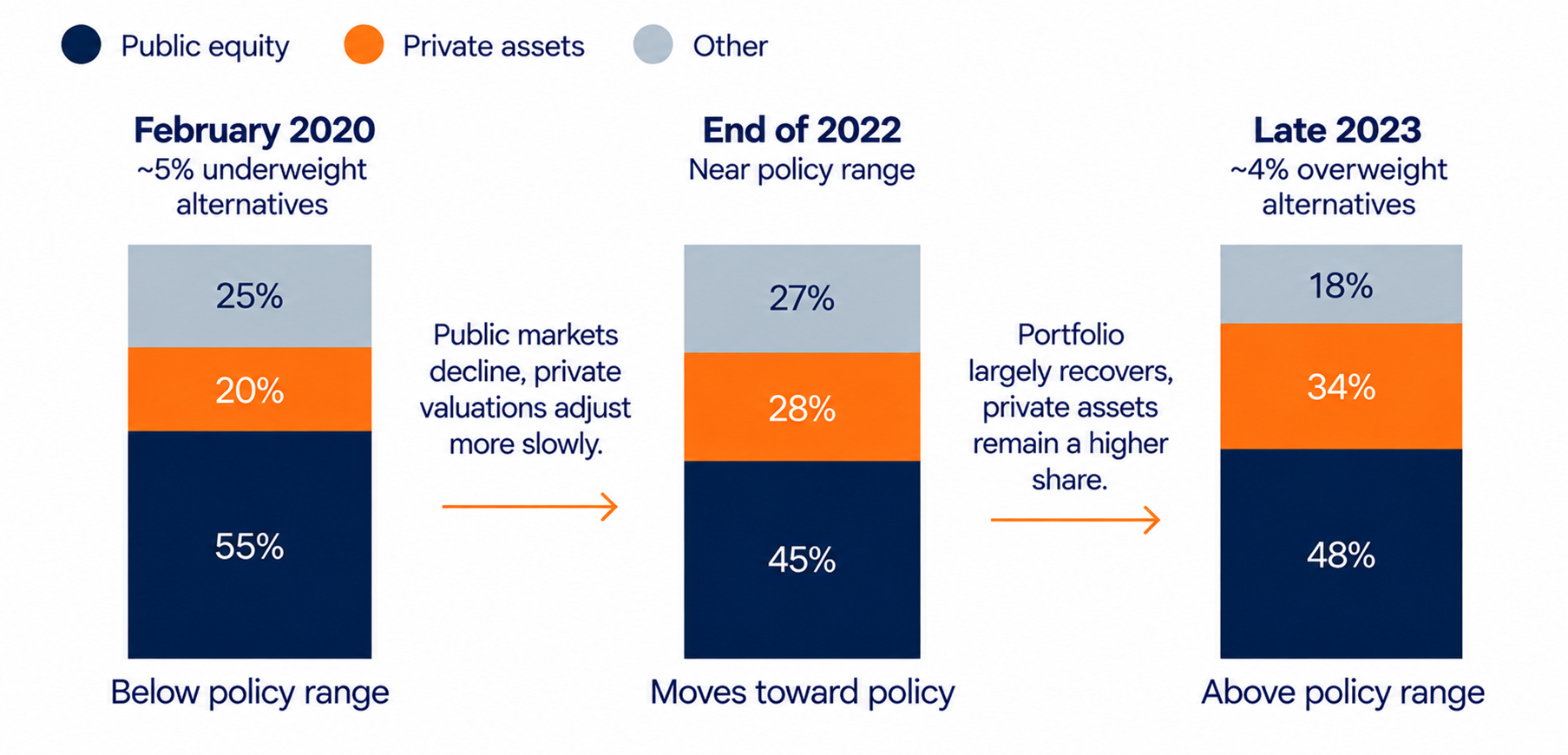
Source: Russell Investments. Illustrative example based on a Russell Investments client experience.
The SpaceX IPO also showed how the transition of private market gains to public market holdings could leave some institutions with large, concentrated public equity positions. Managing the transition required decisions about what to retain, sell or hedge, often faster than existing governance and implementation processes could respond.
For defined benefit plans, drift can also show up in the liability hedge. In one example, changes in interest rates caused both the overall hedge ratio and the 30-year key-rate hedge ratio to move materially outside their policy targets.
Figure 3. Hedge ratios can move materially out of alignment with targets
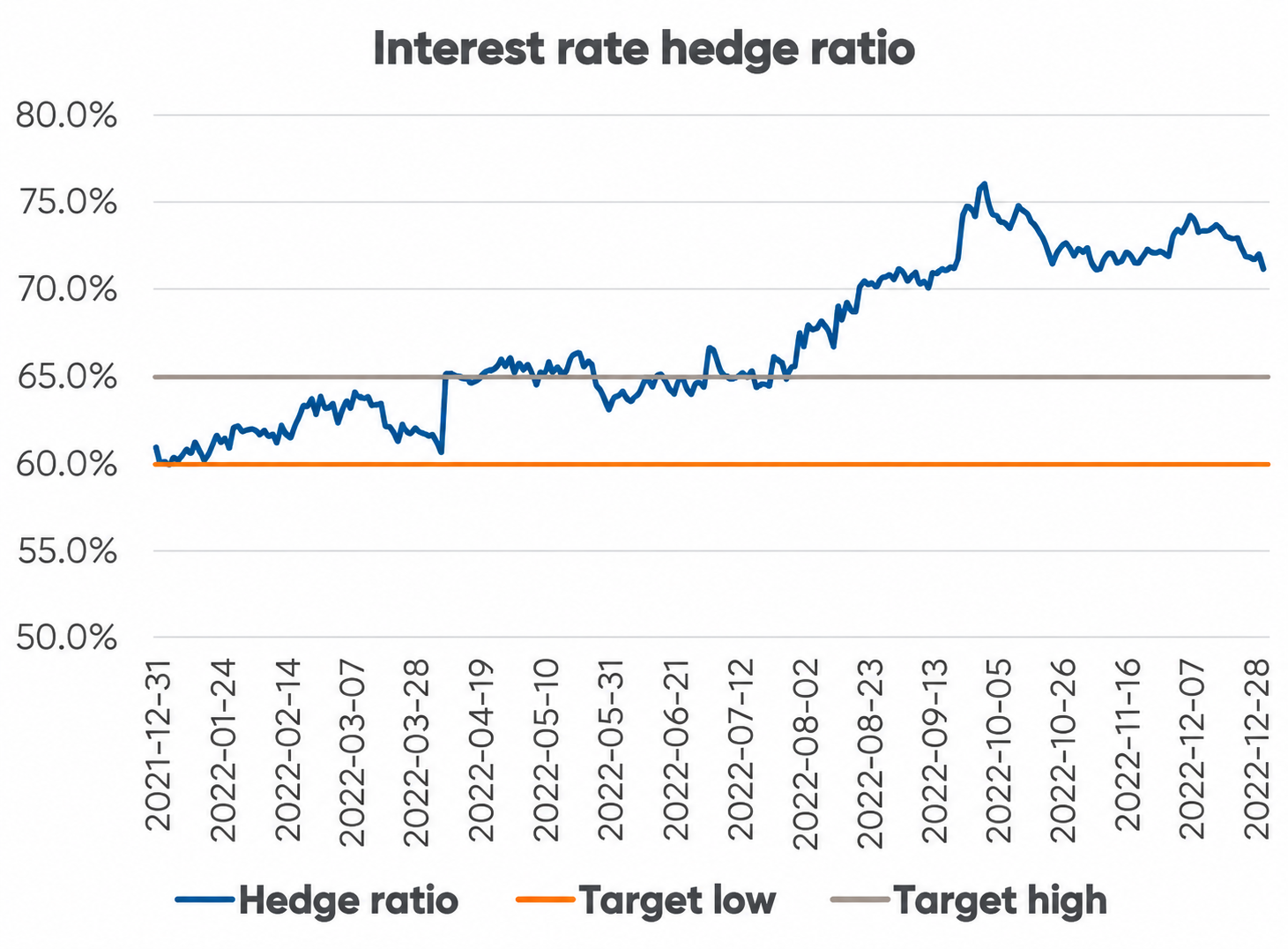
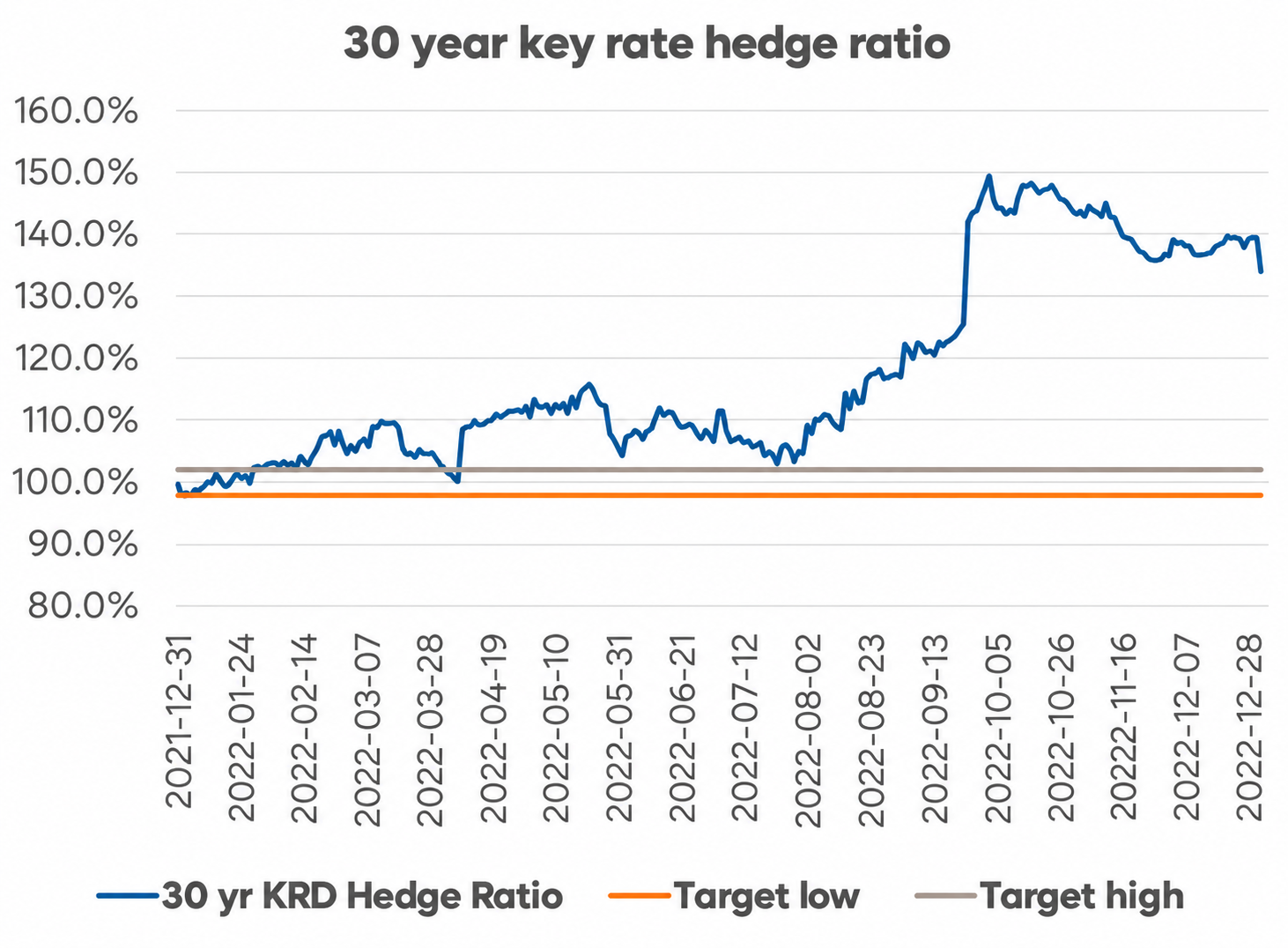
Source: Russell Investments
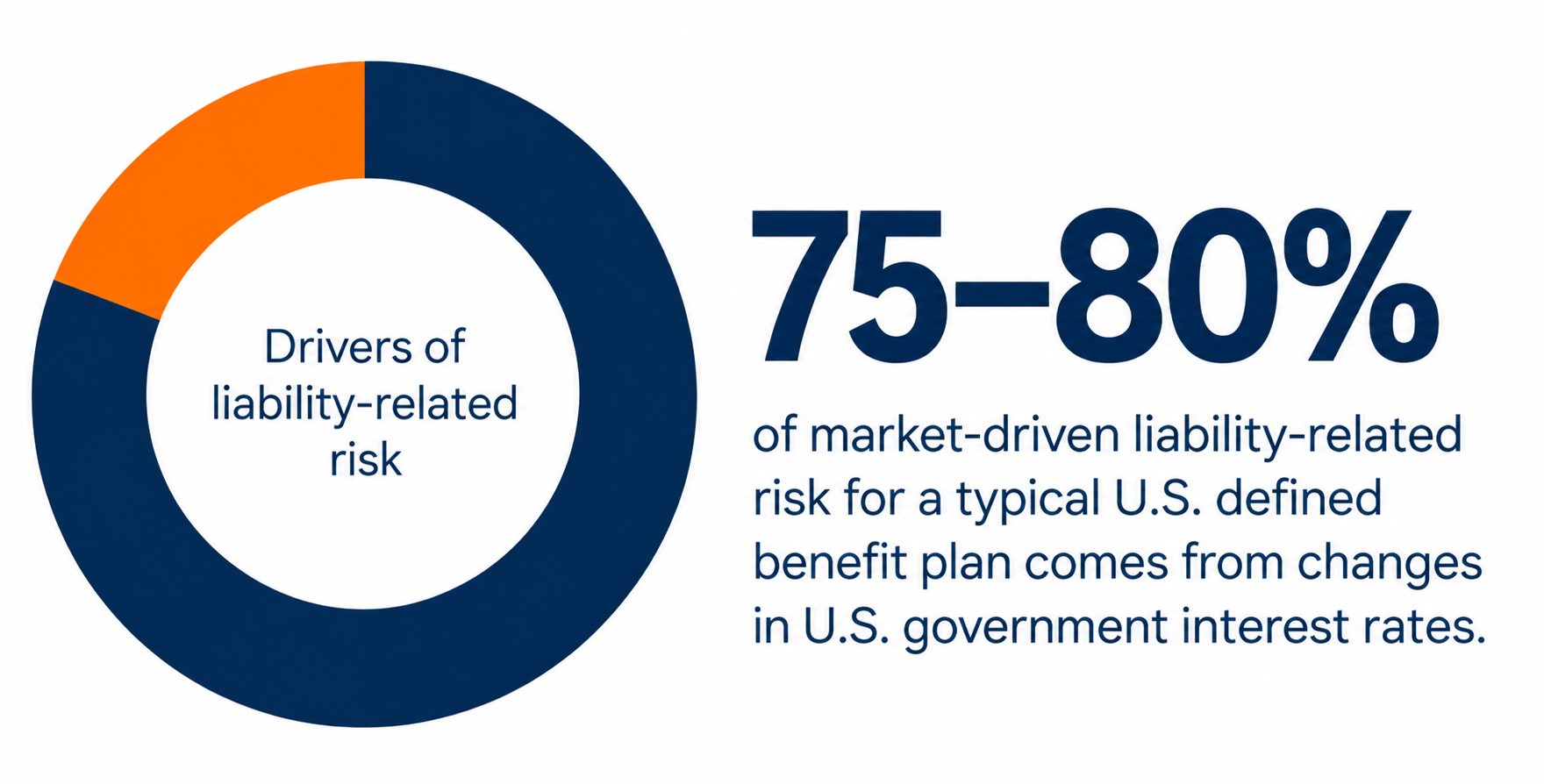
The speed and magnitude of those moves illustrate why hedge ratios may require frequent—and during volatile periods, potentially near-daily—monitoring. Our analysis estimates that changes in U.S. government interest rates could account for roughly 75% to 80% of market-driven liability-related risk, making the hedge ratio too important to treat as a residual of past positioning.
Figure 4. Interest rate changes drive most liability-related risk
Source: Russell Investments
The exposures will differ by institution. A healthcare system or endowment may focus more on equity, regional, style or factor exposures, while a DB plan may put greater weight on liability-relative risk. In each case, institutions need to understand where actual exposures sit relative to their intended risks and whether they have the resources and processes to respond when the two diverge.
Sign 2: Liquidity needs compete across priorities
Liquidity risk can come from having too little cash or too much of it. Too little can force asset sales or limit rebalancing. Too much can leave capital in cash or short-duration assets when it could support longer-term objectives.
The challenge is that liquidity needs rarely come from one place. A mature defined benefit plan needs to fund benefit payments and maintain its liability hedge. A healthcare organization may need capital for operations and major projects. A foundation needs to make its annual spending payouts while preserving assets to support its mission over time.
Figure 5. Higher spending can make recovery from a drawdown more difficult
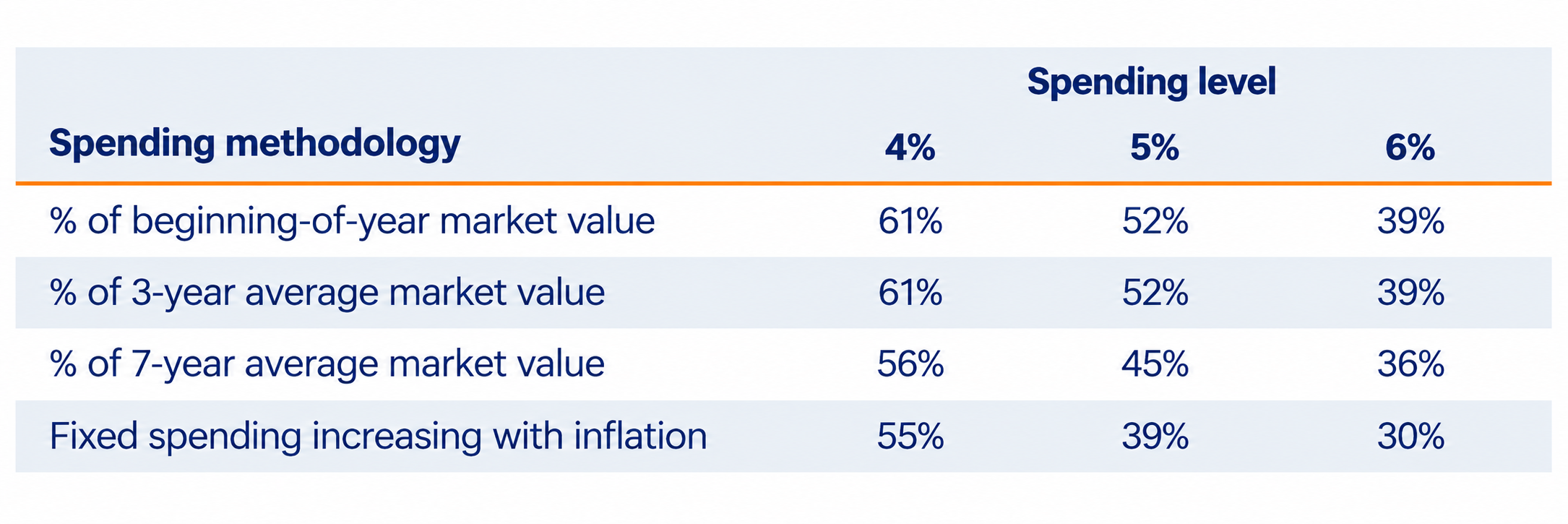
Source: Russell Investments. Based on Russell Investments June 2026 capital market assumptions. These calculations do not repeat actual future performance and are not guarantees of future results.
Private-market commitments can add another layer to those cash demands because the timing of capital calls and distributions is less predictable.
Many institutions have started looking for dedicated liquidity analysis to bring these obligations together. If you cannot readily see how much cash the institution will need, when it will need it and where it will come from, the resources supporting the investment program may deserve another look.
Sign 3: Portfolio risk isn’t connected to the institution’s broader priorities
A portfolio can look reasonable by asset class, manager and benchmark while still leaving an institution without a clear view of the risks most relevant to its objectives.
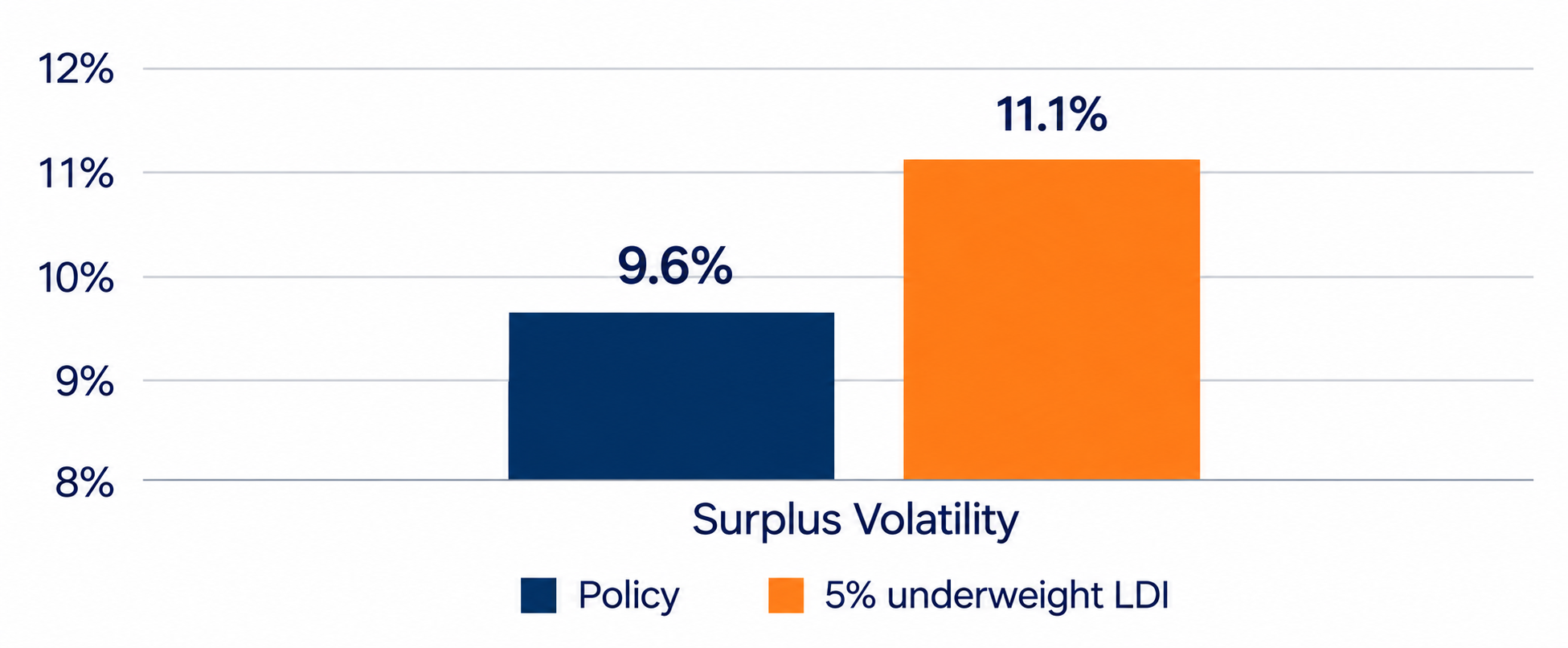
Those risks differ by institution. A defined benefit plan may focus on funded status, contribution volatility and liability-relative risk. In the illustrative example below, a 90%-funded plan that moves 5% below its target LDI allocation and reduces its interest-rate hedge ratio by 10% sees surplus volatility rise from about 9.6% to 11.1%, an increase of roughly 16%.
Figure 6. Drift from LDI targets can increase surplus risk
Illustrative 90%-funded DB plan with LDI assets 5% below target and the interest-rate hedge ratio 10% below target
Source: Russell Investments
A healthcare organization may need to understand how market stress could affect reserves, debt capacity, capital plans and operating flexibility. An endowment or foundation may focus on sustaining distributions while preserving purchasing power. The useful measure of risk depends on what the assets are there to accomplish.
Sometimes those answers are needed quickly. During periods of market stress, institutions may need to understand within hours how a geopolitical event, rate move or commodity shock affects their portfolios. We have seen that firsthand, from helping clients assess Russian holdings as markets reacted to the invasion of Ukraine to understanding portfolio exposure as conflict in the Middle East drove sharp moves in oil prices.
Good governance depends on having that information in time to use it. Committees need to understand what a market move means for the institution, what requires action and which decisions can be made within existing guidelines rather than waiting for the next governance cycle.
If your reporting can tell you what happened in the portfolio but not what it means for the institution or what decisions it may require, it may be time to reassess the analytics, governance and resources supporting the program.
The right response depends on the institution
These signals do not point to a single answer. They are reasons to step back and ask whether the way the investment program is managed still fits the portfolio and the institution it supports.
For some institutions, that may mean adding internal resources or improving analytics, governance or implementation. Others may benefit from specialist support in specific areas. The right approach depends on the decisions the institution needs to make, the capabilities it wants to maintain internally and where additional support can be useful.
What matters is making that assessment deliberately. Investment programs evolve, and the resources around them should be reviewed periodically too. Persistent drift, competing liquidity demands or difficulty connecting portfolio risk to institutional priorities can all be useful prompts to take another look.
An investment program does not need to be struggling to benefit from that review. The goal is simply to make sure the way it is managed still fits what the institution needs from it today.
Common client questions
Risk should be evaluated in the context of what the assets are intended to accomplish. A defined benefit plan may focus on funded status and liability-relative risk, while a healthcare organization may prioritize reserves and financial flexibility and an endowment may focus on spending and purchasing power. Effective oversight helps committees understand not only what happened in the portfolio, but what market movements could mean for the institution and whether action is required.
Liquidity should be evaluated against the institution's total demands on capital, including their timing and purpose. Benefit payments, spending, capital projects, operating needs and private-market commitments may draw on liquidity differently. Looking across those needs can help identify situations where an institution has sufficient liquidity overall but not where or when it is needed—or is holding more liquidity than its objectives require.
Some allocation drift is expected as markets, liabilities and cash flows change. It becomes more concerning when exposures remain outside their intended ranges, introduce risks the institution did not deliberately choose or cannot be readily corrected. For defined benefit plans, drift can also occur in liability-hedging exposures, potentially changing the plan's liability-relative risk even when its long-term objectives remain unchanged.
Persistent policy drift, competing liquidity needs and difficulty connecting portfolio risk to institutional priorities can signal that the resources and processes supporting an investment program deserve another look. These issues do not necessarily mean the investment strategy is wrong. They may indicate that governance, analytics or implementation capabilities have not kept pace with what the portfolio and institution require.