Healthcare and hospital systems

Decades of institutional leadership drive every product and service.

Hospitals and healthcare systems have trusted us for almost 40 years to ensure their investment programs are aligned with their financial objectives.

We offer comprehensive investment solutions for long-term or operating pools, defined benefit and contribution plans, foundation, and insurance assets.

Our services include outsourced CIO (OCIO) solutions and custom investment solutions such as consulting, dynamic, multi-asset class investment management, and implementation services for healthcare organizations of all sizes and levels of complexity.

You can count on these guiding principles that underline our investment approach

Investment discipline

We use a research-driven investing approach free from emotional and behavioral biases. Our investment strategy involves:

  • Evaluating a wide range of investment opportunities.
  • Identifying areas where potential returns are greatest.
  • Maintaining strict investment disciplines to ensure your portfolio remains stable and balanced.

Open architecture

No single asset manager can do it all. We leverage our industry manager research to find the asset managers we believe to be among the best in the world. Then, we incorporate them into a portfolio designed to meet your risk and return requirements.

Outcome-oriented investing

It's not enough to beat benchmark returns. We start with understanding your objectives and then design an investment solution tailored to meet your goals.

Dynamic portfolio management

Our investment capabilities empower us to respond quickly to market changes. Timing and efficient implementation are crucial, and every basis point matters.

Cost-efficient approach

Our investment solutions are designed to help you increase returns and reduce risk, all while staying within your fee budget. We utilize our scale, purchasing power, and access to help you achieve your goals.

Effective risk management

It's critical to "know what you own" before making changes to your investment portfolio. We leverage our advanced software and tools to help manage risk and reduce unexpected outcomes.

We are proud to be globally recognized for excellence in the investment industry

Russell Investments was ranked as the largest global manager of Healthcare outsourced assets, out of 26 firms, in CIO Magazine’s “2024 Outsourced-Chief Investments Officer (OCIO) Survey,” based on the AUM from its fully discretionary clients (as of December 31, 2023).1
Chief Investment Officer 2024 Outsourced CIO Survey award (Healthcare)

Russell Investments' multi-asset approach is core to what we deliver to our OCIO clients.

Multi-asset investing is the process of incorporating exposures to a globally diverse mix of asset classes and dynamically managing those exposures to capture short-term market opportunities and mitigate risks. We integrate this approach into every outsourced CIO solution we build for our clients.

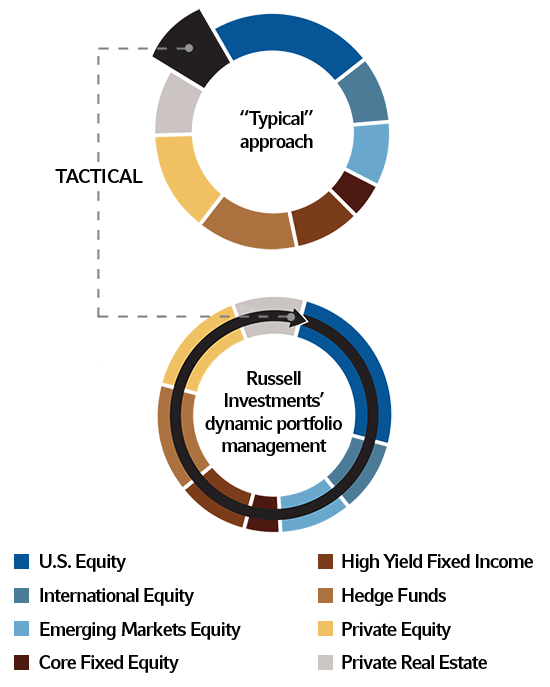
Below illustrates a typical approach and Russell Investments' multi-asset approach. We believe this is what makes us a best-in-class solution, a cut above the rest.
investment approach

The "typical" portfolio shown is constructed using sleeves for individual asset classes combined with an additional tactical sleeve bolted onto the portfolio. In this type of portfolio construction, each sleeve is managed separately, and the tactical sleeve is applied without considering the managers' current position and risk budget in each asset class sleeve.

In Russell Investments' multi-asset approach shown, the decision about what tactical shifts to make is informed by the underlying holdings of the managers and strategies, plus the risk budget of the total portfolio and the shifts in the market. This approach gives our portfolio managers greater flexibility to adapt the portfolio to short-term market shifts to help retain long-term return potential.

This approach requires the skills of a team of full-time, dedicated and experienced investment professionals, and this capability is built into every OCIO solution we offer to our clients.

good afternoon thank you for joining us today I'm Lisa Schneider managing director for Russell Investments Healthcare practice and I'm joined today by Al salvato Al is the senior Vice President of Finance and chief investment officer of Jefferson Health Al is responsible for Jefferson's 11 billion dollar investment program which combines a mix of short intermediate and long-term balance sheet assets as well as their pension programs Al is active in the community serving on a number of advisory boards as well as Community boards and Al holds a degree from Villanova University so we're going to kick this off shortly we do want this to be an active and open dialogue so if you do have any questions please just click on the Q a button on the bottom above Zoom screen we'll see those and be able to address all of your questions so I'm going to kick this off Al many Health Systems nonprofit Health Systems traditionally have managed their balance sheet assets by having a full and very short-term operational cash as well as long-term goal and over the last sort of couple of years particularly coming out of a pandemic many of the new organizations we are talking to are starting to ask questions about the merits of further segregating that to include maybe an extended long-term pool or an intermediate term pool and I know that's something that you've implemented at Jefferson so we'd like to kick this off by just you know tell us a little bit about Jefferson and what sort of challenges were you looking to solve with this structure yeah Jefferson um the Genesis of what we're going to talk about today started back in probably about 2016. um Jefferson for those who don't know is a philadelphia-based the academic Health Center we've got currently today 18 hospitals in the system and academic division as well as an insurance company underneath the program in that profile that I I'm outlining there did not exist in 2014. um uh we've had significant rapid growth uh through primarily mergers and Acquisitions over that period of time uh resulting in a very different balance sheet than what we had originally and what you were highlighting earlier uh relative to how we used to manage money we used to have a working capital pool and a long-term pool um but as the balance sheet of the organization changed it created a need to to kind of take a look at a very different profile of the organization as institutions were coming into the mix uh they go out with them different debt profiles different investment portfolios um and a different risk profile and just in general and so I was thinking about how we could better structure the Investment Portfolio to be responsive to risks that were present on the balance sheet um and we kind of stumbled upon efforts that were going on going along the line with coffin balls and services and consultant with us and other aspects of the organization um but they also had a methodology for allocating assets as compared to the risk profile and the balance sheet um so in 2017 we engaged with Kaufman Hall to take a look at take a look at our balance sheet and our Investment Portfolio and figure out a methodology by which we could uh better manage against the risks that were present on the balance sheet so we undertook a significant effort in 2017 that involved really participation from a very broad segment of the population including ref cycle people including leadership including Finance individuals to kind of look at the balance sheet identify risks that were present then on the balance sheet and then how to take those risks and be responsive from an investment standpoint so this effort again started in 2017 and we've been executing upon that profile um and I know uh you have you have some exhibits with us can you talk to us a little bit about maybe in detail how did it think through organizing all those risks and what does that end up looking like as you start to put it together so what I'll do I'll up uh up against some the slide here and I don't know if the individuals can see this slide but we basically took a look at um again the balance sheet and the risk profiles and we kind of categorized uh some of these risk profiles and series of buckets one would have been working capital reserves which again is monies that you believe you're going to need to have short-term payments against accountants payable some of the other risks in the core operations and strategy buckets reference revenue cycle activities clinical quality operations technology and data issues and then strategy and disruption uh the next bucket would have been the capital spending requirements over a protracted period of time to say five years and what that would potentially demand upon the cash profile and then the last one was a comprehensive debt profiles to kind of make sure that we were satisfying that service requirements as well as um you know our compliance tests on on that as well as just potential for additional debt downline and when we looked at that whole Horizon we identified that we probably had about 3.7 billion dollars worth of contingent risk on the on the balance sheet that we needed to address in some manner um and the analysis work that we did with Kaufman Hall back in 2017 and what we continue to do now is kind of continue to look at digesting information as as we develop our operating budgets or Capital budgets and see how that may impact our investment profile you look at these risk buckets in different ways again working capital bucket again is really how much money do you need need to have on hand to be able to satisfy accounts payable withdrawals or pension draws Etc um the core operating strategy bucket is basically one that you look at with a two to three year kind of horizon what do you think you're going to be doing spending money on over the next two three years so planned expenditures that you already know about that are in the queue that you want to have cash funds available for those programs the capital capital is more of an extended perspective and and you can have a broader perspective on that one because there are capital plans that are in place but you may not choose to execute them execute on them uh considering what your operating performance may be you may say we're going to defer a program or we're going to cancel a program and so that has a different window of opportunity uh that you can lay off some of that risk it doesn't become a dedicated offset it becomes more of a contingent kind of offset down the line and the last buckets is really on the debt side where you have the to satisfy your debt service payments future debt transactions that you may be thinking about or concerns of outputs that you may be facing on on some of those debt transactions so you're able to bucket things and and have what we call risk responses associated with each one of those buckets working cap Apple you have to be 100 percent funded at all times the core operations component that that are things that you know about coming you have to have liquidity available for that the other buckets you can start saying okay we've got contingent liabilities there that we may not choose to satisfy so we don't have to reserve as much and therefore we can invest those and within a longer term perspective um that's what that risk response is is the ability to respond to those kind of risk profiles post that then you can start figuring out how you're going to lay out assets within a series of portfolios to kind of satisfy the returns uh the demands for those particular cash but also generate some returned profiles that are linked to that liability profile so that's kind of how we've structured um the map so to speak right right and I know you call this I think originally an integrated risk Financial framework have you adopted that thinking and how does it really allow you to think about how are you aligning with what you're doing with all of your resources and supporting the broader needs of the organization it is it's an effort that we refresh every year um so every year depending on what's going on with the organizations if there was nothing fundamentally changing in a significant way to the balance sheet profile then we weren't making any changes as far as the acid allocations in the investment accounts but if there were changes like we brought on another institution that had a fair amount of debt associated with it at a fair amount of it had an open pension plan things like that change the Dynamics the other component was we bought an insurance company that changed the Dynamics of the profile and that that forced us to do a deeper dive into a more significant refresh to the liability profile as well as the investment accounts now when you say fever died you know so Jefferson like many Health Systems is a very Broad and complex organization how far into the organization the scope of the types of people within the system do you have to go to get the information that you need to accurate because I think a lot of this depends on accurately evaluating risks that you have so you can catalog them so the first the first go through was a very deep dive into the organization it was a lot of interviews from a lot of different segments whether it be the university components getting a clear understanding of what their wants and needs were going to be in the future whether it was the clinical Builders clinical pillar which was the primarily going to all the presidents of the organizations and speaking to them and understanding it going to the ref cycle folks going to strategy folks and understanding what their demands for Capital might be going out into the future luckily Jefferson always built the five had a very detailed five-year forecast so we were always being informed annually we've been refreshing that five-year forecast we were always being informed of things kind of in advance but it made sense to go out and actually interview folks so ourselves in the Kauffman Hall folks actually went through that pretty extensive process as the years rolled on five-year forecast that we that we're doing kind of pulls a lot of that information out um but as we were integrating other institutions into the mix we then had to go out and speak to those individuals at those same kind of individuals uh finding out what their wants and needs may be or what their concerns may be the last refresh that we did we went from basically 2017 to 2021 doing that refresh kind of on our own because there wasn't anything fundamentally big changing but in 2022 they demanded that we do a more significant refresh we brought Kaufman Hall back in to kind of help us go through that entire process again and realign again the asset allocation profiles and and probably more and we'll get into it about the asset buckets but probably more on the the long-term pool where we were actually able to extend more uh more uh illiquidity into that portfolio than than we had before um so it's an it's a iterative process but it is one that requires a lot of information coming back to us um so the investment office digests that and we also then incorporate um our investment Consultants to help us um structure the accounts and the allocations uh to satisfy the the risk and and uh risk profile and return profiles that we're shooting for right so why don't we um take the owners through that step them it's not the risk profile catalog then what's your next step as you start to move through figuring out what does this mean or how you actually allocate the resources of think through investment structure so once we determine what this risk profile would only be one of the other components that we had to incorporate in was was associated with the debt profile and really the health of the organization from a ratings perspective so we established uh cash flow targets which were linked primarily to us maintaining our credit ratings um we don't really have a day's cash on hand um Covenant test we have a little one relative to um Baghdad but day's cash on hand isn't really a covenant requirement but we established uh bands in which we wanted to live with so our normal cash position um days cash on hand position would be about 200 days Days cash on hand but we set a floor that we did not want to pierce below about 175 days and that was driven principally by medians that the rating agencies have for our rating category so that was one of the one of the tiers that we set we then also looked at um from a from a Investment Portfolio how much uh volatility could we have withstand within the portfolio of these days cash on hand isn't just working capital it's you're unrestricted Assets in your pool and so how much volatility could we withstand within that portfolio to maintain that day's cash on hand Target so we kind of looked at you know you know Black Swan kind of events that that would then uh require you to potentially liquidate assets out of the longer term assets to build up liquidity Etc and we established a loss limit in this particular case of about 14 from a AUM standpoint and then uh also established a Max volatility Target for the overall investment program in 9.6 so those bands basically keep us uh in line with uh maintaining that liquidity profile that we have to have for the overall investment account so that's the second tier of the of the measurement of assets and how frequently do you look at you know updated Capital Market expectations and stress tests how your portfolio might do in the coming economics that's part of that yearly research doing that every year yeah and part of the investment committee report too is measuring against these targets so we actually have a dashboard that we were poured out the allocations the volatility on each one of the pools of assets uh and also the day's casualty and positioning organization so we're reporting that out every quarter so we're always kind of keeping those things in the back of our minds as we're as we're allocating assets for the different strategies from a government from a Governor's perspective do you feel like that's been helpful to the board in the committee and yeah everybody understands yeah should I should have I should have touched on that support yeah when we again the growth factor that we that we had and you talked about asset base going from you know two billion dollars of up to near 11 billion dollars We inherited a lot of assets we also inherited six different investment committees um and so I was struggling with each one of these investment committees because they all had different risk profiles associated with them some were very you know we want a lot of cash some were all invested in Money Market instruments some were invested in mutual funds some had some you know investment programs but they were varied and very expensive but each one of those committees felt very invested in that strategy that they that they had and so I had to think about ways to be able to try to figure out how to get them comfortable with a rational approach this was the rational approach that I that I was able to get them all on board with and and that allowed me to liquidate all those funds and put them into a general University investment program that is unitized so that they each you know if their endowment assets that they have they each have their say on those buckets but the unrestricted assets became University assets um so that was that was a big education process and we created ultimately created a single investment committee that is no longer um no longer made up of individuals who were Legacy trustees it is purely a committee that is investment professionals at this point in time which creates a very different dynamic as well but that this program here allowed them to kind of sink their teeth into the story that we weren't going to be putting organizational assets at risk and risky assets and therefore they got a lot more security out of it they also realized that the benefits of co-mingling assets and the um the savings that was able to be generated as a result of you know much lower Investment Management fees and lower Consulting fees except you know one set of actuaries on and on and on so we inherited 15 different portfolios 10 of them were what we would call the unrestricted asset base restricted as far as endowments go but unrestricted from that bucket we call that the non-qualified assets and we inherited uh six um uh DB plans which are all co-mingled from an investment standpoint now those were all changed as well so very different pace in a relatively short period of time yeah and so this structure and process is really what was ultimately set up for originally was to streamline a lot of post-eminate complexity correct and deal with that and I would imagine significant cost Savings in doing so yeah significant cost Savings in the probably the tens of millions of dollars um in fact when we were first when we first consulted the the assets if I measured the fees that were being paid um by all the institutions uh and just married them up to what our current fee structure is of the 13 million a year Delta in Phoenix alone that's quite significant yeah so it's uh and even to this day um we're reaping significant benefits from the investment Pro program that we have that we can talk about later but that is still resulting in for us about a six to eight million dollar fee rate that's significant now you know it's interesting I mean set this up really to help with the complexity but at what point Did you sort of have that off related to liquidity yeah I think on cash I mean you probably see from having both the finance and the investment arm and you know many cios may not on a day-to-day basis have the the you know acknowledgment of the draw that the the organization might take on their festival and what change how that's changed particularly after the pandemic so I have a lot of great here so I've been around been around a while so I think I had the aha moment in 2008 in all honesty when assets were assets were just being crushed um that portfolio was getting crushed we had a lot of a lot of uh you know variable rate that in there where things were going to be potentially put on me and so I had I had moments of panic during that period of time that that stuck with me um and as we migrated forward to to the point where we started thinking about this it was always in the back of my mind that I needed to create structures that dynamically linked the liability profile of the organization to the investment pool so it started there it's just been reinforced even more so in this this period where the operating lines of many of my peer organizations are just getting hammered because of the inflationary pressures uh no less covid but more more so right now inflation pressures and and the stories that I'm hearing from other institutions who have got long-term pools and working capital buckets um and how they're having to evade into the long-term pools uh to be able to fund some of the calls on cash that they're that they're having now so it's just been reinforced but it's it's since 2008 I was always thinking about it this gave me an opportunity to kind of do something in 2006 gave me an excuse to do something um and therefore um you know I'm happy we're positioned the way we're position Now versus where we may have been if we hadn't done this yeah you know we certainly don't need to go back to 2008 again but it's interesting I think for a Health Systems particularly last year while it wasn't the same 2008 drop on the Investment Portfolio it did come at the same time where you had shrinking or negative operating margins due to the inflationary pressures and then and an episode of you know an environment of rising interest rates where now you may not be able to work Finance the organization with three step financing so that sort of Perfect Storm but do you feel like this structure is has helped manage that environment somewhat or at least understand how to balance and appropriallocate your your resources yeah it has no doubt about it and and it it reaches Beyond just the investment office now too it's actually part of Finance it's part of budgeting it's part of forecasting and it's informed it goes both ways and so it has allowed the organization to kind of focus a little bit more on on credit structures um you know we've took advantage of the market conditions and and basically refinanced all we get so we were sitting at about 80 86 percent fixed rate that now um so it allowed us to to use the same kind of theories into other areas where we're trying to mitigate works you know we're taking down liability profile in the uh in the pension accounts we've annuitized pension assets we've you know built up the ldi portfolio in this in this current environment so it allows it always brings my brain back to how can I mitigate risk in the balance sheet um so it's a broader it's a broader program I'm just worrying about um the investment invested full integration financing and your operations and you're investing and it just and just for you know for for my own purposes I mean I I have the ability because I'm responsible for the debt I'm responsible for the investment accounts they dragged me into all kinds of other projects as well so I have the ability to speak to this in ways that maybe other peers may not have the ability so I've been able to kind of create this environment in a different way yeah so so maybe what why don't we Circle back to the Investments so how did that end up um checking out what does that look like sure so with with these kind of concepts for the liability views and the risk profiles that we're willing to do and kind of go down a path here of creating um the liability profile or the risk profile that we want for the investment accounts so we've we've basically structured in tiers at this point in time we have a cached here which is your working capital bucket we have that scheduled claims uh bucket as well as a contingence claim bucket uh and then we have the ability to go into a liquids where where we just don't think we're ever going to be touching ultimately touching that money um and if we fast forward on that kind of thought process you can see the tiers that we've created in the investment accounts that we've created we've got the operating cash pool that kind of gets replenished based off of operating flows I will say it is definitely stressed right now right and so to be honest that 321 million dollars that you see targeted here we don't have in fact where we do have and and if you remember back a few slides I was talking about ways to mitigate some of that liability requirements we have a lot of credit line availability and so we've drawn down on credit line availability and allowed portfolios to recover um because when we lost a lot of money last year based on fixed income environments um we did not want to go and liquidate assets within the intermediate bucket or the long-term bucket so we drew down on credit lines and we basically Arbitrage that until it made sense to pull funds but we're sitting right now in the cash bucket we're probably sitting at about maybe 280 million dollars not not our full allotment and the operating line is is supporting that now the intermediate bucket we haven't touched we haven't touched a penny through the through the financial crisis I could have gone gone to the intermediate bucket we chose the credit lines instead and we basically played Arbitrage when you set up this structure back in 2017 and you carved out that intern in your bucket did you expect that you might tap in over the next five years or was it more contingency it was more contingency it is it is a contingency bucket for things that we think might hit within two three years if the operating line can support support it up from a cash perspective then we don't need to touch it uh we could have touched it this year when the Arboretum line was definitely impacted and we could have gone and bought old funds down from that bucket it's a very liquid bucket um but again I chose to go to credit line instead and just pay the fees that we had already negotiated and uh and then walk away from those as the operating line started to improve and then the balance of the bucket is again going into the long-term pools the endowment sits in that bucket but then there's a lot of unrestricted Assets in there that are that are included in the day's cash on hand um accounts and we structured the portfolio that is basically 20 preservation and about 80 percent growth um overall overarching all that is that requirement set for volatility levels there's virtually no volatility allowed in the operating cash position it's about a five percent volatility count on any media bucket and then the long-term pool has a bigger volatility Targets in there but overall about 9.6 volatility Target from a blended perspective and that's how we we manage money we've never had to move any money from the long-term pool to the intermediate bucket we've moved money into the long term right right and we've become more illiquid in the long term right over time and so what does that look like then if we look at the actual application yeah so here's here's a snapshot of that allocation and again this this was work that was relatively you know currently done um you can see the three different uh working capital pool intermediate pool and long-term poor working capital pool but again it's short instruments It's actually an extended it's a it's an extended working bucket it actually has a duration of about a year and a half on it liquidity is maintained and it's basically our um sweep account but it's a dynamically managed account it's not it's not in a bank Suite vehicle that's earning nothing um uh the intermediate buckets about uh you know uh 35 about what am I saying about 70 fixed income at this point with the with the risk assets and U.S equity and Global equity and international Equity again that was volatility and that number greater than the five percent during the During the period but that has settled way down and then the long-term pool looks like a a relatively calm endowments from a from a standpoint if it doesn't have the same level of illiquidity in it this year we chose to increase the private Equity allocation right so we've gone from a 12 Target to a 20 Target um it's going to take us and you're legging up to that we're legging up to it um it takes time to build that to build up to the 20 and actually cash out the door uh and then also we've for a few years now we've also been including private debt into the equation as a separate asset class that's actually being it's actually cannibalizing assets from core fixed income again stepping into it we have it targeted to increase it to five percent remember but when you go across the page you can see you can see the overall Consolidated allocations um and that's kind of the bands that we that we live within and then again the volatility targets and everything are the ones that we kind of live that that's our guiding store so to speak for the overall portfolio and you look at the volatility of the total holistic we look at it each we look at each pool individually because if one so we look at each one and then the Consolidated and this these are the numbers that we report out to the uh to the investment committee on a quarterly basis and also up to the finance Community now the you know Capital Market expectations have changed dramatically this year with the increase in interest rates last year so are you thinking about anything differently so we will go and do a refresh coming up in the summer we always let the fiscal year kind of exhaust itself and then we have better transference toward the operating budget is going to be we have a new five-year forecast we have all the all the building blocks to kind of look at it and say okay we need to build more liquidity on the short end of the curve here or we don't need to do that so all that'll take place this will be more of a soft refresh than a hard refresh but we do that every year in July yeah now do you feel I know we've talked to many of our clients they view um the balance sheet assets you know some view it more the sort of a resiliency sort of component for the balance sheet others are looking for long-term growth there isn't a right or a wrong answer to that it's individual to every organization do you feel like this structure sort of allows you to have a bit of both where you have resiliency but where you need to you can actually shoot for some growth yeah and that's that's the to me that's the beauty of setting this portfolio up it gives you the ability to sleep a little bit at night but when there is opportunity like we said we're looking we're looking to move assets into that longer term pool may not this year but then we did before we'll probably do it again um and then uh again increasing that illiquidity to try to get to to the return profiles that we'd like to achieve down the line but we're never we're never going to be you know like a true endowments um because we've got too much demands on the operating room and we have to keep those days cash on hand targets we have to keep all those things in line relative to the debt so it's it's a very much a balancing act um the rating agencies Loveless by the way that's what I'm just going to ask because I know you know in talking to many of our clients that particularly those that haven't thought about going into private assets yet and they would like to take on some in liquidity first big question is what is the rating agency going to think about this yeah when we first started setting this up um and I've walked them through it you could see light bulbs going off the analysts and um we go through this constant you know review every year with them and they always ask you know how is this process going for you guys and we articulate it and they they typically make comments in our in our reviews relatives in the investment portfolios uh as a as a you know food approach to managing status so um yeah I I think uh just in a general theme this this um has been good for communication with the board um uh and communication to external parties relative to bank credit or the or the capital markets credit that we have we have about three 3.4 billion dollars of Dead Island Street um and so it's it is something that even the analysts uh who from your firm or anybody else who's looking to buy our bonds this comes up it does how are you managing in that sense um because so much of it is and I think you know over the last or if you go back you know the last sort of 20 years where we've been in an environment with deep declining interest rates it was much more comfortable position to be in or you can issue debt at a low free and know that I can invest somewhat with a moderate risk asset allocation comfortably get that rate of return that I know is going to deliver a cost to Capital plus to cushion and things will balance out nicely but that environment has now changed very different yeah very I mean even even for the some of the capital programs that we were looking at you know do we build a new research building right well when you're looking at rates and high fives makes that makes a math equation a little difficult and so um that's when you start deferring on some of those projects to make sure that you're not getting ahead of your students that are on various issues now have you um have you had conversations with other cios or peers on this or you've seen others start to think about this adopt it I always talk about this so I sit on a you know a fair amount of advisory boards and it's made up of other cios and and I and I talk about this approach and I think um in the earlier years I think there was less interest in it um and again part part of the in some cases you have an investment office and you have the finance function and they're not they're not connected in any real way um and so the investment office has a very different mandate it's very growth even and if it's and if it's an organization that has more Endowment in mind it if it's a university or whatever if it's more endowment this doesn't ring ring a bell to them especially on the investment side but institutions that are Healthcare organizations who go through what we've been going through for a series of years the operating line has become much more a a critical issue and therefore the demands on the investment side have become more prevalent right um and so uh I think this

Webinar recording

A conversation with Alfred Salvato, SVP and CIO

Alfred Salvato, SVP and CIO at Thomas Jefferson University Hospitals (Jefferson Health) joined us to discuss how Al implemented an integrated risk framework across TJU’s balance sheet assets to align the investment risk positioning with expected capital needs over the short, medium, and long term.

A Guidebook for Healthcare Systems

We created the Healthcare Fiduciary's Guidebook as a step-by-step guide for non-profit hospitals and healthcare systems to provide a fiduciary roadmap to help you simplify your complex investment programs.
Healthcare fiduciary's guidebook

Partner with us

Get in touch with us through this form, and we'll reach out to you.
Lisa Schneider, CFA

Lisa Schneider, CFA

Managing Director,
Market Leadership
855-771-2966

1A Top Global Manager of Outsourced Assets (CIO): The 2012-2024 Chief Investment Officer (CIO) Magazine OCIO survey ranking is based on global outsourced assets under management (AUM) from fully discretionary clients, using quantitative data reported as of December 31 of the previous calendar year. The survey includes a varied number of firms, differentiated by year: 2024 (26 firms), 2023 (47), 2022 (45), 2021 (47), 2020 (50), 2019 (35), 2018 (34), 2017 (53), 2016 (53), 2015 (49), 2014 (36), 2013 (29), and 2012 (24). We paid this publication a fee for licensing usage and rights of the award logo/badge.

The information, analyses and opinions set forth herein are intended to serve as general information only and should not be relied upon by any individual or entity as advice or recommendations specific to that individual entity. Anyone using this material should consult with their own attorney, accountant, financial or tax adviser or consultants on whom they rely for investment advice specific to their own circumstances.

Products and services described on this website are intended for United States residents only. Nothing contained in this material is intended to constitute legal, tax, securities, or investment advice, nor an opinion regarding the appropriateness of any investment, nor a solicitation of any type. The general information contained on this website should not be acted upon without obtaining specific legal, tax, and investment advice from a licensed professional. Persons outside the United States may find more information about products and services available within their jurisdictions by going to Russell Investments' Worldwide site.

Russell Investments is committed to ensuring digital accessibility for people with disabilities. We are continually improving the user experience for everyone, and applying the relevant accessibility standards.

Russell Investments' ownership is composed of a majority stake held by funds managed by TA Associates Management, L.P., with a significant minority stake held by funds managed by Reverence Capital Partners, L.P. Certain of Russell Investments' employees and Hamilton Lane Advisors, LLC also hold minority, non-controlling, ownership stakes.

On July 2, 2026, Russell Investments Group, Ltd. (“Russell Investments”) entered into a definitive agreement and plan of merger (the “Transaction”) pursuant to which Russell Investments will be acquired by a consortium led by B Capital Group Management, L.P. that includes California Public Employees Retirement System. The Transaction is expected to close by the end of Q1 2027, subject to the receipt of regulatory approvals and other customary closing conditions.

Frank Russell Company is the owner of the Russell trademarks contained in this material and all trademark rights related to the Russell trademarks, which the members of the Russell Investments group of companies are permitted to use under license from Frank Russell Company. The members of the Russell Investments group of companies are not affiliated in any manner with Frank Russell Company or any entity operating under the "FTSE RUSSELL" brand.

© Russell Investments Group, LLC. 1995-2026. All rights reserved. This material is proprietary and may not be reproduced, transferred, or distributed in any form without prior written permission from Russell Investments. It is delivered on an "as is" basis without warranty.