

growing-your-business-with-direct-indexing-hero.webp

Growing your business with Direct Indexing

2024-06-27

Jack Van Dyke

Jack Van Dyke

Investment Consultant, Personalized Solutions


Executive summary:

  • An advisor’s role is to ensure that each investor’s portfolio reflects their individual needs and circumstances.
  • Direct Indexing allows advisors to do just that, creating the potential for significant value-add
  • Offering Direct Indexing options may help advisors build their business as they can help solve each client’s specific issue

As an advisor, you know that no two clients are alike. Each has their own financial goals, risk tolerance and opinion on how they want to invest. Each comes to you with a different starting point: with or without an existing portfolio, and at a unique age, marital status, financial situation, and outlook, among other characteristics. Your role is to ensure their portfolio reflects their individual preferences and meets their future needs.

One strategy that could help you do just that is Direct Indexing. You may have been hearing a lot about it recently. That’s because its ability to help you create a personalized portfolio for each client is spurring its tremendous growth.

After all, we know that the trend in personalization is expanding across all aspects of our lives – at the coffee shop, on our streaming apps, and even in our transportation (way beyond business class and coach!). Personalization has also become a key aspect of financial planning. And why not? Just as every family is different, every investment plan is different. Every person has different goals, circumstances and preferences – all of which can evolve across their lifecycle.

Your clients expect personalization
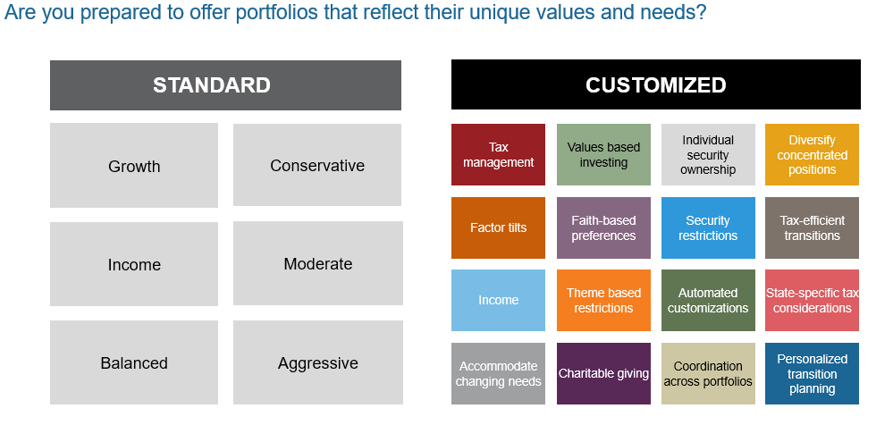
client personalization
Hypothetical scenario for illustrative purposes only.

Over the last few years, I and my colleagues at Russell Investments have written numerous blogs on direct indexing and the impact it is having on the investment industry. Among the many topics discussed: Top Five Reasons to use Direct Indexing, the tax advantages of using direct indexing and using direct indexing for charitable gifting.

In this blog I will discuss how a financial advisor can implement a direct indexing strategy to grow their business by focusing on the specific groups that could benefit from the customization capabilities that direct indexing offers.

What is Direct Indexing?

In its simplest form, direct indexing is a strategy in which an investor hires a portfolio manager to purchase a selection of the securities that make up a specific index and hold them in a Separately Managed Account (SMA). This gives the investor similar market exposure as the index but also gives them the opportunity to build a customized portfolio. The investor can exclude certain securities to reflect their specific goals, needs, or circumstances. This approach not only allows for greater customization but also greater flexibility.

How can a financial advisor use direct indexing to attract new clients?

As a financial advisor, it may be a good growth strategy to target specific groups who can benefit from using a direct indexing approach.

By offering a direct indexing option, you can tailor each client’s portfolio to their specific needs. You can recommend a proper benchmark and then give your client the option to tweak their portfolio to their unique situation. This capability could be very attractive to investors who have strong opinions on how they want to invest, as well as to investors with concentrated portfolios or embedded capital gains.

We have found that much of the value an advisor provides comes from their ability to create personalized investment plans for their clients. Imagine how much more value you could provide if you could build a portfolio that clearly aligns with each of your clients’ goals, needs and circumstances – and helps solve their specific issues.

Examples could be:

Individuals who are overweight their company stock.

  • Direct indexing can restrict their company stock as well as similar companies or sectors in their portfolio thus potentially reducing overall risk.

Small institutions who want their investment portfolios to represent their values. e.g., Religious groups, environmental or socially conscious organizations, schools, etc.

  • A theme-based restriction can give the investor group exposure to an index but eliminate the companies that do not align with their mission statement. A school, for example, may want passive exposure to the S&P 500 but restrict alcohol and cannabis stocks.

Employees at companies that restrict purchasing stock in their clients’ companies. e.g., Accounting and consulting firms.

  • Direct indexing can restrict the purchase of any stock that the client is not eligible to purchase.

Individuals who want to implement their religious values in their portfolio.

  • Direct indexing allows the investor to choose a benchmark and restrict any individual companies, or in some cases, choose a specific theme that implements the restrictions determined by a certain religion.

Your direct indexing provider may offer preset screens or themes that you can select for your clients. The table below shows some of the potential options:
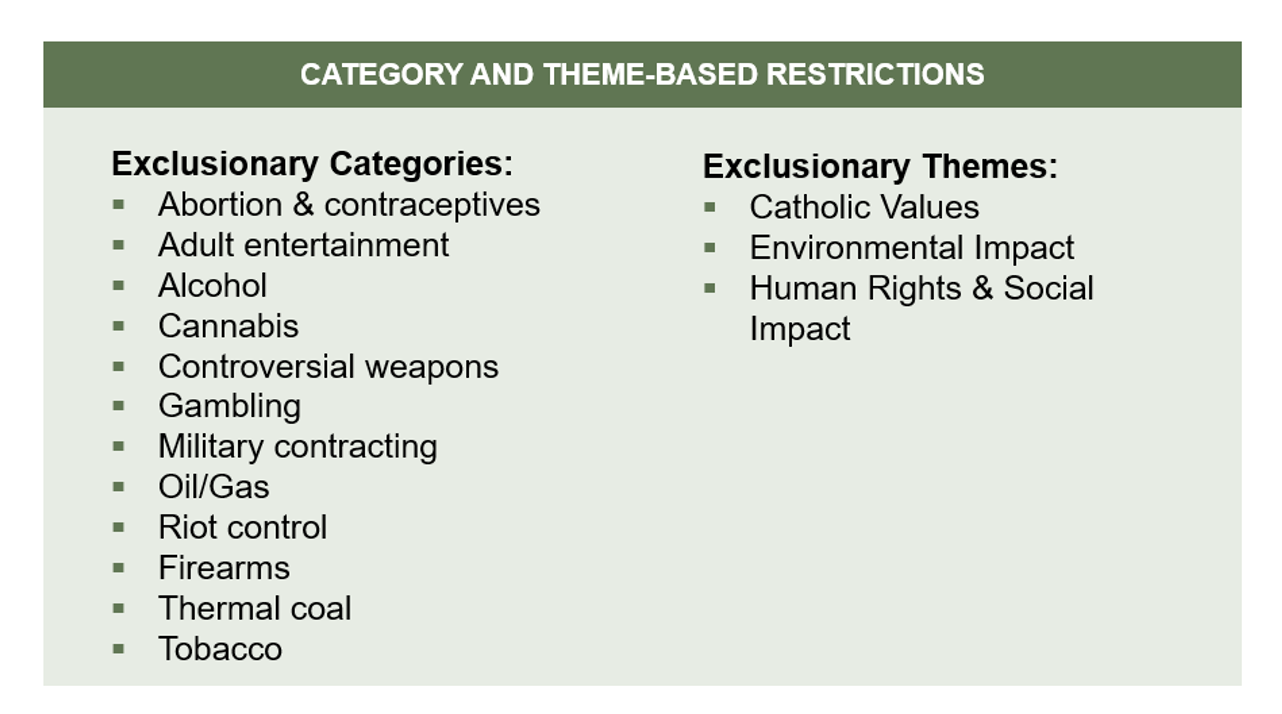
category and theme-based restrictions

Direct indexing is experiencing tremendous growth. Why not use it to grow your practice?

Assets in direct indexing portfolios reached $535.1 billion in assets under management at the end of Q3 20231. A report by Cerulli Associates projects that direct indexing will make up 33% of the retail SMA market by 2026 and assets held in direct indexing products will reach $800 billion2.

As a financial advisor looking to grow your business, it may be smart to consider using direct indexing not only with your existing clients but as a way to attract new ones as well.


1 Source: FUSE, Money Management Institute, Cerulli Associates.

2 Source: https://www.cerulli.com/press-releases/cerulli-associates-projects-direct-indexing-assets-to-top-800-billion-by-2026-while-outpacing-growth-of-etfs-mutual-funds-and-smas


These views are subject to change at any time based upon market or other conditions and are current as of the date at the top of the page. The information, analysis, and opinions expressed herein are for general information only and are not intended to provide specific advice or recommendations for any individual or entity.

This material is not an offer, solicitation or recommendation to purchase any security.

Forecasting represents predictions of market prices and/or volume patterns utilizing varying analytical data. It is not representative of a projection of the stock market, or of any specific investment.

Nothing contained in this material is intended to constitute legal, tax, securities or investment advice, nor an opinion regarding the appropriateness of any investment. The general information contained in this publication should not be acted upon without obtaining specific legal, tax and investment advice from a licensed professional.

Diversification and strategic asset allocation do not assure a profit or guarantee against loss in declining markets.

Please remember that all investments carry some level of risk, including the potential loss of principal invested. They do not typically grow at an even rate of return and may experience negative growth. As with any type of portfolio structuring, attempting to reduce risk and increase return could, at certain times, unintentionally reduce returns.

The Russell Investments logo is a trademark and service mark of Russell Investments

The information, analysis and opinions expressed herein are for general information only and are not intended to provide specific advice or recommendations for any individual entity.
 
Personalized Managed Accounts (“PMA”) is a program of Russell Investment Management, LLC (“RIM”) and offers customized portfolio management services.
 
Each Personalized Direct-Indexed Separately Managed Account is a product of Russell Investment Management, LLC (”RIM”) and offered through RIM’s Personalized Managed Accounts (“PMA”) program. It represents a direct indexed portfolio provided by RIM. PMA is a separately managed account program of individually owned securities that can be tailored to meet investor’s investment objectives. RIM offers diversified, single or multi-asset managed accounts that can be customized to the investor’s investment objectives, circumstances and preferences, such as (but not limited to), market exposure, risk management, tax management, category and theme-based restrictions, and return objectives. Excluding any allocations to pooled investment vehicles, if any, each investor’s account is managed separately from other investor accounts, allowing for a personalized experience to deliver unique investment outcomes.

The decision to use PMA in investors’ portfolios and related investment advice are provided through financial advisors and other financial intermediaries that are independent of RIM and its affiliates. Investors should consult with their financial advisor to determine which services and programs are appropriate to meet their investment objectives.

Russell Investments' ownership is composed of a majority stake held by funds managed by TA Associates Management L.P., with a significant minority stake held by funds managed by Reverence Capital Partners L.P.. Certain of Russell Investments' employees and Hamilton Lane Advisors, LLC also hold minority, non-controlling, ownership stakes.

Copyright © 2024 Russell Investments Group, LLC. All rights reserved. This material is proprietary and may not be reproduced, transferred, or distributed in any form without prior written permission from Russell Investments. It is delivered on an “as is” basis without warranty.

The information, analyses and opinions set forth herein are intended to serve as general information only and should not be relied upon by any individual or entity as advice or recommendations specific to that individual entity. Anyone using this material should consult with their own attorney, accountant, financial or tax adviser or consultants on whom they rely for investment advice specific to their own circumstances.

Products and services described on this website are intended for United States residents only. Nothing contained in this material is intended to constitute legal, tax, securities, or investment advice, nor an opinion regarding the appropriateness of any investment, nor a solicitation of any type. The general information contained on this website should not be acted upon without obtaining specific legal, tax, and investment advice from a licensed professional. Persons outside the United States may find more information about products and services available within their jurisdictions by going to Russell Investments' Worldwide site.

Russell Investments is committed to ensuring digital accessibility for people with disabilities. We are continually improving the user experience for everyone, and applying the relevant accessibility standards.

Russell Investments' ownership is composed of a majority stake held by funds managed by TA Associates Management, L.P., with a significant minority stake held by funds managed by Reverence Capital Partners, L.P. Certain of Russell Investments' employees and Hamilton Lane Advisors, LLC also hold minority, non-controlling, ownership stakes.

Frank Russell Company is the owner of the Russell trademarks contained in this material and all trademark rights related to the Russell trademarks, which the members of the Russell Investments group of companies are permitted to use under license from Frank Russell Company. The members of the Russell Investments group of companies are not affiliated in any manner with Frank Russell Company or any entity operating under the "FTSE RUSSELL" brand.

© Russell Investments Group, LLC. 1995-2025. All rights reserved. This material is proprietary and may not be reproduced, transferred, or distributed in any form without prior written permission from Russell Investments. It is delivered on an "as is" basis without warranty.